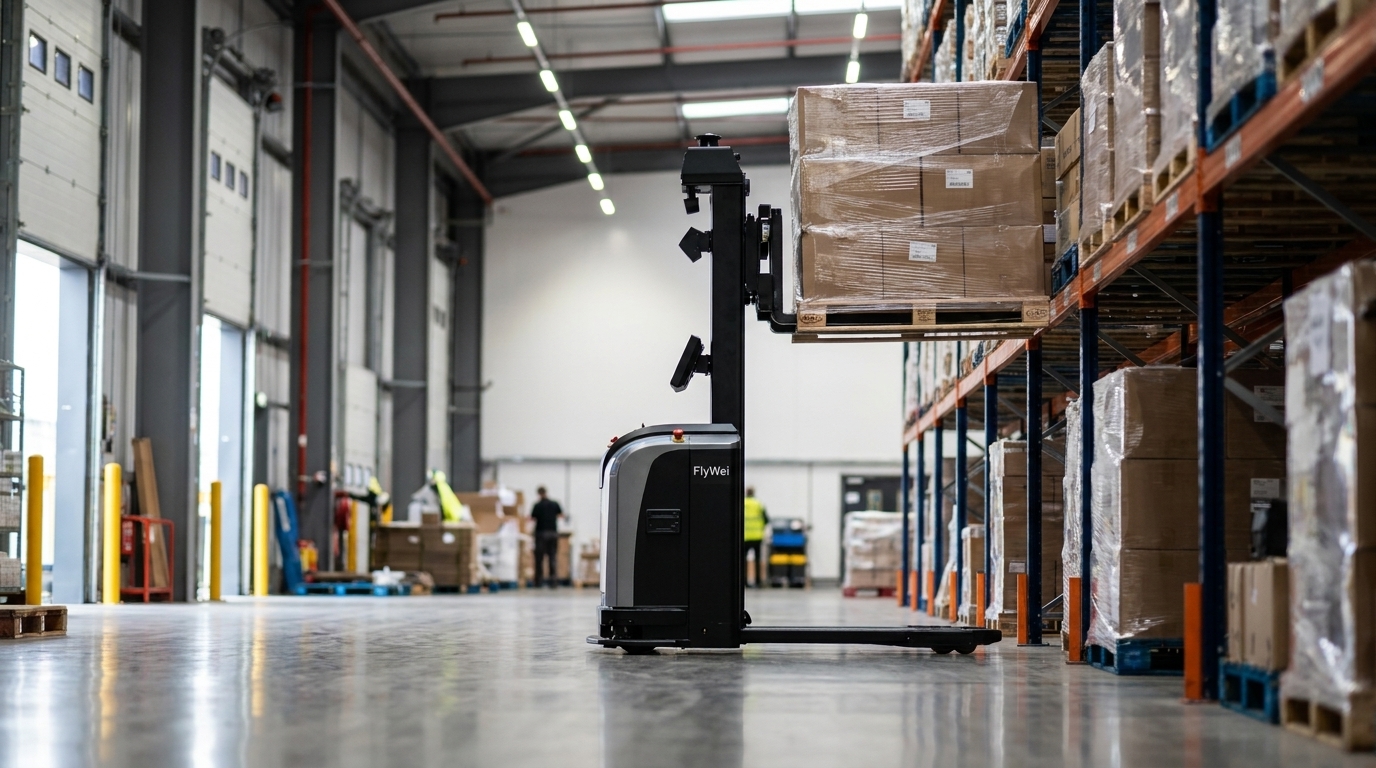
Autonomous forklifts are driverless industrial lift trucks that move, lift and stack pallets under software control rather than under a seated operator. The scale of the manual-handling burden they displace is documented: the Health and Safety Executive records 511,000 workers suffering from a work-related musculoskeletal disorder in its key figures for Great Britain 2024 to 2025 (HSE key figures, 2024/25). For a warehouse manager running a retail distribution centre above 100,000 square feet, that number arrives wearing a rota. Golden-quarter volume is already landing, agency cover for counterbalance work is thin, and replenishment to the pick face slips behind by mid-shift because the licensed drivers you do have are nursing goods-in. In a UK retail distribution centre, autonomous forklifts earn their return not at peak throughput but at shift changeover, where a driverless fleet keeps replenishment running through the hours a human fleet cannot cover.
Why the pick face falls behind on nights
A retail distribution centre is rarely short of pallet movement capacity in aggregate. It is short of it in one window, on one leg, for the same three reasons.
The first is licence scarcity rather than headcount scarcity. A grocery or multi-channel DC can be fully staffed on paper and still be two counterbalance tickets short on a Tuesday night. With a trailer on the clock and a detention charge attached, the shift manager moves licensed drivers onto unloading and away from replenishment. That call is right in the moment and wrong across the week: the pick face degrades slowly, and by the time short-picks surface in the despatch report the cause is three shifts old.
The second is changeover. Every manual fleet loses running time twice a day to handover, briefing and the gap between one crew walking off and the next getting keys in hand. Across the golden quarter, that compounds into a replenishment debt nights inherit and cannot repay.
The third is that the work is punishing and seasonally staffed. HSE guidance is explicit that vehicles and pedestrians sharing space is among the highest-consequence risks a warehouse runs (HSE workplace transport), and agency-heavy peak crews have the least site-specific familiarity. Logistics UK has tracked the same structural labour pressure across UK warehousing for years, and the pattern at Magna Park, DIRFT, SEGRO East Midlands Gateway and the Daventry corridor is consistent: the hardest roles to fill are the ticketed ones.
None of this is a racking or WMS problem. It is a question of who can drive a truck at 02:00 in November.
Lever one — automate the replenishment leg, not the whole site
The operational lever that works is narrow. Take the highest-volume flow running bulk stock down to the ground-level pick face and automate that lane end to end. In most grocery and multi-channel DCs it is a well-defined move: full pallet out of a bulk location, down a fixed aisle route, into a marked replenishment position.
That profile is exactly what autonomous forklifts handle well. The route is stable, load presentation is consistent, and the task repeats hundreds of times a night without judgement calls. It is also the leg your shift manager sacrifices first, so automating it removes the trade-off causing the damage.
Resist starting with goods-in. Trailer unloading is variable, time-pressured and full of exceptions — damaged wrap, mixed pallet heights, drivers waiting. Start where the work is boring, measure pick-face fill rate through one peak, then widen. A previous look at automated forklift fleets in UK retail DCs reached the same conclusion from the goods-in side: put-away throughput, not storage capacity, is the constraint worth attacking first.
Lever two — put one orchestration layer over mixed traffic
The technical lever is orchestration, and it decides whether a project succeeds or quietly underdelivers. A retail DC will run driverless and manned trucks in the same aisles for years; nobody converts a live site overnight. The failure mode is treating the driverless fleet as an island with its own screen, rules and idea of where a pallet sits.
M4 exists to prevent that. It holds the map, traffic model and task queue for the whole fleet, assigns work by capability and proximity, and manages charging so trucks come off the floor at the right moment rather than mid-replenishment. Because it speaks VDA 5050 — the open standard for fleet-to-vehicle command and control — it is not tied to one manufacturer's vehicles, which matters on a site adding truck classes over a five-year plan.
Above that, RDS handles dispatch across robot types and the handshake into the systems you already run. Your enterprise WMS stays the record of stock: it issues the replenishment task, the fleet layer turns it into a route and a vehicle assignment, and a completion writes back so balances move as pallets move. Do not accept a proposal requiring you to replace your warehouse system to make robots work — where it cannot expose open work over a documented interface, middleware is almost always cheaper.
Lever three — build the PUWER and safety case before the truck lands
The regulatory lever most often delays a go-live, and it is entirely avoidable. Driverless trucks are work equipment. The Provision and Use of Work Equipment Regulations 1998 apply in full (PUWER 1998), covering suitability for the task and the place, inspection and maintenance, and the competence of everyone who interacts with the equipment — which now includes supervisors and fleet controllers who never touch a control.
ISO 3691-4 governs driverless industrial trucks and their systems, and is the reference your safety case should be written against. Practically, that means agreeing the protective-field configuration for each route, defining what the truck does when a pedestrian enters its path, documenting manual recovery, and marking where mixed traffic is permitted. HSE guidance on work equipment and machinery is the right starting point.
Floor condition is the quiet item. Navigation and load stability both depend on a floor holding tolerance, so a TR34 assessment of the routes you intend to automate belongs in the pre-works package, not a snag list afterwards.
Lever four — fund it against the shift you cannot staff
The commercial lever is framing. A capex request for driverless trucks competes against racking, chillers and MHE renewal, and usually loses on unfamiliarity. The stronger case is continuity: this is the spend that keeps the pick face fed on the shift you cannot reliably staff, in the quarter where a short-pick costs a service-level penalty rather than an hour of labour.
That framing changes the funding route too. Leasing over three, five or seven years puts robots, software, maintenance and UK support into one monthly figure sitting against the operating cost it displaces, rather than a capital ask against a budget that closed in August. For a warehouse manager needing a result this peak, a term matching the contract length you are protecting is the easier argument to win.
| Lever | What changes on nights | Cost profile | First KPI to watch | Owner |
|---|---|---|---|---|
| Automate one replenishment lane | Bulk-to-pick-face moves continue when drivers go to goods-in | Single-lane deployment | Pick-face fill rate at 04:00 | Warehouse manager |
| Orchestration over mixed traffic | Mixed trucks share aisles under one traffic model | Software and integration | Aisle congestion holds per shift | Operations and IT |
| PUWER and ISO 3691-4 case | Commissioning is not held up by an unwritten assessment | Internal time plus survey | Weeks from delivery to live running | SHEQ and engineering |
| Lease rather than buy | Cost lands monthly against the shift it protects | 3, 5 or 7-year term | Cost per pallet moved on nights | Procurement and operations |
In a UK retail distribution centre, autonomous forklifts earn their return not at peak throughput but at shift changeover, where a driverless fleet keeps replenishment running through the hours a human fleet cannot cover.
What FlyWei does here
FlyWei is an independent UK systems integrator of autonomous forklifts and AMRs. Vendor neutrality matters here: the truck class suiting your bulk-to-pick-face lane is rarely the one suiting your narrow-aisle high bay, and FlyWei integrates the right machine for each flow across multiple manufacturers rather than fitting one catalogue to every problem.
FlyWei starts with a survey of the replenishment lane itself — route, floor, load presentation, aisle widths, and where manned trucks will still operate. From that, FlyWei specifies the class: a FlyWei counterbalanced autonomous forklift for ground-level work, an autonomous pallet stacker for mid-height replenishment, or a narrow-aisle reach truck where bulk locations sit high. Where cage and trolley movement runs alongside pallet work, FlyWei's lifting robots and base AMRs cover that leg without a second control system.
FlyWei delivers the orchestration layer with it. M4 holds the fleet, map and traffic model; RDS dispatches across robot types and handles the interface into your existing WMS. The safety case, PUWER documentation and supervisor training are part of delivery, not a follow-on order. For the basics, read FlyWei's guide to what an autonomous forklift is or the industry solutions library.
Frequently asked questions
Can autonomous forklifts run alongside manned trucks in the same aisle?
Yes, and on a live retail DC they almost always do. Mixed running needs a traffic model held centrally by the fleet manager, protective-field settings per route, and marked zones where mixed operation is permitted. Two fleets with no shared view of the floor is what fails.
Do we have to replace our WMS to use driverless forklifts?
Usually not. An orchestration layer sits above your warehouse system and takes work from it, so that system stays the record of stock. Replacement is only worth considering where it cannot expose open work through a documented interface or scheduled export.
What does PUWER require for an automated forklift fleet?
PUWER 1998 treats driverless trucks as work equipment, so duties on suitability, inspection, maintenance and competence apply. In practice: a documented risk assessment per route, a planned inspection regime, recorded training for supervisors and fleet controllers, and a written manual-recovery procedure.
How long does a first deployment take in a retail DC?
The vehicles are rarely the long pole. Floor survey, route mapping, the safety case and the WMS interface set the timetable. Sites arriving with a TR34 assessment, a documented interface and a nominated SHEQ owner move far faster than those starting at commissioning.
Is leasing or buying better for a first autonomous forklift project?
Leasing usually makes the internal case easier on a first deployment. A three, five or seven-year term bundles robots, software, maintenance and UK support into one monthly figure set against the cost it displaces. Buying suits sites with a proven flow.
What happens if the network or WMS connection drops mid-shift?
A well-designed integration degrades rather than stops. Trucks finish the task already issued, then hold safely in a defined position, while the fleet layer queues completions and replays them once the link returns. Ask how long the fleet manager runs detached from the host.
If a pick face that falls behind on nights is on your Q3 risk register, the fastest way to size the fix is one lane rather than the whole building.
Book a free 30-minute site survey and we will walk your highest-volume replenishment lane with you — route, floor, load presentation and where manned trucks still run. To start with the equipment instead, the autonomous forklifts range covers pallet trucks through to narrow-aisle reach trucks.
UK-based engineers, no obligation, reply within one business day.