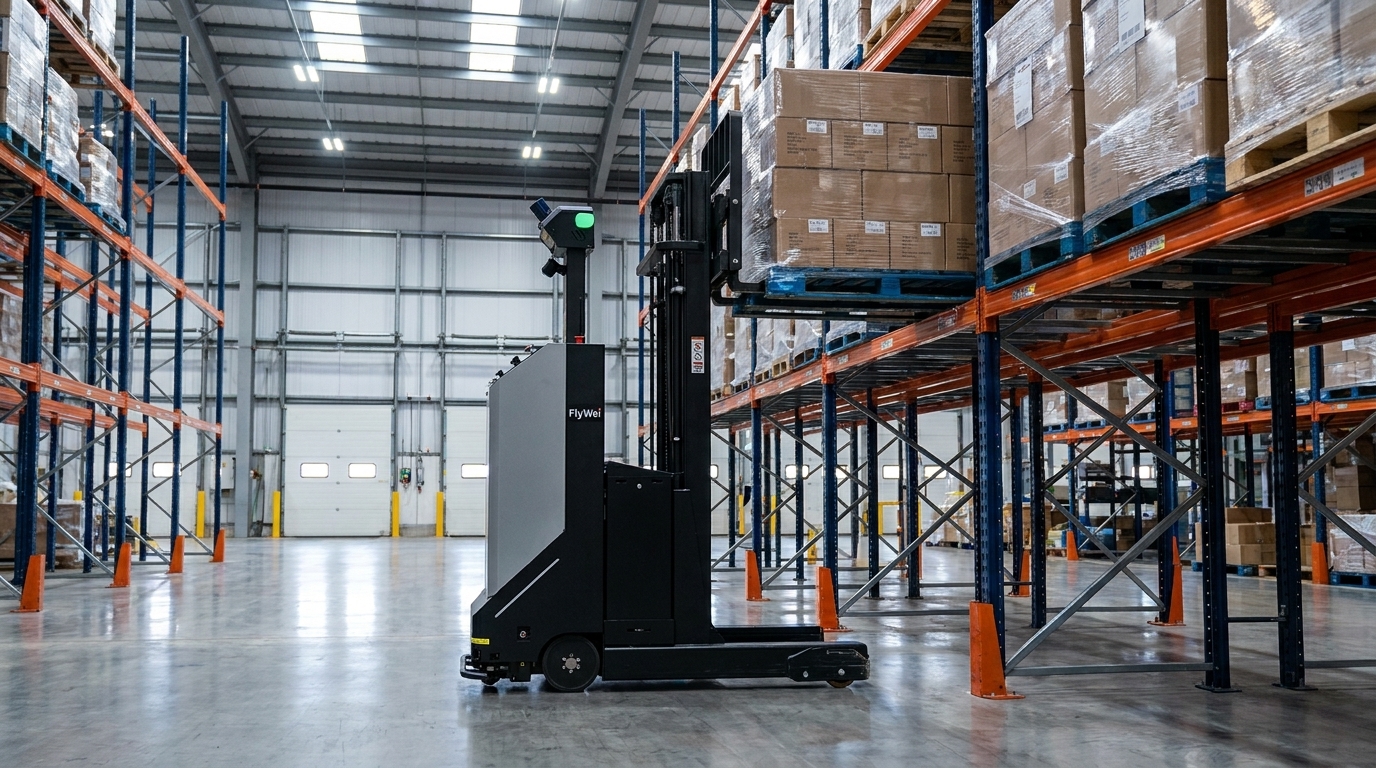
An automated forklift is a driverless industrial truck that lifts, carries and stacks palletised loads under software control, without an operator on board. In Great Britain these machines are regulated as work equipment under the Provision and Use of Work Equipment Regulations 1998 (PUWER), and are designed to ISO 3691-4, the international safety standard for driverless industrial trucks. For a supply chain director running a multi-temperature retail distribution centre, that regulatory clarity matters less this quarter than a simpler problem: pallets are landing at goods-in faster than they can be put away. Trailers wait on the yard. Bulk locations sit half-filled while the pick face runs dry. Store replenishment slips a wave, then two, and the peak trading plan starts to depend on overtime that nobody has budgeted and agency drivers who have not yet been booked.
Why goods-in backlog happens in a UK retail DC
Retail distribution centres are built around a promise of rate. Inbound arrives to a booking slot, is checked, and is put away into bulk within a target window so replenishment can pull from it. When put-away slips, everything downstream inherits the delay, but the delay is never visible in the racking. It sits in the labour plan.
Three UK-specific pressures push it there. First, the counterbalance and reach truck operator pool is thin, seasonal and expensive, and the sites competing hardest for it sit within a few miles of one another around Magna Park, DIRFT, Daventry and SEGRO East Midlands Gateway. A shift you cannot crew is a shift of put-away you cannot do. Second, multi-channel volume has made inbound profiles lumpier: a grocery DC now blends full-pallet ambient intake, mixed-case store returns and e-commerce feed stock, each with a different put-away path and none of them evenly spread across the day. Third, the compliance load has risen. Workplace transport remains a standing enforcement priority for HSE, and the segregation, training and inspection regime following from PUWER takes real time out of every operator's shift.
The result is a DC whose peak rate is set by how many trained operators are on site at 3am, not by its racking or its dock doors. That is the constraint an automated forklift removes: a driverless truck's rate does not change between the first hour of a shift and the eleventh, nor between a Tuesday and the Saturday before a bank holiday.
Lever one, operational: automate the dock-to-bulk leg before anything else
The instinct in a backlog is to automate broadly and thinly. It is the wrong instinct. Pick the highest-volume, most repetitive flow in the building, which in a retail DC is almost always full-pallet put-away from goods-in to bulk, and cover it completely.
Do the analysis on movements rather than on square footage. Pull ninety days of task history and rank flows by move count, by distance travelled and by how tightly they cluster in time. A lane carrying a high share of moves over a consistent route, to a consistent height, with consistent pallet quality, is one a fleet can hold all day. Cover-everything automation on one lane beats shallow cover on six, because a partly automated lane still needs an operator on standby, so the labour you were automating to release has not been released.
Set the acceptance test before procurement, not after. Agree the sustained pallets-per-hour the lane must hold across a full shift, the pallet presentation standard the trucks will accept, and what the fleet does with a load it refuses. Vague acceptance criteria are the most reliable predictor of a project that never quite finishes.
Lever two, technical: orchestrate one fleet, not several islands
An automated forklift only pays back when it is fed work automatically. That means an orchestration layer between your enterprise WMS and the vehicles: taking work over a documented interface, converting it into missions, managing traffic and charging, and writing completions back so the warehouse system stays the record of stock.
This is where fleets stall. Buy trucks first and orchestration second and you end up with islands of automation: a put-away fleet that cannot see the replenishment fleet, two traffic domains that meet at a junction neither controls, and an integration bill per manufacturer. FlyWei's M4 fleet manager exists to prevent exactly that, arbitrating traffic and task allocation across mixed vehicle types, while FlyWei fleet dispatch software handles the dispatch rules that decide which machine takes which job and in what order.
Two questions separate a fleet that scales from one that does not. Does the fleet layer speak VDA 5050 natively, so a vehicle class from another manufacturer can be added without a bespoke integration? And how long does it run detached if the link drops, replaying completions cleanly rather than duplicating stock movements? Ask both in writing, at tender.
Lever three, regulatory: design the safety case in, do not retrofit it
A driverless truck is work equipment. The duties that apply to your manual fleet under PUWER apply to it too: suitability for purpose, inspection, and the training given to everyone who works around it. ISO 3691-4 governs driverless industrial trucks and their systems, and is the document your safety case should be written against. Where lifting accessories are in scope, the Lifting Operations and Lifting Equipment Regulations 1998 (LOLER) apply alongside it. Standards are available in the UK through BSI.
Three items belong in the design phase rather than in commissioning. Floor flatness and joint condition, because a slab that is fine for a manned truck may not hold a driverless truck's navigation tolerance at height, and TR34 is the reference your civils team will want. Pedestrian segregation, because the traffic plan a fleet enforces is only as good as the walkways and crossing points it is given. And a written scheme covering what happens on exception, from an obstructed aisle to a load the truck refuses, so that the answer is a defined procedure rather than a shift manager's improvisation. Guidance and enforcement expectations sit with the Health and Safety Executive, and sector context is published by Logistics UK.
Lever four, commercial: fund the flow, not the fleet
Capex committees reject business cases that ask for a building. They approve cases that ask for a flow. Scope phase one as a single lane with a measurable rate, fund it against the labour and agency cost that lane consumes today, and write the expansion path into the same contract so phase two is a variation, not a fresh approval.
Funding structure matters as much as scope. Full-service leasing over three, five or seven-year terms moves an automated forklift fleet from capital to operating budget, aligns cost with the shifts it covers, and keeps service and availability with the supplier.
In Great Britain, an automated forklift is regulated as work equipment under the Provision and Use of Work Equipment Regulations 1998 (PUWER) and designed to ISO 3691-4, the international safety standard for driverless industrial trucks.
| Lever | What it changes at goods-in | Capital profile | Speed to visible effect | What it does not fix |
|---|---|---|---|---|
| Operational: cover one dock-to-bulk lane | A fixed, shift-independent rate under the busiest put-away flow | Contained, single lane | Fastest | Flows outside the lane; pallet presentation upstream |
| Technical: single orchestration layer over a mixed fleet | Removes manual dispatch; one traffic domain, many vehicle classes | Moderate, mostly integration | Medium | Little, if the warehouse system cannot expose work |
| Regulatory: safety case designed in at concept | Prevents rework on segregation, slab and exceptions later | Low as design cost, high as retrofit | Slowest to show | Throughput; it protects the case, it does not raise the rate |
| Commercial: lease the flow, phase the fleet | Turns the approval from a building into a measurable lane | Operating, not capital | Immediate, at approval | Weak acceptance criteria; leasing cannot rescue unmeasured scope |
What FlyWei does here
FlyWei is an independent, vendor-neutral UK systems integrator of autonomous forklifts and AMRs. FlyWei does not manufacture one range and then argue it fits every flow. FlyWei surveys the flow first, then integrates the machines that suit it across multiple manufacturers. That matters in a retail DC, where a full-pallet dock-to-bulk lane, a chilled put-away lane and a mixed-case replenishment lane rarely want the same vehicle.
For a goods-in backlog, FlyWei starts with a movement study of ninety days of task history, sizes a fleet of FlyWei automated forklift counterbalance and reach-truck class machines against the rate that lane must hold, and fixes the pallet presentation standard and exception routes before anything is ordered. Where trolleys or cages sit alongside the pallet flow, FlyWei lifting robots cover them under the same traffic plan rather than as a separate project.
FlyWei then delivers the orchestration layer that makes the fleet a fleet. M4 holds traffic and task allocation, fleet dispatch software holds the dispatch rules, and both integrate to the enterprise WMS and ERP you already run rather than replacing them. Sector configurations sit across FlyWei solutions, and where the case is better made against operating budget, FlyWei leasing covers three, five and seven-year terms with service included.
Frequently asked questions
What is an automated forklift?
An automated forklift is a driverless industrial truck that lifts, carries and stacks palletised loads under software control, with no operator on board. It navigates from onboard sensing rather than buried wire, takes work from a fleet management layer connected to your warehouse system, and comes in counterbalance, reach, stacker and pallet-truck classes.
How is an automated forklift different from an AGV?
The terms overlap heavily in UK tenders. Older automated guided vehicles followed fixed infrastructure such as buried wire, while a modern automated forklift navigates from its own map and can be rerouted in software. The practical test is whether changing a route requires changing the floor.
Will an automated forklift work in our existing brownfield DC?
Usually yes; brownfield is the normal case, not the exception. The deciding variables are aisle width, floor flatness and joint condition against TR34, racking condition, pedestrian routes and pallet quality at goods-in. Pallet presentation limits more sites than anything structural.
Do we have to replace our WMS to run an automated forklift fleet?
Normally not. An orchestration layer sits above the warehouse system and takes work from it, so that system stays the record of stock and orders. Replacement is only worth considering where it cannot expose work through an interface or a scheduled export.
What happens when a pallet is damaged or a load will not lift?
It becomes a defined exception, not a stoppage. The truck refuses the load, reports the reason to the fleet layer, and the task is rerouted or queued for a supervisor. Agreeing this at design stage keeps real availability close to quoted availability.
Can we lease an automated forklift fleet rather than buy it?
Yes. Full-service leasing over three, five or seven-year terms moves the fleet from capital to operating budget and keeps service obligations with the supplier. For a capex committee this often turns a rejected building-scale case into an approved lane-scale one.
If goods-in backlog and an uncrewable night shift are on your Q3 risk register, the fastest way to size the fix is to measure one flow rather than model the whole building.
Get a 48-hour feasibility read on your highest-volume flow, or see how FlyWei automated forklift fleets are specified for retail DC put-away.
UK-based engineers. No obligation. We reply within one business day.