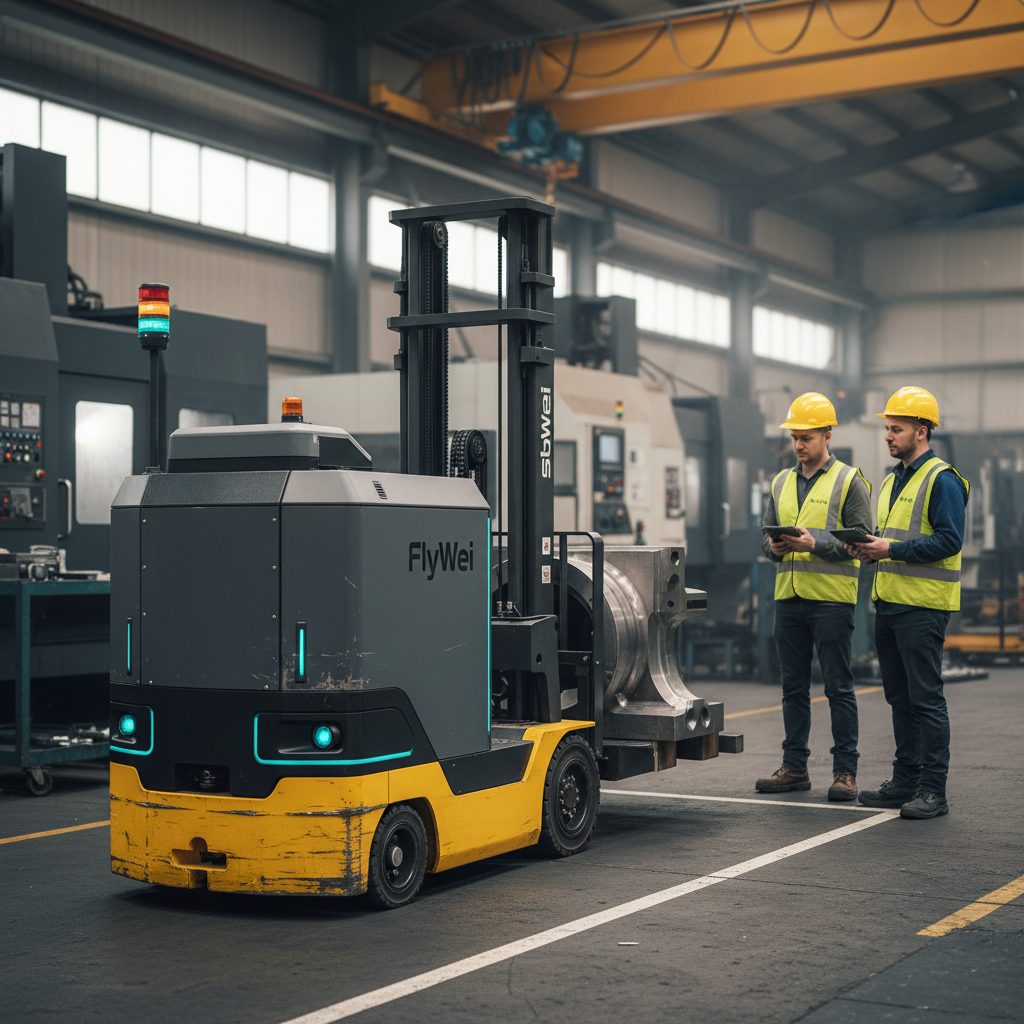
Autonomous forklifts for UK engineering plants are driverless industrial trucks that move heavy machined components, castings, and sub-assemblies between CNC cells, heat-treatment, finishing, and dispatch without an operator on board. Workplace transport remains one of the largest causes of serious injury in UK industry, and forklift-related events recur throughout HSE workplace-transport guidance. For a plant director running a heavy-parts facility in 2026, the pain is concrete: a shrinking pool of counterbalance-certified drivers, machined components worth thousands sitting idle on the floor waiting for a truck, and the daily tension between keeping CNC cells fed and keeping pedestrians safe in shared aisles. Every hour a finished casting waits for transport is an hour of working capital frozen and an hour the next operation starves.
Why heavy-parts flow stalls
Engineering plants are designed around their machines. The CNC cells, the furnaces, the grinding and inspection stations are mapped, costed, and optimised to the minute. The transport between them rarely gets the same attention, and that is exactly where throughput quietly leaks away.
A finished component does not move itself. It waits for a counterbalance truck and a certified driver. When the plant runs three shifts but only has enough drivers for two, the third shift either slows or stops feeding the next operation. Recruitment does not solve it: counterbalance and reach-truck licences take time and money, and the pool of operators willing to do night and weekend shifts in heavy-industrial settings keeps shrinking. The Logistics UK skills agenda has flagged the materials-handling operator gap for several years running, and engineering plants compete for the same drivers as every distribution centre in the region.
The cost is not only idle time. A machined casting parked in an aisle is working capital frozen in place, an inspection bench starved of input, and a dispatch slot at risk. Plant directors know the symptom well: the machines are not the bottleneck, the movement between them is. Throughput is lost in the gaps, not at the spindle.
There is a safety dimension layered on top. Heavy machined parts in shared aisles, pedestrians crossing between cells, and reversing trucks are a long-recognised incident pattern. Every near-miss is a reminder that the plant is one mistake away from a stoppage, an investigation, and an HSE improvement notice, and that the same driver shortage which throttles throughput also means the drivers you do have are tired and stretched.
The levers that fix it
Three levers, applied together, move a heavy-parts plant from driver-limited to flow-limited, and flow is something a plant director can actually engineer.
1. Operational: decouple component flow from driver rosters
The first lever is operational. Map the highest-frequency moves in the plant, typically the CNC-to-inspection and inspection-to-dispatch legs, and assign them to autonomous forklifts. These routes are repetitive, predictable, and need to run at all hours, which is exactly what autonomy does well. Skilled drivers are then freed for the genuinely variable work: goods-in, awkward one-off loads, and exception handling. The plant stops losing its third shift to a roster gap, and component flow becomes a function of production demand rather than driver availability. For a plant director, that is the single biggest change: the transport layer stops being a staffing problem and becomes a capacity decision.
2. Technical: one fleet manager across mixed equipment
The second lever is technical. An engineering plant rarely has the budget or the appetite to replace every truck at once, and it should not have to. The FlyWei M4 fleet manager orchestrates autonomous forklifts alongside existing manual trucks and conveyors: dispatching tasks, resolving traffic at junctions, sequencing charging, and feeding live equipment status back to the plant's existing systems. Because M4 and the fleet dispatch layer speak the open VDA 5050 protocol, the plant is never locked to a single vendor: new autonomous units join the same control plane regardless of supplier. That protects the investment as the plant scales cell by cell, and it means the first pilot is the start of a roadmap, not a dead end.
3. Regulatory: deploy under PUWER and ISO 3691-4
The third lever is regulatory, and it is non-negotiable. Any powered truck in a UK plant must be provided and used in line with the Provision and Use of Work Equipment Regulations (PUWER). Autonomous forklifts add a further standard: BS EN ISO 3691-4, which governs driverless industrial trucks and their safety systems. A compliant deployment maps pedestrian zones, sets safety-rated speed limits, validates the LiDAR and laser-scanner stop fields, and documents every step. Lifting attachments and racking interactions also fall under LOLER where applicable. Done properly, autonomy is measurably safer than a tired driver at the end of a night shift: the truck does not lose concentration, and the compliance audit trail is generated automatically rather than reconstructed after an incident.
| Factor | Manual forklift fleet | Autonomous forklift fleet |
|---|---|---|
| Third-shift cover | Limited by driver roster | Runs to production demand |
| Component dwell time | Waits for next free driver | Dispatched on task creation |
| Pedestrian-zone safety | Depends on driver alertness | Safety-rated stop fields, capped speeds |
| Compliance evidence | Reconstructed after the fact | Logged automatically per move |
| Scaling | Recruit and license drivers | Add VDA 5050 units to M4 |
What FlyWei does here
FlyWei supplies and integrates autonomous forklift fleets for UK engineering and heavy-parts plants. The range spans counterbalanced trucks for palletised castings and machined components, reach trucks for high-bay storage of work-in-progress, and heavy-lift autonomous robots built for engine blocks, transmission cases, and large sub-assemblies moving along a line. Every deployment is run under a four-phase method (site survey, simulation, deployment, and audit) so the plant director sees the throughput case proven before committing to scale. The M4 fleet manager and fleet dispatch layer give a single live view of every machine on the floor, autonomous and manual alike. UK-based engineers handle commissioning, spares, and ongoing support, and a typical single-cell pilot reaches go-live in 8 to 14 weeks. That pilot is the evidence base for a staged, low-risk, plant-wide rollout: capital spread across phases, each phase proving its own return before the next begins.
Frequently asked questions
Can autonomous forklifts handle the weight of machined castings and engine components?
Yes. FlyWei counterbalanced autonomous forklifts handle payloads up to 3,000 kg, and heavy-lift autonomous robots are built specifically for engine blocks, transmission cases, and large sub-assemblies. The right model is matched to the plant's heaviest routine load during the site survey.
Do we have to replace all our existing trucks at once?
No. The FlyWei M4 fleet manager orchestrates autonomous forklifts alongside existing manual trucks. Most engineering plants start with one cell or one high-frequency route and scale in stages, so capital is spread and each phase proves its own return.
How do autonomous forklifts stay safe around people in shared aisles?
They run under BS EN ISO 3691-4, the standard for driverless industrial trucks. LiDAR and laser scanners maintain safety-rated stop fields, speeds are capped in pedestrian zones, and the deployment is mapped and validated against PUWER before go-live.
How long does deployment take?
A standard single-cell deployment runs 8 to 14 weeks from site survey to go-live, covering mapping, navigation calibration, integration, safety validation, and team training. Larger multi-cell rollouts are staged from that proven pilot.
Will autonomous forklifts integrate with our existing plant systems?
Yes. The M4 fleet manager and fleet dispatch layer use the open VDA 5050 protocol and integrate with WMS, WCS, and ERP systems via REST API, so autonomous tasks are driven by the plant's existing production schedule.
What happens to our skilled forklift drivers?
They move to higher-value work. Autonomy takes the repetitive, all-hours routes; experienced drivers handle goods-in, awkward one-off loads, and exception handling: the work that genuinely needs human judgement.
Planning autonomous material handling for an engineering or heavy-parts plant? Talk to FlyWei for a site survey and a single-cell ROI model.