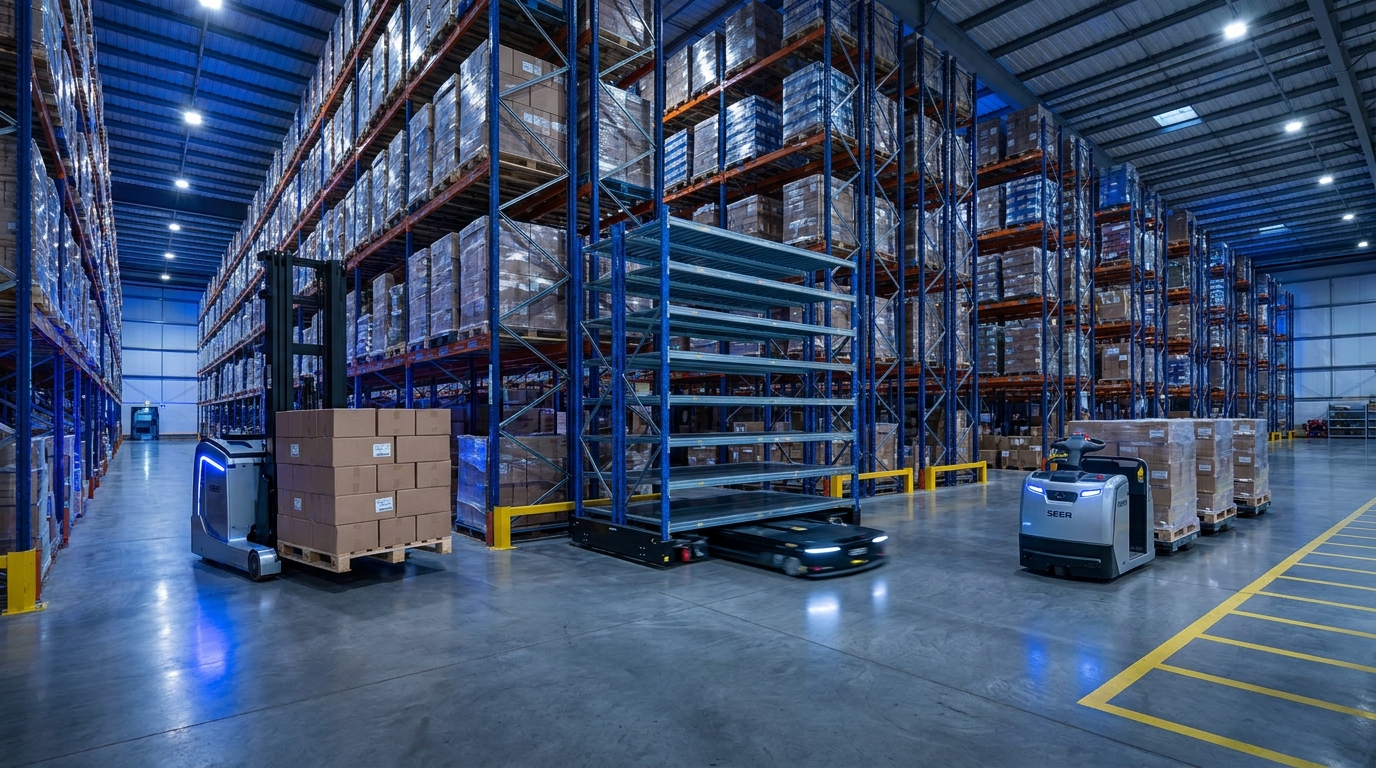
Locus Robotics has just unveiled Locus Array, a fully autonomous fulfilment system that handles picking, putaway, induction and replenishment inside the aisle. UK 3PLs do not have to bet the depot on a single vendor to get there: here is how end-to-end warehouse autonomy works without vendor lock-in, using an open autonomous fleet deployed by FlyWei.
What Locus Array actually announced
At MODEX 2026 in Atlanta (13 to 16 April 2026), Locus Robotics launched Locus Array, branding it a new class of "Physical AI" robotics for fully autonomous fulfilment. According to Locus, Array combines mobile robotics, an integrated robotic picking arm and AI-powered perception to complete picking, putaway, induction, drop-off, slotting and replenishment without manual handoff. Locus markets significant manual-labour reduction and round-the-clock operation. DHL Supply Chain is named as an early-access customer, and Locus says it will scale into Europe and APAC over the coming quarters.
It is a credible, well-engineered system, and a real signal that the market is moving past goods-to-person toward what Locus calls "robots-to-goods" (R2G). Crediting that engineering work matters, because the question for a UK 3PL operator in 2026 is not whether autonomous fulfilment is real. It is. The question is how to acquire it without trading one operating problem for another.
What Locus Array does not do (yet) for UK 3PLs
Read the launch coverage closely and a few gaps emerge that matter to a UK depot manager:
- Single-vendor stack. Array is built around Locus'' own fleet, control plane and picking arm. That is a feature for early adopters who want one throat to choke; it is a liability if your peak season exposes a software bug or a hardware revision delay.
- WMS coupling. Press materials reference integration but do not publish a confirmed integration list. UK 3PLs typically run a mature host WMS (SAP EWM, Manhattan Active Warehouse, Oracle WMS Cloud, Microsoft Dynamics 365 SCM or Blue Yonder) and any new fleet has to slot in without a 12-month re-platform.
- Mixed-fleet operation. Most UK depots already run a blend of manual MHE, conveyor, sortation and at least one earlier AMR pilot. Array's value proposition assumes a clean-sheet aisle.
- UK service depth. Early-access deployments are confirmed in North America. UK field engineering, spares stocking and SLA cover for a brand-new platform are still being built out: a real consideration when you are running a 24/7 fulfilment operation in Daventry or East Midlands Gateway.
None of that diminishes Locus Array. It does mean a UK 3PL evaluating "fully autonomous fulfilment" should treat Array as one architecture, not the architecture.
The vendor lock-in problem
Buying an end-to-end fulfilment platform from one vendor compresses three risks into one signature: hardware refresh cadence, software roadmap, and commercial leverage at renewal. If your AMRs, picking arm, dispatcher and WMS-adapter all come from the same supplier, the cost of switching in year five is your entire operation. That is why the largest UK logistics operators are increasingly buying autonomy as capability, not as a closed product: choosing open dispatch software, mixed-fleet orchestration, and AMRs that integrate with whatever WMS the customer already runs.
End-to-end autonomy without lock-in: how FlyWei deploys FlyWei
FlyWei is a UK warehouse-robotics company running the autonomous fleet platform. The FlyWei stack delivers the same outcome, pallet-in to pallet-out with no human handoff, but is engineered to drop into existing UK warehouse IT and MHE rather than replace it. The numbers for UK depot operators:
- SSR-1400EU autonomous forklifts: 1,400 kg payload, 2 m/s travel speed (laden and unladen), ±10 mm positioning accuracy, 1,384 mm minimum aisle width, up to 10 hours battery endurance, CE-certified to ISO 3691-4:2023.
- FlyWei SJV-SW600 lifting robots: 600 kg payload, 1.5 m/s laden, ±5 mm accuracy, 12 hours battery, SLAM navigation requiring no floor modifications.
- FlyWei M4 warehouse software: a unified WMS, FMS and WCS with open APIs to SAP, Oracle and Manhattan Associates, so your host system stays.
- FlyWei fleet dispatch: heterogeneous mixed-fleet orchestration with ride-sharing and pre-loading task allocation, so AMRs can co-exist with whatever automation you already run.
- ROI: typical FlyWei UK retrofit deployments return investment in under 18 months (varies by SKU mix, shift pattern and labour rates).
The point is not that FlyWei is "better" than Locus Array: both are capable platforms. The point is that an open architecture lets a UK 3PL automate aisle-by-aisle, keep the WMS, and avoid betting the depot on one vendor's roadmap.
UK considerations that change the buying decision
Three UK-specific factors should shape any autonomy procurement in 2026:
- HSE and ISO 3691-4:2023. Any AMR or autonomous forklift on a UK warehouse floor must meet the latest industrial truck safety standard. Confirm the certification, not the marketing claim.
- Post-Brexit spares and service. Lead times for replacement parts shipped from the US or APAC have not normalised. UK-stocked spares and a UK-resident engineering team are now a procurement requirement, not a nice-to-have.
- Existing depot constraints. UK racking, floor flatness (DM2 vs DM1), aisle widths and dock layouts vary widely across the East Midlands "golden triangle", Greater Manchester, Doncaster and the M4 corridor. SLAM-based navigation that adapts to your floor, rather than requiring you to adapt the floor, saves weeks of build cost on a retrofit.
Those three points alone can move a payback period by six months. They are also why FlyWei sells automation solutions rather than a single product line: the right answer for a 685,000 sq ft new-build is not the same as the right answer for a 90,000 sq ft brownfield retrofit in Lutterworth.
FAQ
Is FlyWei competing directly with Locus Array?
No. Locus Array is a single-vendor, end-to-end system aimed at greenfield deployments. FlyWei deploys autonomous fleets that integrate with a customer's existing WMS and MHE, so the buying decisions are different. We acknowledge Locus is a strong platform; we offer an open alternative.
Will AMRs work with my SAP, Manhattan or Oracle WMS?
Yes. FlyWei M4 exposes open APIs and has been integrated with SAP EWM, Oracle WMS Cloud and Manhattan Active Warehouse. M4 can act as a thin orchestration layer above the host WMS, so the host system remains the system of record.
What is a realistic ROI window for a UK 3PL retrofit?
Typical FlyWei retrofit deployments return investment in under 18 months, driven by labour displacement, throughput uplift and reduced damage rates. Final ROI depends on shift pattern, SKU mix and existing labour cost.
Can autonomous fleets co-exist with our existing AMRs or conveyor?
Yes. FlyWei fleet dispatch software is a mixed-fleet dispatcher and supports heterogeneous robot fleets. We routinely deploy FlyWei alongside legacy conveyor, sortation and earlier-generation AMRs.
Where does FlyWei provide UK service cover?
FlyWei serves the United Kingdom (England, Scotland, Wales and Northern Ireland) with UK-stocked spares and a UK-resident engineering team for installation, training and ongoing SLA support.
Next step
Want end-to-end warehouse autonomy without locking your depot to one vendor? Talk to FlyWei about a autonomous fleet deployment for your UK site.