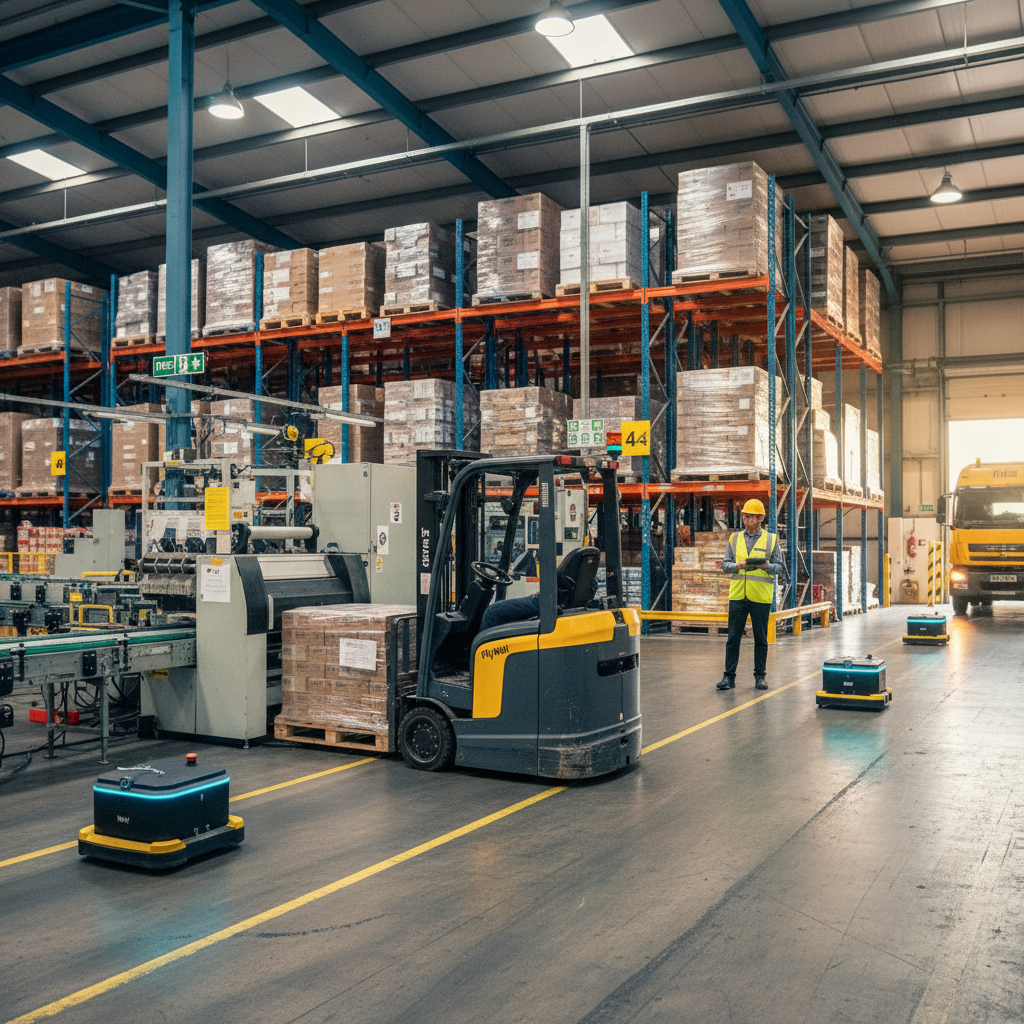
FMCG warehouse automation in the UK rarely fails because of the warehouse: it fails at the line end. Across packaging halls in Burton-on-Trent, Daventry and the East Midlands Gateway corridor, plant directors describe the same recurring frustration: a biscuit or sauce line will run beautifully for forty-three minutes, then idle for ninety seconds while a forklift driver finishes a different job and crosses the floor. Multiplied across three shifts and twelve lines, those ninety seconds become the difference between hitting weekly volume and missing a major retailer's Friday despatch cut-off. The fix is not a bigger warehouse, more pallet bays or a fresh tranche of overtime. It is a pull-based, autonomous end-of-line, and most UK FMCG sites are one quarter away from being able to run one.
On a UK FMCG packaging line, ninety seconds of pallet pull-away delay every cycle compounds across three shifts into more than two hours of lost throughput per day, exactly the gap that autonomous forklifts coordinated by an M4 fleet manager are designed to close.
Why end-of-line pallet flow breaks on UK FMCG sites
UK food and drink manufacturing is the country's largest manufacturing sector by turnover, and the Food and Drink Federation consistently highlights the gap between line capacity and warehouse capacity as a structural drag on output. Three forces collide on a typical FMCG plant in the East Midlands.
First, packaging lines have grown faster than internal logistics. Wrappers, case-packers and palletisers from the last decade comfortably push 1,800 cases per hour; the forklift fleet that pulls finished pallets away is often a mixed-age, mixed-fuel collection accumulated over twenty years and dispatched by a written rota that has not been redesigned to match line cadence.
Second, labour. The Logistics UK 2025 skills evidence makes plain that internal forklift driver vacancies are running multiple percentage points above pre-pandemic levels, with churn highest on continental three-shift patterns: the exact pattern most FMCG packaging halls operate. A site with eight FLT seats budgeted will, in practice, regularly run with six. The lines do not slow down to match.
Third, regulation. The Health and Safety Executive has been tightening guidance on workplace transport for a decade, and on most FMCG sites the highest-residual-risk activity in the risk register is now the manual forklift cycle around end-of-line conveyors and stretch-wrappers: pedestrians, reverse manoeuvres, sugar dust DSEAR zones and tight aisle clearances all in one place. PUWER 1998 and ACOP L117 demand that this risk is reduced so far as is reasonably practicable. With autonomous forklifts available, "reasonably practicable" is moving.
The four levers that fix end-of-line pallet flow
1. Operational lever: re-engineer the line end as a pull system
The most common mistake on FMCG packaging halls is to treat finished-goods movement as a sweep schedule: every thirty minutes, an FLT does a circuit and clears whatever is on the floor. This guarantees variance. The fix is to call each pallet individually, the moment it crosses the stretch-wrapper photoeye, with a queued task targeted at whichever vehicle can reach the line in the shortest time. The signal is a simple PLC-to-fleet-manager event, not a complex MES integration. On a four-line packaging hall in Burton-on-Trent, switching from a thirty-minute sweep to event-driven pull typically removes more than half of the residual line-stoppage minutes attributed to "logistics", without buying a single extra forklift. The line still runs at the same cadence; the warehouse simply stops being the variance source.
2. Technical lever: one fleet manager, VDA 5050 underneath
The technical decision that most often goes wrong is letting an autonomous forklift OEM own the orchestration layer. On a multi-line FMCG site, finished-goods flow is rarely served by one robot type forever: chilled bays, ambient bays, raw-material in-feed, finished-goods despatch and bonded storage all eventually want different vehicles. FlyWei's M4 fleet manager is built around an open VDA 5050-aligned interface so a plant director can add a second or third vehicle class later without re-procuring the orchestration. That single decision (orchestration above the vehicles, not inside them) is what turns a forklift project into a long-term automation programme.
3. Regulatory lever: PUWER, ACOP L117 and BS EN ISO 3691-4 done together
UK plant directors who have not yet looked at BS EN ISO 3691-4, the standard governing driverless industrial trucks and their systems, should do so before the next safety review. When autonomous forklifts replace manual cycles around end-of-line conveyors, three regulatory documents tighten together: the PUWER 1998 risk assessment loses its highest-residual-risk activity, the ACOP L117 review covers fewer manual lift-truck movements per shift, and any DSEAR zone around sugar dust or alcohol vapour sees fewer ignition-source crossings. The same project that improves throughput is also the cleanest paper trail an HSE inspector will see all year. Treating the safety case as the lead, not a footnote, is what unlocks the capex committee.
4. Commercial lever: measure against line OEE, not fleet utilisation
Forklift contracts in UK FMCG plants are still routinely written against fleet utilisation: hours run, jobs completed, vehicles deployed. That is the wrong KPI for an autonomous fleet whose entire job is to keep the lines fed and cleared. The right metric is OEE on the lines the fleet serves: specifically the availability component, where logistics-induced micro-stops show up. A 12-month commercial structure tied to line availability rather than vehicle hours forces the right behaviour from both sides: the fleet is rewarded for invisibility, and the plant team is rewarded for designing pull-flow rather than padding the rota. Most procurement teams have never seen this contract shape; it is worth a single conversation with finance before the next renewal.
What FlyWei does on UK FMCG sites
FlyWei supplies and integrates autonomous forklifts for UK food, drink and household-FMCG packaging halls. On a typical Burton-on-Trent or Daventry deployment, FlyWei autonomous forklifts pull finished pallets from end-of-line wrappers to the despatch lane on event-driven calls from the M4 fleet manager, with FlyWei fleet dispatch software handling the moment-to-moment dispatch decisions and exception routing. The vehicles are CE / UKCA marked and assessed against BS EN ISO 3691-4; the orchestration speaks VDA 5050 so a plant director never paints themselves into a single-vendor corner. M4 surfaces a real-time view of pallet-pull-away latency by line, by shift and by SKU, which is the exact dataset finance needs to confirm the OEE gains at the next quarterly review.
Crucially, FlyWei leads on the integration: scoping, simulation, deployment, training and the after-sales service contract are all FlyWei-delivered. The underlying FlyWei Robotics technology platform sits inside the vehicles; FlyWei is the company a UK plant director signs the SLA with. For background on how this looks in adjacent UK sectors, see our UK 3PL warehouse automation guide, the autonomous forklift ROI capex playbook, and our analysis of why UK SMEs should not bundle robots into ERP contracts.
| Dimension | Manual FLT rota | Autonomous forklifts under M4 |
|---|---|---|
| Pallet pull-away trigger | 30-minute sweep | Event from wrapper photoeye |
| Variance per shift | High: driver-dependent | Low: orchestrated |
| PUWER residual risk | High around line ends | Reduced; fewer manual cycles |
| Vendor lock-in | FLT lease only | Open VDA 5050 fleet layer |
| KPI baseline | FLT utilisation | Line OEE availability |
Frequently asked questions
What does FMCG warehouse automation in the UK actually mean for a plant director?
It means treating the warehouse as a continuation of the packaging line rather than a separate cost centre. The practical change is moving from a manual forklift rota to autonomous forklifts under a single fleet manager, calling pallets the moment they are wrapped, and reporting performance against line OEE.
How do autonomous forklifts handle end-of-line pallet pull-away?
The wrapper's PLC raises an event when a pallet is finished. The M4 fleet manager queues that event, picks the nearest available autonomous forklift, dispatches it via fleet dispatch software and reports the closed cycle. No human is in the loop unless an exception (overweight, mis-wrapped, mis-labelled) is detected.
Are autonomous forklifts in FMCG packaging halls PUWER and ACOP L117 compliant?
Yes: provided the deployment is assessed against PUWER 1998 and BS EN ISO 3691-4, with the site's ACOP L117 review updated to reflect the change. FlyWei deployments include the safety-case documentation as part of the integration scope.
What is VDA 5050 and why should an FMCG plant director care?
VDA 5050 is the open interface standard between fleet managers and autonomous mobile vehicles. Specifying VDA 5050 in your tender means you can add a second vehicle type (a different OEM, a different form factor) later without replacing the orchestration layer. It is the single most important decision in protecting the long-term economics of the project.
How long does an autonomous forklift deployment take on a Burton-on-Trent or Daventry site?
A focused single-line pilot can run inside a quarter; a full packaging-hall rollout across multiple lines is typically a 6 to 9 month programme including simulation, safety case, deployment, operator training and SLA hand-over. Brownfield sites generally take longer than greenfield because of the existing rack and aisle geometry.
Can FlyWei autonomous forklifts work alongside our existing manned forklift fleet?
Yes. Mixed manned-and-autonomous operation is normal in UK FMCG and is explicitly addressed in the BS EN ISO 3691-4 safety case. The M4 fleet manager segments tasks so autonomous vehicles take the predictable, repetitive end-of-line and despatch-lane work while manned forklifts retain exception handling and ad-hoc moves.
What is the right KPI to measure an autonomous forklift fleet on?
Line OEE: specifically the availability sub-component, which is where logistics-induced micro-stops show up. Measuring fleet utilisation is the wrong instinct: an idle, ready autonomous vehicle that prevents a single line stop has paid for itself many times over.
Talk to FlyWei
If you are a UK FMCG plant director scoping the next round of warehouse capex, talk to FlyWei about a single-line pilot designed to be live and reporting against line OEE inside one quarter. Bring your last quarter's line stoppage data; we will bring the simulation.