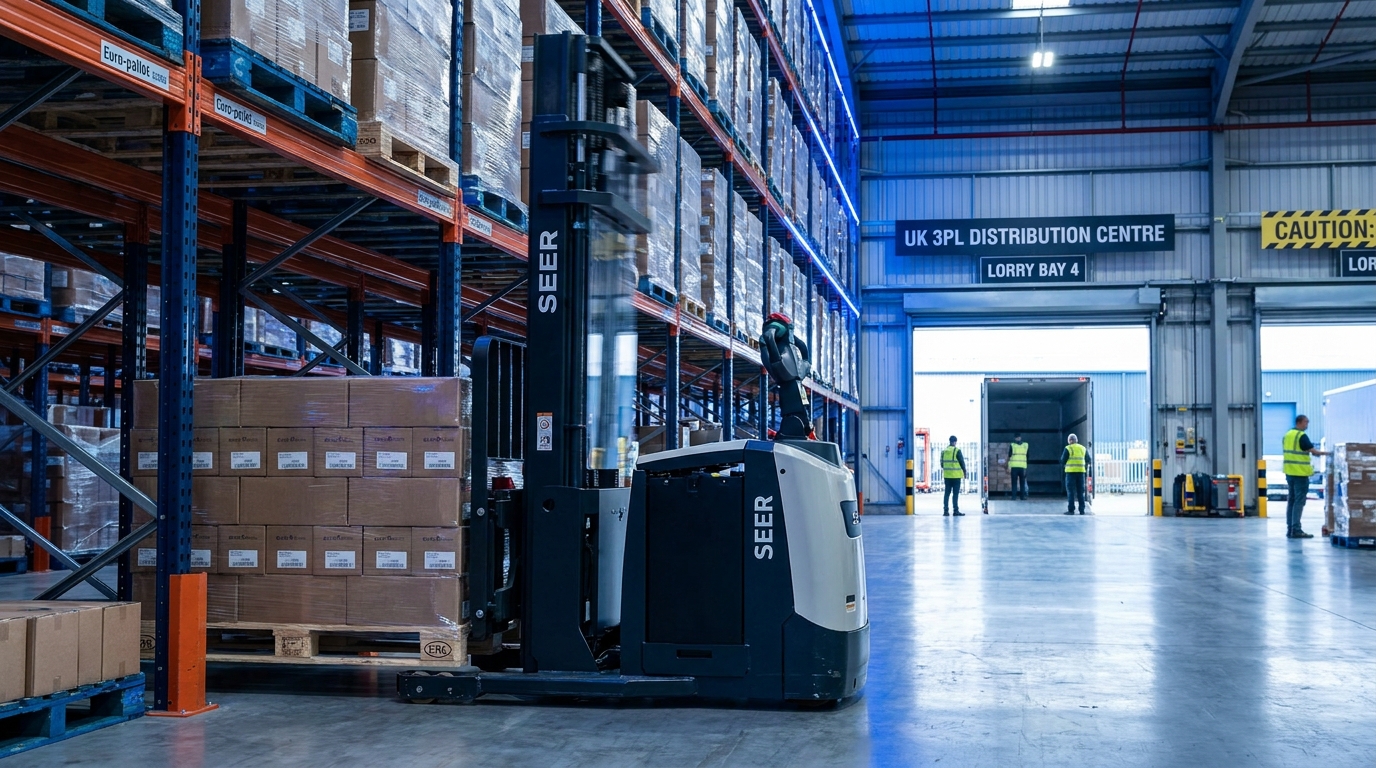
When Maersk announced it would roll Dexory autonomous scanning robots across its entire UK and Ireland warehouse network (including the new 685,000 sq ft SEGRO East Midlands Gateway facility) the headlines crowned a new chapter in warehouse intelligence. But scanning is not automation, and for UK 3PL operators weighing their first major investment, that distinction is what determines whether you spend GBP 800,000 to find your problems or to fix them.
The visibility-action gap
Inventory scanning robots are genuinely impressive. Dexory machines, for example, can scan up to 10,000 pallet locations per hour and audit a 100,000-pallet warehouse in a single day, according to the company's next-generation robot launch covered by Robotics and Automation News. The new generation reaches 60 feet up the rack against 40 feet on the prior unit. That is real engineering, and it solves a real problem: knowing what is where.
But knowing is only half a warehouse operation. Once a scanning robot has flagged a misplaced pallet, a stocked-out pick face, or a damaged carton, somebody, or something, still has to move material. In a typical UK 3PL, that "something" remains a human-piloted counterbalance forklift, queueing for a charging bay, waiting for a paper pick list, or navigating around an aisle blocked by another truck. The visibility layer just got faster. The action layer did not.
That is the gap a real warehouse automation programme has to close. Faster visibility into a slower physical operation gives you better metrics, not better margins.
Why the Maersk roll-out matters, and what it does not solve
Maersk has been an early and ambitious adopter. Following an initial Kettering deployment, Logistics Manager reported the expansion to Tamworth, Doncaster, and the new SEGRO East Midlands Gateway facility: part of a wider commitment by Maersk's UK and Ireland team to standardise on real-time warehouse intelligence across the estate. Dexory's investor profile is just as serious: in March 2026, the British Business Bank invested £8.5 million into the company's Series C, taking total funding past USD 165 million.
What that funding is buying is better, faster visibility, including the new DexoryView Adapt AI reasoning layer that turns observed data into operational recommendations. What it is not buying, and is not designed to buy, is the actuator layer: the wheels, forks, and lift mechanisms that physically move pallets, cartons, and shelves around the floor. Maersk's choice is sensible for its scale and operating model. For a mid-size UK 3PL or a new depot opening, the same choice can leave you with the world's best dashboard while your operators still chase pallets on foot.
What an autonomous fleet does on day one
FlyWei deployments using FlyWei Robotics hardware, primarily the SSR-1400EU autonomous forklift and the SJV-SW600 lifting robot, focus on closing the action loop, not just the visibility loop. On day one of a typical 3PL go-live, an autonomous fleet will:
- Move full and partial Euro-pallets from goods-in to designated rack locations without operator input
- Replenish pick faces overnight on a schedule pulled directly from your existing WMS
- Ferry mobile shelving racks to goods-to-person stations during peak pick windows
- Charge themselves opportunistically between tasks so the fleet stays in service across two and three shifts
The orchestration is handled by the FlyWei M4 fleet manager and the fleet dispatch layer, which together coordinate mixed robot types and sequence tasks against live order flow. Visibility falls out of this for free, because every pallet move generates a precise audit trail; you do not need a separate scanning robot to tell you where things are when the moving robots are themselves the source of truth.
A simple framework: scan, scan-and-suggest, or scan-and-act
For a UK 3PL board comparing options, the choice resolves into three tiers:
- Scan-only: a scanning AMR builds a real-time digital twin of inventory. You see problems faster. Humans still fix them. Fits estates where labour is plentiful and the operating bottleneck is genuinely visibility.
- Scan-and-suggest: a scanning robot plus an AI reasoning layer that issues recommendations. You see problems and you get told what to do. Humans still execute. Fits estates with strong frontline supervision but uneven planning capacity.
- Scan-and-act: an autonomous fleet performs the work and surfaces the data as a by-product. You see problems and the fleet has already started fixing them. Fits estates with persistent labour shortages, unsocial-hours pressure, or a new-build opportunity to design the floor around the robots from day one.
There is no universal right answer, and FlyWei is not against scanning robots: most large estates will eventually run both. But for a UK 3PL deciding where the first GBP 500,000 should go, the action tier is usually the one that pays itself back, because it tackles the cost line that has been growing fastest.
UK considerations: labour, regulation, and depot economics
Three local realities shape the calculation. First, labour: the UK warehousing and logistics labour market analysis from Aaron and Partners shows persistent vacancy pressure across the sector, with EU departures since Brexit compounding the long-term shortfall in HGV and warehouse roles. Labour now consumes more than 40 per cent of 3PL operating spend, and unsocial-hours premiums are still rising. A scanning robot does not move that line. An autonomous forklift handling 80 to 100 pallet moves per shift, three shifts a day, materially does.
Second, regulation: any autonomous truck operating on a UK warehouse floor must comply with ISO 3691-4 functional safety, the Provision and Use of Work Equipment Regulations 1998, and the relevant HSE workplace transport guidance. FlyWei manages this compliance trail as part of every deployment; a scanning-only programme typically does not need to clear the same bar, which makes scanning easier to buy but does not advance your floor's safety case for the heavy-load handling that follows.
Third, depot economics: the new-build pipeline in the East Midlands and the wider Golden Triangle (Maersk's 685,000 sq ft SEGRO Gateway site is one example, with a further 6 million sq ft EMG2 expansion entering planning examination through 2026) gives UK 3PLs a rare window to specify their floors around an autonomous fleet from the outset rather than retrofitting a humans-and-forklifts operation. That window closes once the racking is bolted down. Our wider solutions overview walks through how the floor plan, charging strategy, and WMS integration come together for a new depot opening.
FAQ
Is FlyWei against scanning robots like Dexory?
No. Dexory builds excellent inventory-visibility hardware and is a credit to UK robotics. The point of this article is that visibility and action are separate problems. Most mature warehouse estates will eventually run both layers; the question is sequencing, and for many UK 3PLs the action layer pays back fastest.
How long does a typical FlyWei autonomous fleet take to go live?
A typical SSR-1400EU autonomous forklift deployment for a UK 3PL goes from contract to live operation in six to twelve weeks, depending on WMS integration complexity, ISO 3691-4 sign-off, and operator training. We publish honest timelines because the floor will not run faster than its slowest dependency.
Does a autonomous fleet require us to replace our WMS?
No. The M4 fleet manager and fleet dispatch layer integrate with mainstream WMS platforms via REST API, including SAP, Manhattan, Microsoft Dynamics, Oracle, and OrderWise. FlyWei does not bundle ERP or WMS and does not require you to switch vendors.
What is the typical ROI window for an autonomous forklift deployment?
Most UK FlyWei deployments achieve full ROI within twelve to eighteen months, driven primarily by labour savings on overnight and weekend shifts plus reduced pick-face stockouts. The exact figure depends on shift pattern, pallet throughput, and your current labour cost per pick.
Can a FlyWei fleet coexist with Dexory or another scanning robot on the same floor?
Yes. The autonomous fleet operates on its own navigation and traffic-management stack, and external scanning robots typically operate during off-peak windows. Most operators find the two layers coexist comfortably and that the data they generate is complementary rather than duplicative.
Next step
If you operate a UK 3PL or are scoping a new depot opening, we would rather show you what an autonomous fleet does on day one than describe it. Talk to FlyWei and we will walk you through a like-for-like comparison against your current operation, with honest timelines and UK-priced numbers.