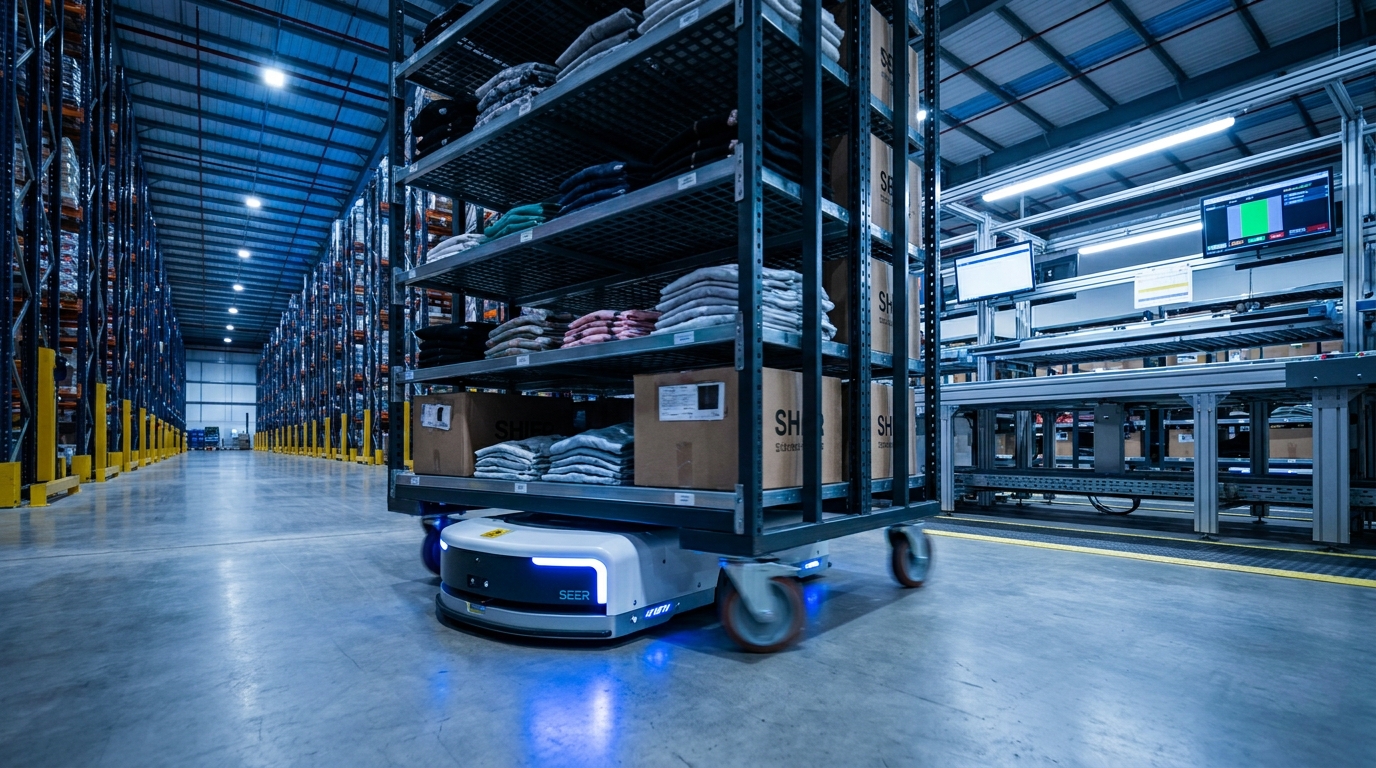
Hikrobot's 46-robot deployment at Superdry's Burton-upon-Trent depot, documented at 300 to 350 returns per hour, has set the benchmark for UK fashion 3PL returns throughput. The harder question for every other British operator: how do you match those numbers without handing your warehouse floor to one robot vendor for a decade?
The £27bn returns problem on Britain's fashion floor
UK fashion ecommerce returns are running at 25 to 40 per cent of dispatched units, with figures tracked by ZigZag and Retail Economics showing some apparel retailers pushing the higher end. The combined cost of UK retail returns is now estimated at £27bn, and pricing intervention alone is no longer enough: by 2026, 35 per cent of the UK's top 100 fashion retailers charge for returns, up from 23 per cent in 2023. The bottleneck has moved from the customer's letterbox to the depot's returns lane.
That bottleneck is staffed, and the staffing is fragile. The operative shortage cited by OrderWise sits at roughly 70,000 across UK warehousing, with Midlands and Thames Valley distribution corridors hardest hit. Logistics UK warns the gap will not close organically. Manual returns sortation is precisely the work with the lowest margin and the highest dropout rate.
The maths is unforgiving: rising returns volume, falling returns headcount, narrower retail margins. Automation is no longer optional for a fashion 3PL competing for new East Midlands or Yorkshire contracts. The only real question is which automation, and on whose terms.
What Superdry actually proved at Burton-upon-Trent
The reference point everyone is now quoting is Superdry's Burton-upon-Trent DC. After a 2018 pilot with six Goods-to-Person AMRs, Superdry scaled to 46 Hikrobot units operating alongside manual pickers. According to IT Supply Chain, returns put-away rose from under 100 units per hour to 300 to 350 units per hour: roughly a threefold improvement. Logistics Manager reports that 99 per cent of returned items are now re-dispatched within 24 hours, with a meaningful share turning around inside the hour.
Credit where it is due: the engineering at Burton-upon-Trent works. The site is operated by Clipper Logistics, integrated by Invar Systems, and built on Hikrobot. It is the strongest UK fashion-retail proof point any AMR vendor currently has. The honest read: 300+ returns per hour with a 99 per cent same-day re-dispatch SLA is achievable with Goods-to-Person robotics on a 2026 fashion floor.
The less-discussed implication is what comes next. A 46-robot single-vendor estate is now Superdry's baseline. When the next-generation Hikrobot model arrives, or when it does not, the depot's productivity ceiling is set by one supplier's roadmap, one supplier's spare-parts logistics, and one supplier's WMS connector. Every other UK fashion 3PL evaluating GTP automation needs to decide, before signing, whether that single-vendor concentration risk fits an asset class with a 7 to 10 year depreciation profile.
Open fleet vs single-vendor estate
The alternative architecture, and the one FlyWei delivers in the UK as the authorised FlyWei Robotics partner, is an open, multi-form-factor fleet under a single fleet manager. The same depot floor runs SJV-series lifting robots for Goods-to-Person returns sortation, SSR-series autonomous forklifts for inbound and pallet move-out, and tugger AGVs for line-side flow: all coordinated by FlyWei M4 fleet manager.
The structural difference appears when the customer's volume profile shifts. A single-vendor GTP estate scales by buying more of the same SKU. An open fleet adds the form factor that fits the next bottleneck, regardless of brand. FlyWei fleet dispatch software handles the deployment side (site survey, simulation, racking integration, WMS handshake) without forcing a re-platform when a new robot type joins. The result is a warehouse floor that is upgradable, not replaceable.
The protocol layer matters. The VDA 5050 standard defines an open interface between fleet managers and AMRs from multiple vendors. FlyWei M4 is built around the same interoperability principle, with documented APIs for SAP EWM, Manhattan SCALE, Microsoft Dynamics 365 SCM, Oracle WMS Cloud and OrderWise. That open posture is the difference between a fleet that grows with the business and an estate that boxes it in.
A FlyWei-class fleet that hits Superdry-grade numbers
For a UK fashion or e-commerce 3PL targeting 300+ returns per hour with 99 per cent same-day re-dispatch, FlyWei's reference configuration is built around three robot product lines, sized to the building.
For the returns-sortation cell, the SJV-SW600 low-profile lifting robot slides under modular pick-walls or mobile shelving, lifts up to 600 kg, and delivers the rack to an operative at a pick-to-light station. Throughput per cell scales linearly with robot count up to floor-density limits. For a 46-robot equivalent estate, FlyWei typically deploys 40 to 60 SJV units depending on rack design and travel distance.
For inbound pallet flow and finished-goods consolidation, the SSR-1400EU autonomous forklift handles Euro-pallets to 1,400 kg under the same M4 fleet manager. This is the lock-in piece nobody discusses: a GTP-only estate still needs forklifts, and on a single-vendor floor those forklifts are either manual or sourced from a second supplier with a separate orchestration stack. FlyWei's open fleet eliminates that split.
The orchestration layer, M4 plus fleet dispatch software, is what holds Superdry-grade SLAs in place. M4 schedules tasks across heterogeneous form factors, manages charging windows and intersection traffic, and exposes an event API to the host WMS. Fleet dispatch software runs digital-twin simulation before any robot lands on site, which is how FlyWei takes a typical UK 3PL deployment from contract signature to go-live in 6 to 12 weeks rather than 6 to 12 months.
UK regulatory and commercial reality
Any AMR fleet placed on a British warehouse floor in 2026 has to satisfy three overlapping regimes. The first is functional safety under ISO 3691-4:2023, the international standard for driverless industrial trucks. The 2023 revision tightens personnel detection, braking and operating-area requirements, and is harmonised with the EU Machinery Directive: meaning UKCA-marked AMRs imported into Great Britain must demonstrate the same essential health and safety conformity.
The second is operational compliance under the Provision and Use of Work Equipment Regulations 1998 (PUWER), which obliges the operator, not the vendor, to ensure work equipment is suitable, maintained, and used by trained personnel. The HSE's PUWER guidance is unambiguous that introducing an AMR fleet triggers fresh risk assessments, training records and inspection regimes. FlyWei builds these into the fleet dispatch software deployment runbook by default.
The third is commercial. UK fashion 3PLs price in pounds, and capex is competing with National Living Wage uplifts driving operative cost upward year on year. A 40-robot SJV-class fleet plus M4 and fleet dispatch software, including integration, typically lands in the £1.4m to £2.2m range depending on building size, with payback in 24 to 36 months on a depot processing 25,000+ returns per week. That is faster than most automated sortation conveyors and considerably more flexible when peak volumes shift between Black Friday, January sales and back-to-school.
Frequently asked questions
Can a autonomous fleet really match the 300+ returns per hour Superdry achieves with Hikrobot?
Yes. Throughput is a function of robot count, rack design, pick-to-light cell layout and operator ergonomics, not of the specific vendor. A correctly sized SJV-SW600 fleet of 40 to 60 units, orchestrated by M4 with the right WMS handshake, has delivered equivalent or higher units-per-hour figures on continental European fashion 3PL deployments. The Superdry numbers are a reasonable baseline, not a vendor-specific ceiling.
How long does a FlyWei returns automation deployment take in the UK?
Six to twelve weeks from contract signature to operational go-live for a fleet under 50 robots, assuming the building is suitable and WMS API access is granted in week one. Larger or multi-site deployments run 12 to 20 weeks. Fleet dispatch software digital-twin simulation runs in parallel with the site survey, so integration risk is front-loaded rather than discovered on the floor.
Will FlyWei robots integrate with our existing WMS: OrderWise, SAP EWM or Manhattan?
Yes. M4 exposes a documented event and task API and is in production with SAP EWM, Manhattan SCALE, Microsoft Dynamics 365 SCM, Oracle WMS Cloud and OrderWise. FlyWei's deployment runbook includes the WMS handshake as a fixed work package, with sample payloads for the host integrator. There is no requirement to migrate the WMS to use FlyWei robotics.
What protects us if FlyWei or FlyWei changes pricing or roadmap?
The robots run on industry-standard navigation, charging and safety hardware, and M4 orchestration is moving toward VDA 5050 interoperability. That means a autonomous fleet can be extended with another VDA 5050-compliant AMR if a future commercial reason demands it, without replacing the orchestration layer or retraining operators on a new HMI. This portability is the structural protection an open fleet provides over a single-vendor estate.
Is the fleet ISO 3691-4:2023 and UKCA compliant for a British warehouse floor?
Yes. SSR-1400EU autonomous forklifts and SJV-series lifting robots are certified to ISO 3691-4:2023, the current functional-safety standard for driverless industrial trucks, and conformity is documented for UKCA marking. FlyWei provides the PUWER-aligned risk assessment, operator training records and HSE-ready inspection schedule as part of the fleet dispatch software deployment package.
Next step
If your 3PL is being briefed against a Superdry-style benchmark, or you are pricing a new fashion or e-commerce contract against East Midlands competitors, and you want to see what Superdry-grade throughput looks like on an open autonomous fleet that does not lock you in, talk to FlyWei. We will run a digital-twin simulation against your real returns volume profile before you commit a pound of capex. See FlyWei's full UK 3PL solution suite.