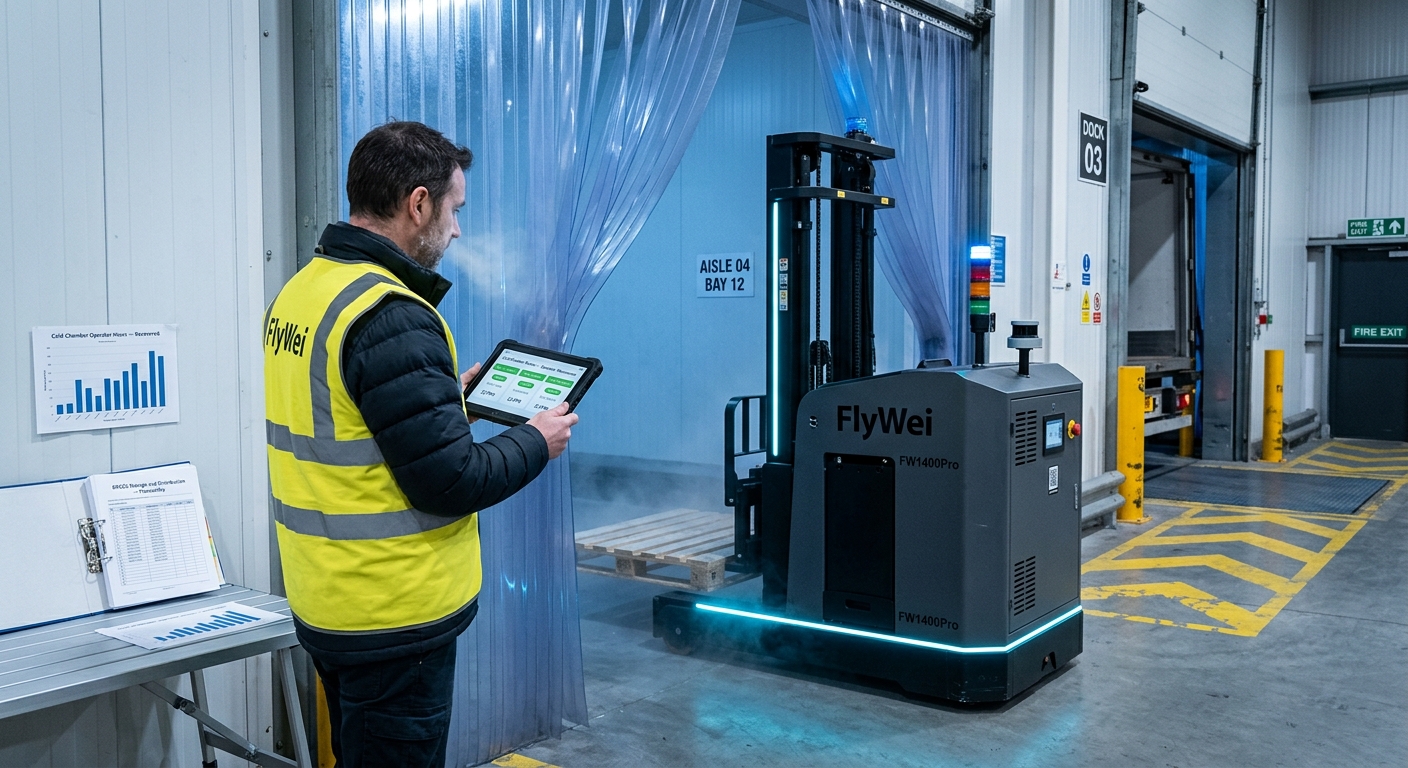
Five sectors, one pattern: cold chain, FMCG, drinks, Southern Europe and 3PL ops are clearing the same wall — without a multi-year integration project.
Hook
It is a Wednesday afternoon in May. Somewhere in the East Midlands, a supply chain director has just closed her laptop on the third agency-driver call this morning. Two of the names on the list ghosted the interview. One was a no-show on Monday. The rota gap she is trying to plug is 4.2 FLT operators on the inbound shift, and the agency rate has just stepped up again. Her July build plan needs another 38% throughput on the goods-in dock by week 27. She does not have a hiring problem anymore. She has a throughput problem dressed up in a hiring problem's clothes.
That sentence — that the driver shortage has stopped being a labour issue and quietly become a throughput issue — sits underneath every conversation we have had with UK warehouse directors this fortnight. And it shows up in the five articles we have published since Thursday.
Thesis
Across UK cold chain, FMCG, drinks, Southern European retail DCs and pan-European 3PLs, the FLT driver gap has tipped over from "annoying" to "structural" — and the operators who are clearing peak this year are the ones who stopped trying to hire their way out of it and started replacing specific routes inside the building they already own.
1. Re-reading the shortage: from rota gap to throughput gap
RTITB's 2026 census records a structural 34% shortfall of certified FLT operators in the UK food and beverage sector. That number is not a peak number. It is a baseline. Peak in F&B typically pushes throughput 35-45% above that baseline — so the network you cannot staff on a quiet Tuesday in March is the same network you are asked to push half again as hard between weeks 24 and 32.
The director's instinct is to keep working the hiring funnel. Wider catchment, higher rate, more agencies. That instinct paid off in 2021 and 2022. In 2026 it does not. The pool you are fishing is the same pool every other DC manager within an hour's drive is fishing, and the pool itself is shrinking faster than agency rates are rising. The arithmetic stops working somewhere around the third 18% rate uplift in eighteen months.
What changes the picture is to stop trying to fill the rota and start asking which routes inside the building are pure waste of a certified operator's time. Inbound dock-to-stock. Frozen pallet putaway. Trailer-to-staging shuttles. Long straight-line travel between the wrap line and the chamber. These are the routes where a counterbalance forklift spends 70% of its cycle doing nothing a human eye and hand are required for. Take those routes off the human roster and the rota becomes solvable again. The same 4.2-operator gap stops being a constraint on throughput. The question to ask in your next vendor meeting: which three routes in my building burn the most certified-operator hours on tasks that do not require certification-grade judgement?
2. The retrofit clock vs the project clock
Most directors we meet have one bad memory of a warehouse automation project. Eighteen months from kick-off to first pallet moved. Civil works. Floor levelling. A site survey that turned into a structural survey that turned into a building-control conversation. The DC manager sat in the gantt review every Friday for a year and a half and watched the go-live date slide right twice.
That memory makes the next vendor pitch hard to hear. So here is the contrast that matters this week: a retrofit autonomous forklift drops onto a 3PL's existing racking, picks up the existing pallets, and typically goes live on a first aisle in eight to twelve weeks. No civil works. No racking change. No floor levelling. No fixed grid being built. The truck is a truck. It just does not have anyone in the cab.
That eight-to-twelve-week clock is not a marketing number. It is the time it takes to scan the aisle, calibrate the routes, run the truck in shadow alongside a human operator for two weeks, paint the floor chevrons that separate human and autonomous traffic, and sign off the PUWER inspection. The slow part is the human review and the floor paint, not the robot.
The implication for capex governance is bigger than it looks. If go-live is eight weeks not eighteen months, the business case can be tested on one aisle, in one site, with a single trial truck, before the multi-site rollout question is even on the agenda. The director gets to find out whether the saving is real before she has to defend it to a board committee. The question to ask: can I see this working in my aisle, on my pallets, in eight weeks, with the option to send the truck back?
3. The sub-zero question: why minus-ten changed the maths
Cold chain used to be where automation went to die. Battery chemistry hated minus-eighteen. Sensors fogged. Tyres hardened. The aisle was too narrow because the chamber was too expensive per square metre to over-build. The straightforward answer for years was that you simply could not run an autonomous lift truck inside a frozen chamber, so you kept the human in the heated cab and paid the cold-chamber premium on the wage.
That answer is no longer correct. Modern autonomous forklifts certified for minus-ten and lower operate on inbound dock-to-stock, frozen pallet putaway and chamber-to-chamber shuttles without a thermal break in the human roster — because there is no human in the chamber to begin with. In a UK cold-chain network of three or more sites, a supply chain director can recover up to eighteen months of forklift driver attrition through autonomous deployment on those routes, while keeping every pallet inside the BRCGS Storage and Distribution traceability envelope.
This matters because cold chain is the sector where the driver shortage hurts twice — once on the rota, and once on the cold-chamber premium that the rota commands. Taking a single human out of a minus-eighteen chamber recovers between £4,800 and £7,200 a year in chamber premium alone, before you count agency rate or attrition. Multiply that by the number of certified cold-chamber operators in a three-site network and the arithmetic starts to look very different to the 2021 version. The question to ask: how much of my cold-chamber wage premium is paying for the chamber, and how much is paying for the human inside it?
4. The multi-site problem: replicate, do not re-procure
The single hardest conversation in multi-site capex is the second site. Site one was the proof-of-concept. Everyone agreed it worked. Then site two arrives, and the project lead discovers that the enterprise WMS at site two is on a different version, the racking is from a different supplier, the floor is two centimetres off level, and the operations manager hates the dashboard the site-one team picked. Eighteen months later, site two is finally live, on a different stack to site one, and the director is now running two automation programmes instead of one.
The pattern this week from cold-chain multi-site networks is different. Replicate, do not re-procure. The same retrofit truck and the same fleet-coordination layer that worked on site one is dropped onto site two without a new RFP. The site survey at site two takes a week, not eight. The shadow run uses the routes already mapped at site one as the starting template. The go-live at site two happens in twelve weeks again, not twenty-four months.
The board-level consequence is that capex governance gets simpler, not harder, as the network grows. The first site is the case to make. The second through fifth sites are repetitions of that case, with the slope of the saving line getting steeper because the engineering work is mostly amortised. The director stops defending five separate business cases and starts defending one with five rows. The question to ask: can the same fleet-coordination layer run on every site in my network without bespoke engineering at each one?
5. The cross-border deadline: EN ISO 3691-4 and what it forces
For directors whose network crosses the Channel, there is a date in the diary that the vendor conversations have not quite caught up to. Under Regulation (EU) 2023/1230, autonomous industrial trucks placed on the Southern European market from 20 January 2027 must carry a Declaration of Conformity referencing EN ISO 3691-4:2023, supplied in the operator's national language.
That date is closer than the typical capex cycle for a multi-site European rollout. A director starting the conversation in May 2026 with a vendor whose CE paperwork is not yet aligned to EN ISO 3691-4 will be unwinding the procurement in September. A director who has the question on the table now — show me the Declaration of Conformity, in French and Italian, today — is doing in May what her competitors will be scrambling to do in October.
This is not a UK-only point even for UK-only operators. Eurostat labour costs in French, Spanish and Italian DCs are rising on the same curve as ours. The case for retrofit autonomy in Lyon or Zaragoza is the same case as in Wakefield, with one extra clause about the language on the conformity certificate. The question to ask: can the vendor show me an EN ISO 3691-4:2023 Declaration of Conformity in the language of each country I operate in, today, not at PO time?
The Arithmetic
The numbers stacking up this week:
- 34% — RTITB's 2026 census shortfall of certified FLT operators in UK food and beverage. Structural, not seasonal.
- 35-45% — typical peak-season throughput uplift in F&B above baseline. The rota you cannot staff in March is the same rota that needs to flex half again in July.
- 8-12 weeks — typical time to first-aisle go-live for a retrofit autonomous forklift on existing racking. No civil works.
- 16 months — typical payback period for autonomous forklift deployment in UK F&B DCs at current agency rates and energy prices.
- £4,800-£7,200 — annual cold-chamber wage premium recovered per human operator removed from sub-zero chamber routes, before agency rate or attrition is counted.
- 20 January 2027 — deadline for EN ISO 3691-4:2023 conformity on autonomous industrial trucks placed on the EU market, language-specific.
What To Do On Monday Morning
This week, three things any UK warehouse director can do before lunch:
- List your top three operator-hour sinks. Not your top three pain points — your top three routes inside the building where a certified FLT operator spends the most hours on tasks that do not require certified judgement. Inbound shuttles, putaway, wrap-line-to-chamber. If you cannot name them by Tuesday, your supervisor team can.
- Ask one vendor for an eight-week trial on one aisle, with a return clause. If the answer is "we do not do that, we do twelve-month integration projects" — that is information. Note it and move on. The retrofit cohort exists and is willing to be tested on one aisle.
- Pull the conformity question forward. If any part of your network is in France, Spain or Italy, ask every shortlisted vendor today for their EN ISO 3691-4:2023 Declaration of Conformity in the relevant national language. Not at PO time. Today. The directors who do this in May will not be the directors unwinding procurement in October.
Closing
If any of the patterns above sound like the building you walked through this morning, reply to this edition or drop a line in the comments. We will send back a quiet read of an open-fleet design — one aisle, eight to twelve weeks, no lock-in — sketched against your sector and your sites. No sales call. Just the arithmetic, on your numbers.