Three plants this week — pharma, e-commerce, engineering. One hidden constraint they all share: the handoff between operations, gated by a driver shortage nobody costed.
Every operations leader knows their headline number. Picks per hour. Castings per shift. Pallets through the door. The whole plant is costed, measured, and optimised around it.
This week the FlyWei team published three guides — for a Saudi pharma procurement committee, a UK e-commerce operations director, and a UK engineering plant director. Three sectors that could not look more different. They produced the same conclusion.
The pattern
In none of the three is the headline operation the constraint.
The pharmaceutical distribution centre is not slow because the cold rooms are slow. The e-commerce site is not behind because the pick faces are badly laid out. The engineering plant is not capacity-limited at the CNC spindle. In every case, the operation itself is running fine. What is not running fine is the move between operations — the handoff from one costed, optimised process to the next.
That handoff is almost always a forklift move. And a forklift move depends on two things nobody put on the capacity plan: a truck being free, and a certified driver being on shift to drive it.
Why it bites now
The handoff was always there. It used to be invisible because there were enough drivers to absorb it. That is the part that has changed.
The counterbalance and reach-truck driver pool is shrinking, and it is shrinking everywhere at once. An engineering plant in the Midlands competes for the same operators as the distribution centre down the road. A Gulf pharma DC scaling under Vision 2030 is hiring into the same tight market. When a site runs three shifts but can only crew two with drivers, the third shift does not stop machining — it stops moving. Finished goods pile up between operations. Working capital freezes on the floor. The headline number quietly drops, and the cause does not show up in any of the dashboards built around that headline number.
What actually fixes it
The three guides land on the same three-part answer, because the problem is structurally the same.
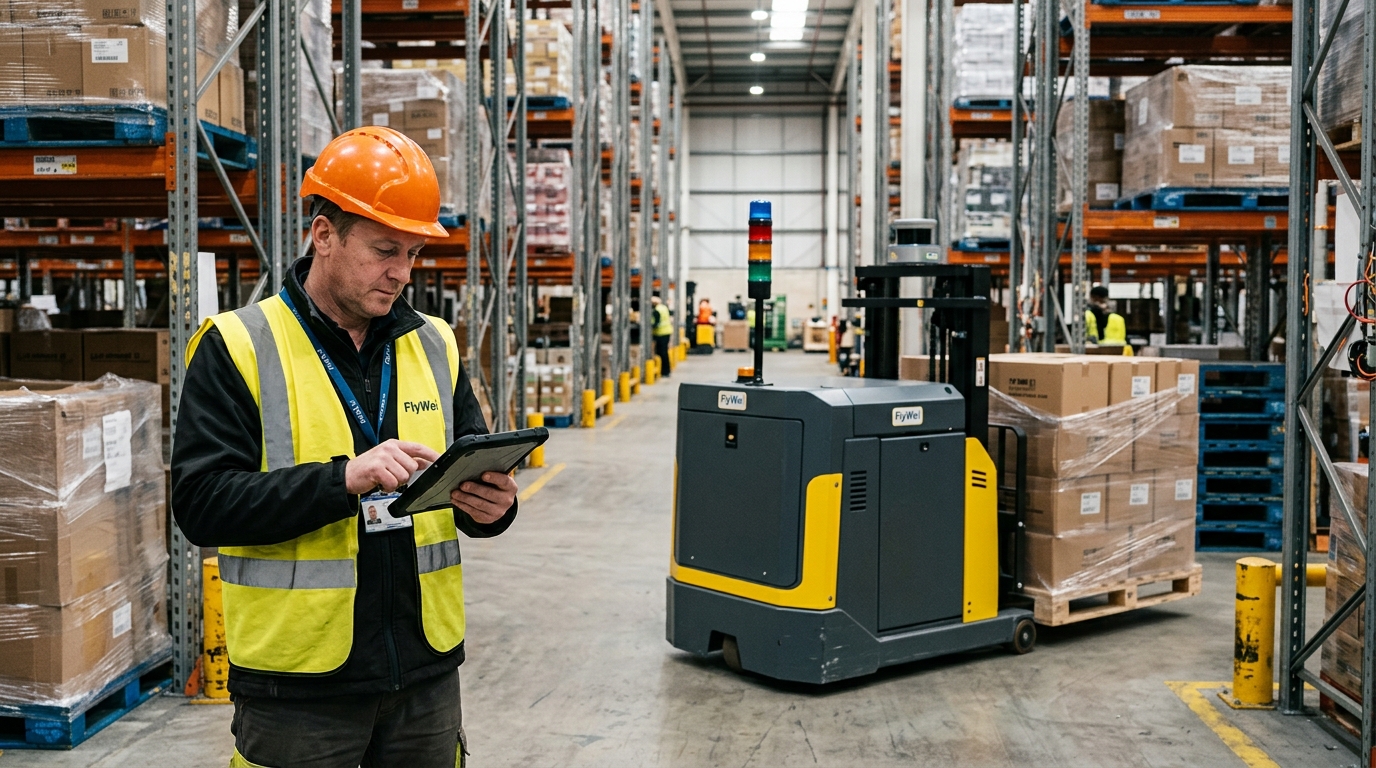
Decouple flow from rosters. The repetitive, predictable, all-hours moves — pick face to dispatch, CNC cell to inspection, cold room to marshalling — are exactly what autonomous forklifts do well. Hand those routes to autonomy and your skilled drivers move to the genuinely variable work: goods-in, awkward loads, exceptions. Flow becomes a function of demand, not of who turned up.
Run one control plane. No site replaces every truck at once, and none should. The FlyWei M4 fleet manager orchestrates autonomous forklifts alongside the manual trucks already on the floor, on the open VDA 5050 protocol — so the plant is never locked to one vendor and the first pilot is the start of a roadmap, not a dead end.
Deploy compliantly. Autonomous trucks run under PUWER and BS EN ISO 3691-4, with mapped pedestrian zones, safety-rated stop fields, and an audit trail generated automatically. Done properly, autonomy is measurably safer than a tired driver at the end of a night shift.
This week's guides
- Autonomous Forklifts for Saudi Arabia's Pharma Distribution Centres — how a Vision 2030 procurement committee specifies driverless trucks for an SFDA-regulated cold-chain DC.
- Autonomous Picking Robots for UK E-Commerce Fulfilment — where the real throughput leaks for a UK e-commerce operations director, and the levers that close them.
- Autonomous Forklifts for UK Engineering Plants — a plant director's guide to moving heavy machined components without a driver-limited transport layer.
The takeaway
If your headline number is drifting and the obvious operation looks healthy, look at the handoff. Cost the move between the machines the way you costed the machines themselves. That gap — the one nobody put on the plan — is usually where the throughput went.
A single-cell pilot reaches go-live in 8 to 14 weeks. That is long enough to prove the number, and short enough to act on it this year.
Reply to this newsletter, or talk to FlyWei for a site survey and a single-cell ROI model.