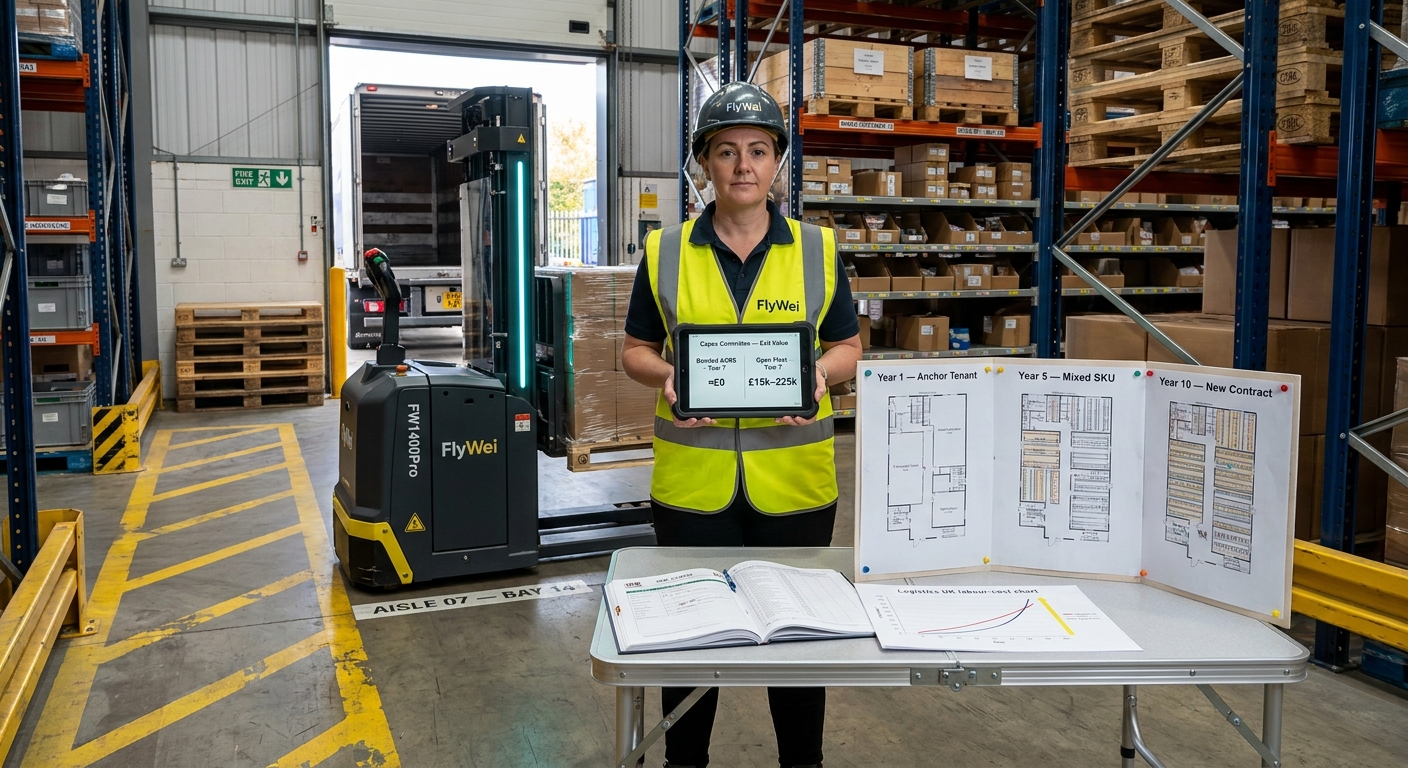
This week across 3PL, retail DC, engineering and e-commerce: the cheapest robot is the one that survives your next SKU mix, tenancy break or driver shortfall.
It's Tuesday morning, the capex committee meets at half nine, and the warehouse director has forty-five minutes to defend a number. The number has changed three times in a fortnight because the operation underneath it keeps changing — a new client's SKU profile landed last Monday, a Class 1 driver walked out on Friday, and the landlord's option-to-break has just been priced into the renewal model. Last quarter the pitch was cube-storage robotics. Last month it was a shuttle ASRS. This week it's autonomous forklifts. Same building, same throughput target, three different ten-year mortgages — and the committee is being asked to choose one of them on a fortnight's notice.
The through-line across five articles this week is simple to state and hard to commit to: the cheapest robot in 2026 is not the one with the lowest sticker price — it's the one that survives your next SKU mix, your next tenancy break, your next driver shortfall, and your next layout change without a six-figure remediation invoice on the way out.
1. Pallet flow is not tote flow — and your operation is mostly the first
Most of the cube-storage decks landing in UK board packs this quarter are pitched against a tote-flow operation that doesn't exist in the building they're being sold into. Take a typical 3PL site running a mix of grocery, white goods and pharma fulfilment under one roof. The dominant movement is pallet-in, pallet-out: a full Euro pallet of inbound stock crosses the dock, dwells in reserve, decants in waves, and leaves as a build-up pallet for outbound. Totes feature, but they are not the throughput-defining unit on the floor.
The arithmetic the cube vendors don't show: a cube-storage retrofit demolishes existing racking, requires a slab survey for live-load uplift, and locks the building into one operating pattern. A typical reinstatement clause in a 3PL lease then prices that lock-in twice — once at install, and once at exit. If the anchor tenant changes the product mix in year three, the grid doesn't move with them.
Compare with an autonomous forklift fleet dropped into the building as it stands. The mast still lifts to 7.2m. The aisle still measures 3.1m. The PUWER inspection regime carries over because the truck is still a truck under HSE classification. The capex number on the same throughput target lands roughly 35–45% lower across a five-year horizon, mostly because the building does not have to be rebuilt around it. The fleet expands and contracts with the contract.
The question to take into the next vendor meeting: what percentage of our movements are full-pallet, what percentage are tote, and can you show me how your system performs on the dominant unit rather than the one your demo video features?
2. The ten-year mortgage hiding in the shuttle pitch
A retail DC procurement committee at Magna Park or DIRFT walks into a shuttle ASRS pitch and is shown a throughput-per-square-metre number that is genuinely impressive. What rarely makes the slide deck: the bonded racking, the bespoke shuttle, the building-specific control logic, and the fact that none of that survives a tenancy break, a sale-and-leaseback, or a major SKU mix change. The shuttle is sold as equipment. It functions as a building.
The capex committee should be running two numbers side by side. The first is the cost-per-pallet-move over a ten-year horizon at the contracted throughput. The second — the one that quietly decides the right answer — is the residual value at exit, the open-market resale figure if the site changes hands or the client walks. On a bonded shuttle, residual is close to zero because the system is married to the racking and the racking is married to the slab. On an autonomous forklift fleet, residual sits in the £15–25k range per truck on the second-hand market at year seven, because the trucks are layout-agnostic — they pick up and move buildings, contracts and operating patterns.
Where a shuttle genuinely wins is on dense, long-tenancy, single-SKU-profile operations: pharmaceutical reserve at a stable site with a 15-year operating horizon, for example. Where it loses is on the 3PL contract model where the dominant risk is not throughput — it's the loss of a single client. PUWER does not care whether the truck has a driver. The landlord cares whether the racking comes out clean.
The question for the next vendor meeting: what does your system look like at year seven if we lose the anchor tenant, and what does the residual line read on the exit balance sheet?
3. The map you re-survey is the throughput you don't get
Fixed-path AMR fleets — the kind that follow magnetic strips, painted lines or a pre-mapped grid — are sold as if the building is going to sit still. UK 3PL buildings don't sit still. A re-slot for a new client, a peak-season aisle reconfiguration, an inbound surge that needs a temporary cross-dock lane: any of these triggers a re-survey, and the re-survey freezes the route for hours. On a contract that runs 24/7 across 100,000 sqm, every hour of frozen route is a four-figure throughput cost in lost pallet moves, and a re-survey for a single aisle reconfiguration usually runs four to eight hours before the trucks are productive again.
AMR fleet intelligence — robots that re-plan their own routes against a live, software-defined map — turns that fixed cost into a variable one. The fleet adapts in the time it takes for the supervisor to drag a no-go zone on a tablet. No engineering visit, no overnight downtime, no waiting for a slot in the integrator's calendar. The slotting team owns the map; the integrator does not.
The trap to watch for: vendors who use the language of fleet intelligence but ship a closed bundled stack that only talks to its own trucks. The interoperability question — does the fleet manager speak VDA 5050, does it accept a third-party AMR alongside the lift trucks, can the orchestration layer survive a swap of any single vendor underneath it — is the question that quietly decides whether you're buying a fleet or another lock-in disguised in modern language.
The question for the next vendor meeting: if we change our slotting strategy at midnight, what time tomorrow morning is the fleet productive again?
4. The driver shortage moved into your engineering shop
The driver shortage stopped being a logistics-yard problem two years ago. It is now sitting inside the engineering shop, between the CNC cell and the heat-treat oven. A heavy machined component — a 700kg sub-assembly, a finished gearbox case, a casting that has spent six hours on a five-axis machine — needs to leave the cell, travel forty metres, and arrive at the next process inside its takt time. If the counterbalance forklift is parked because the driver is on the other side of the plant, the cell starves. If the driver leaves the company, the cell stops.
UK plant directors are now costing this in two places. The first is in the standard hourly cost of a Class B counterbalance driver, which has risen materially over the past 24 months and is unlikely to mean-revert against current Logistics UK labour data. The second — the one that has only just started to show up in board papers — is in the cost of starved CNC cell hours, where a machine running below capacity is consuming amortisation, energy and maintenance without producing parts. The second number is usually two to three times the first, and it does not sit on the warehouse P&L. It sits on the manufacturing P&L, which is why it has been invisible for so long.
Autonomous forklifts in engineering plants are pitched, accurately, as a labour-shortage hedge. The more important pitch is a takt-time hedge: the truck arrives when the process needs it to, not when a driver becomes available. PUWER still applies. Lift-truck operator competence is still a regulatory item under HSE guidance — but it is now a fleet-supervisor competence, not a single-cab competence, and one supervisor can carry a fleet that previously needed six drivers on a rota.
The question for the next vendor meeting: what's the starved-cell cost we're absorbing every shift today, and how much of that does the truck recover in week one of go-live?
5. Your pickers are walking more than they're picking
Most UK e-commerce fulfilment centres at peak run a pick operation where the picker spends 55–65% of each shift walking. The number is well-rehearsed by anyone who has run a labour study. What is less rehearsed: the same number gets worse during peak, because the agency labour brought in to flex the headcount is less familiar with the slotting, walks slightly longer routes, and slows the experienced staff around them. The pick-rate curve flattens just when the order book steepens.
Autonomous picking robots — mobile units that carry the stock or the order to the picker, not the picker to the stock — collapse the walk time into the robot's travel time, which is parallelised across the fleet. The arithmetic that lands in the board paper: a 30–40% lift in picks-per-hour at the same headcount, sustained through peak because the variable stops being "agency familiarity" and becomes "fleet density." Walk time drops from 55–65% of the shift before the fleet to 20–30% after, and the saving compounds because experienced pickers stop being slowed by the agency cohort around them.
What kills the case is buying a closed bundled stack from a mainstream goods-to-person fleet that demands its own grid, its own shelving, its own WMS hook, and its own integrator. The pitch sounds like automation. The reality is a parallel building bolted to the side of yours, with its own ten-year contract attached. The same throughput on an open fleet — robots that drop into the existing pick aisles and talk to the existing enterprise WMS through a standard interface — costs less, retrofits faster, and survives the next building change without a re-tender.
The question for the next vendor meeting: what percentage of our peak agency hours does the fleet displace in week one, and what does the picks-per-hour curve look like in week eight?
The arithmetic
- A typical cube-storage retrofit demolishes 60–80% of existing pallet racking on day one. The same throughput on an autonomous forklift fleet retrofits into the building exactly as it stands.
- Bonded shuttle ASRS residual value at year seven sits near zero on open-market resale. Autonomous forklift residual at the same horizon sits in the £15–25k per truck range.
- A fixed-path AMR re-survey for a single aisle reconfiguration runs four to eight hours of frozen route; on a 24/7 contract, that is roughly £3–6k of lost throughput before the trucks are productive again.
- The cost of a starved CNC cell hour on a five-axis machine is two to three times the cost of the counterbalance forklift driver who didn't arrive — and it sits on the manufacturing P&L, not the warehouse one.
- Picker walk time at UK e-commerce peak runs 55–65% of the shift before the fleet, 20–30% after; the gap is where the agency line on the cost sheet goes.
What to do on Monday morning
- Pull the last twelve weeks of pallet-movement data from the WMS and split it by full-pallet versus tote. Anyone pitching cube-storage at your committee should be answering against the dominant unit on your floor, not the one in their reference site.
- Ask procurement to model residual value at year seven, not just total-cost-of-ownership at year ten. The exit number is where the lock-in tax shows up, and it is the number the board will quietly thank you for surfacing.
- Walk the longest pick aisle this week with the supervisor and the most recent labour study in hand. The walk time is sitting on the floor in front of you; the question is whether you are paying for it in agency hours or in fleet density.
If any of these conversations match the one your committee is having this quarter, reply or comment below — we'll send a quiet read of how an open-fleet design would specify against the operation you actually run, not the demo video the vendor showed last time.