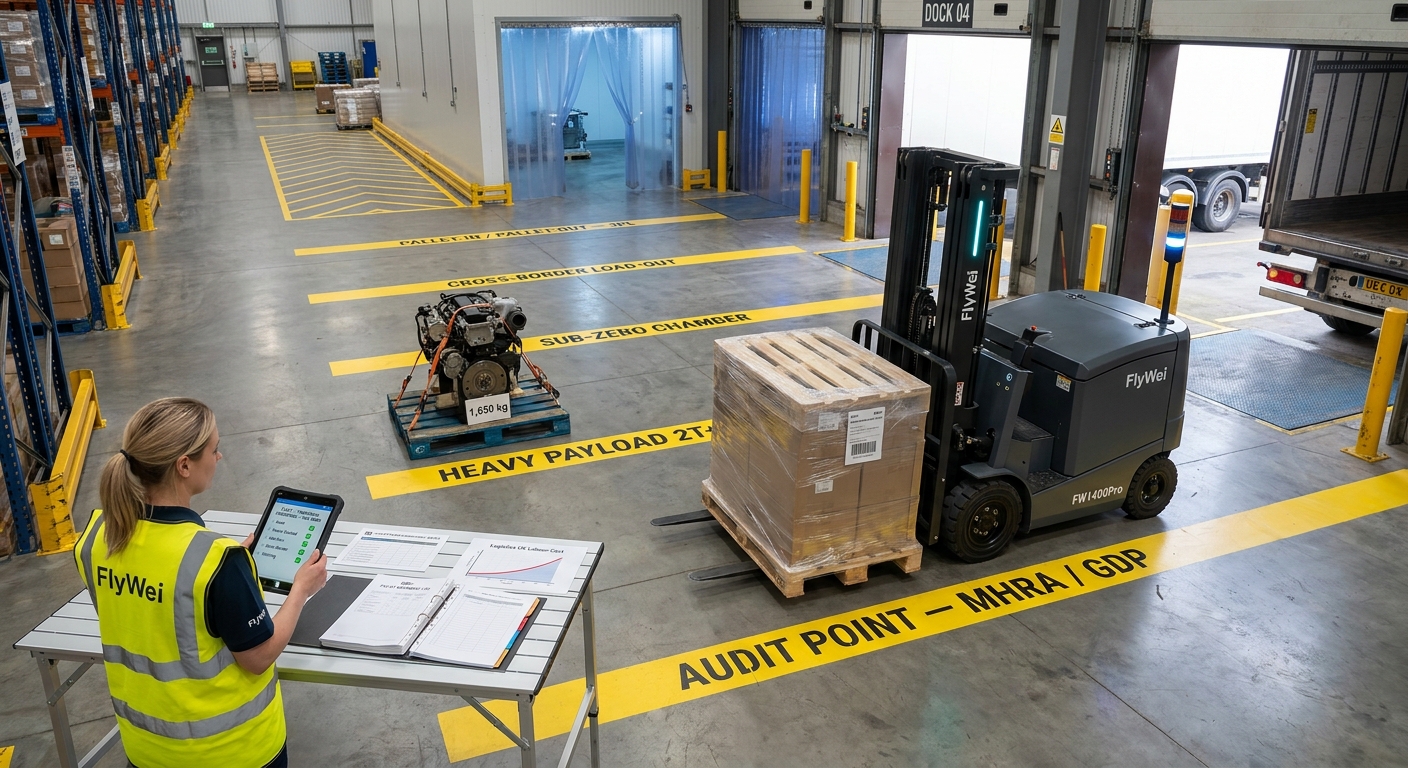
From a Nordic sub-zero aisle to a 2-tonne UK engine plant to an MHRA pallet log: one open standard, five thresholds, no remediation invoice.
The Five Lines
It's late May. You're a UK warehouse director sitting in front of three letters this week: an MHRA audit notice, a contract extension request from a customer who now wants frozen pallets handled at the same rate as ambient ones, and a quote from your tier-one MHE channel partner that adds a £180,000 racking-modification line to a fleet you already part-own. None of those three letters is a robot problem. All three are the same problem in different uniforms: every threshold your fleet has to cross this year is a place where a bonded, closed stack breaks and the invoice lands on your desk.
Across this week's reading — engineering, pharma, 3PL, retail DC, Nordic cold-chain — the through-line is identical: in 2026 your fleet has to cross five hard operational lines, and the cheapest fleet is the one that crosses all five on the same operating standard.
1. The Cross-Border Threshold
Most warehouse-automation pitches still assume a building. The 2026 supply-chain reality is multiple buildings in multiple jurisdictions sharing one parts list. A European Tier-1 engineering programme might move a 1.6-tonne casting from a Midlands machining cell to a Polish assembly plant to a French finishing line and back to a UK distribution centre — same component, four operating environments, four sets of regulators, one fleet expected to behave the same in all of them.
The closed bundled stack's answer is usually four separate quotes with four separate orchestration layers and four separate engineering-change windows. The arithmetic is unflattering: at roughly £4,800 per change request per site per year, a four-site programme is paying a low-six-figure annual tax on the privilege of having more than one building. Open-fleet alternatives running on VDA 5050 v2.1 collapse those four orchestration layers into one, and EN ISO 3691-4:2023 carries the same safety case across the Channel without re-validation.
The capex committee question writes itself but rarely gets asked: when the Stuttgart plant changes its pallet-position rules next quarter, do you pay your supplier to re-engineer four sites, or one?
2. The Weight-Class Threshold
The pitch decks default to 1.2-tonne payloads because that's where the volume curve sits — totes, cartons, mid-weight pallets. The work that keeps a UK engineering plant solvent is the 800-to-2,000 kg band: engine sub-assemblies, transmission cases, motor castings, machined housings. Anything below 1.2 t is handled by a mainstream goods-to-person fleet. Anything above is queueing for the overhead crane and a licensed banksman.
Chain-hoist crews and licensed-operator forklifts share the same aisle and eat takt budget the same way: queues. The HSE's most recent figures put workplace-transport collisions at around 25% of all fatal workplace injuries in Great Britain in 2024–25 — and that exposure does not drop when the payload doubles. It rises with it. The driver-licence pipeline is shrinking on top of that; the average counterbalance ticket-holder on a UK engineering site is older than the average machinist on the shop floor.
Heavy-lift AMRs in the 800-2,000 kg band run on the same VDA 5050 traffic layer as their lighter siblings. One orchestrator, two payload classes, no extra dispatcher and no second WCS to license. The question to ask: how many of your between-cell moves queued for the crane last week, and how many of those were under 2 tonnes?
3. The Audit Threshold
A UK pharma warehouse manager opening 2026 has two structural problems sitting on the same line of the same risk register: a forklift-operator shortfall in the order of 34%, and a GDP auditor who increasingly wants chain-of-custody traceability on every pallet move — not just every shipment. The two pressures look like two different problems. They are one. Timestamped, autonomous pallet moves close both at once.
Manual pallet moves are auditable in principle and unauditable in practice. A paper sticker, a hand-written initial, a missing line on a clipboard at 02:00 — multiply that across a 24/7 GDP-controlled environment and the auditor finds gaps because the gaps exist. Autonomous pallet moves on an EN ISO 3691-4 platform write a timestamped, mission-id-bound, immutable record per move into the enterprise WMS log the moment the truck releases the pallet. The MHRA inspection becomes a query, not a search.
The same logic generalises straight into BRCGS Storage and Distribution audits and into food-grade cold-chain operations, where Logistics UK has been flagging the same labour-traceability squeeze for two years running. The question to ask in your next operational review: pull the per-pallet audit record for last Tuesday's 14:00 shift change. How long does that take, and how many initials are missing?
4. The Wage-Curve Threshold
Sweden, Norway, Denmark and Finland share the EU's steepest forklift-operator wage premium, and the Nordic driver pool has been contracting for half a decade. The UK is on the same curve, roughly two years behind. Any business case that assumes today's operator wage is the operator wage you'll still be paying in 2028 is already wrong, and the longer the lease, the more wrong it gets.
The Nordic ops director's brief writes itself: a CE-certified, EN ISO 3691-4 + VDA 5050 v2.1 autonomous fleet that plugs into the existing enterprise WMS and pays back inside 12 to 18 months. That payback isn't a vendor promise — it's an arithmetic outcome of the wage premium. In a high-wage Nordic DC, every operator-shift the fleet absorbs is recovered cash on a steeper slope than in a mid-wage UK DC. The same fleet on the same standard works both buildings; the payback timeline simply shortens with the wage curve.
The trap is the closed bundled stack that quotes a single national payback against today's wage. It is a useful number for the slide and a useless one for the lease. The question to ask: what wage assumption sits underneath the payback line on this quote — 2024's number, or 2028's?
5. The Slotting Threshold
The capex committee gets the loudest pitches from cube-storage vendors because cubes photograph well. The actual contract economics of a UK 3PL move pallets in and pallets out — not totes. Cube grids assume a flow they don't have, demand a racking demolition they can't justify, and lock the building into one operating pattern for the length of the lease.
Autonomous forklifts on an open standard do the opposite work. They retrofit into the building as it stands, handle full-pallet flexibility on day one, and the same fleet keeps working when the anchor tenant rotates out and a new contract with a different SKU mix rotates in. PUWER inspections stay simple because the platform stays simple. The exit value at year seven is not zero, because the fleet is portable across sites and across contracts. You do not pay a remediation invoice on the way out.
This is the threshold that hides best on a pitch deck because it lives in the future. The deck shows year one. The lease lives in years three through ten. The question to ask, on email and in writing: if my anchor customer leaves in eighteen months and a new one walks in with a totally different SKU profile, how much of this automation goes in the skip?
The Arithmetic
- Workplace-transport collisions accounted for around 25% of fatal workplace injuries in Great Britain in 2024–25 (HSE). The risk does not vanish when the operator does — it concentrates onto the truck's safety case, which an EN ISO 3691-4:2023 platform is built to carry.
- UK pharma faces a structural ~34% forklift-operator shortfall, closed in the same move as the GDP traceability gap by timestamped autonomous pallet moves.
- A four-site European engineering programme on a closed bundled stack pays a low-six-figure annual tax in change-request fees that a single VDA 5050 v2.1 orchestration layer eliminates.
- Heavy-lift AMRs in the 800-2,000 kg band run on the same traffic layer as 1.2 t units — one orchestrator, not two, no second WCS licence.
- Nordic DC payback on an open-standard fleet sits at 12-18 months and shortens as the operator wage curve steepens.
What to Do on Monday Morning
- Print the last four weeks of your floor's between-cell or pallet moves and circle every one that queued for a licensed operator, a crane or a banksman. That circled list is your hidden takt tax — and the first place an open fleet pays for itself.
- Pull your last GDP, BRCGS or MHRA audit-finding list and tag every line that would have closed itself if every pallet move was timestamped to a mission ID. That tagged list is your audit threshold — and the second place an open fleet pays for itself.
- Ask whoever signed your last automation quote one question on email, in writing, no meeting: "What does this fleet's exit value look like at year seven if our anchor customer leaves?" Keep the reply on file. If the answer is silence or hedging, you already have your data point.
Closing
If you'd like a quiet read of an open-fleet design for the five thresholds your operation actually has to cross this year — your sites, your payload classes, your audit regime, your wage curve, your slotting reality — reply to this newsletter or comment below and we'll send one over. No deck. One PDF, your numbers, your building.