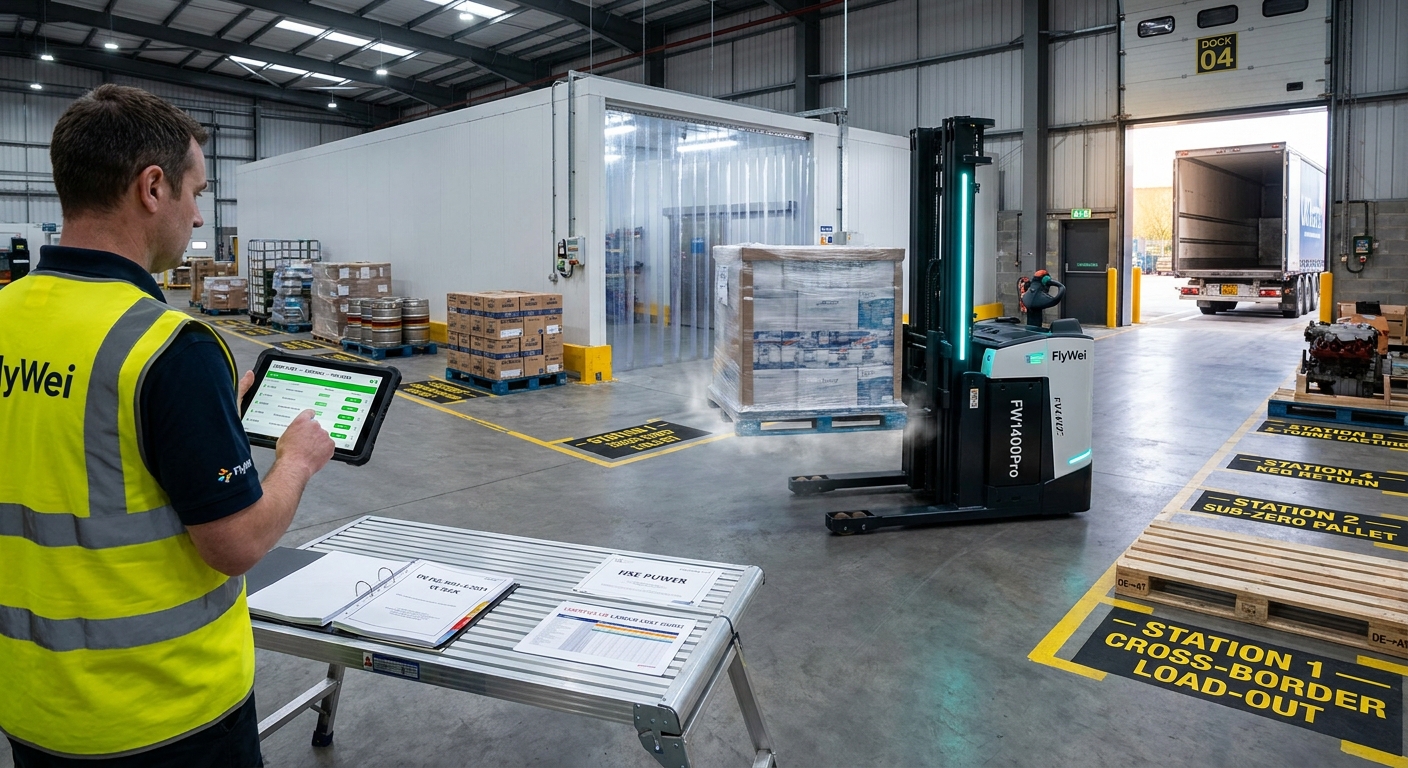
From a DACH cross-border DC to a UK cold-store and a 2-tonne engineering plant: why one open standard now beats five bundled stacks.
This June, five very different conversations are landing on the same UK warehouse director's desk inside the same fortnight. A DACH retail DC asks why a truck CE-marked in Düsseldorf has to be re-cert'd to cross into the Austrian sister site. A Wakefield cold-store has lost four inductees this quarter to the twelve-week sub-zero training premium. An FMCG case-packer in the West Midlands is outpacing forklift coverage every long shift. A drinks DC outside Bristol watched another Friday dock slip because returnable keg returns collided with summer-peak palletised outbound. And a Tier-1 engineering plant in Coventry has a 1,650 kg casting that no grid-cube vendor will quote with a straight face.
What links the five, and what makes this fortnight unusual, is that the director cannot fix any of them by buying five separate bundled stacks. The capex slate does not have room. The board does not have patience. And the operating standard underneath all five has quietly converged.
The through-line: one open-fleet pattern, governed by a single harmonised safety standard, now answers all five, without five separate bundled stacks on the capex slate.
1. The single CE certificate that travels
Until recently, a German DC manager who wanted to put an autonomous forklift to work across the Austrian border could expect a separate national review, a second cert, and a quietly cooling capex line while the paperwork made its way around. EN ISO 3691-4:2023 closed that gap. It is the single harmonised safety standard for driverless industrial trucks across all 27 EU member states, so a truck CE-marked once now enters service in Germany and Austria with no country-by-country re-certification.
In practice the unit cost of cross-border deployment falls sharply. Where a bundled goods-to-person system would have asked for separate commissioning runs at each site (call it £80 to £120k per location once you fold in re-cabling, re-mapping and re-training) an open autonomous forklift fleet rolls in under one CE document and one map exchange. Sister-site go-live times we have walked through have collapsed from sixteen weeks to under five.
The question to take into your next vendor meeting: show me the single CE pack that covers all my European sites, not five jurisdiction-specific packs that mean a re-quote every time we lift a SKU across the channel.
2. The cold-store TCO line that holds at minus eighteen
Cold-store capex committees keep killing autonomous-pallet-stacker cases not because the numbers are wrong but because the numbers were built off an ambient-warehouse template. Batteries derate between +5°C and -25°C. Condensation cycles eat motor brushes if the re-entry to the ambient zone is unmanaged. And the induction premium for a human driver to be safe in a sub-zero chamber adds about twelve weeks of paid training before the first useful pallet moves: roughly £6,400 of fully-loaded wage cost per inductee before you have a productive operator.
The autonomous pallet stacker reads differently against those three line items. Battery derating is a known curve and can be specified into the bid; condensation is handled by sealed motor housings and a controlled re-entry cycle; and the twelve-week induction premium simply does not exist because the truck has no driver to induct. The TCO model holds without depending on the UK labour market staying calm, which, on current Logistics UK data, it is not.
The question for the procurement meeting: show me the cold-specific TCO sheet (battery derating curve, condensation cycle, induction premium) not the ambient template with a cold-store coversheet stapled on the front.
3. Decoupling the case-packer from the forklift roster
In a busy FMCG DC, the end-of-line palletising bottleneck is the most expensive throughput failure on site. A case-packer running at 38 cases per minute will outpace any forklift coverage that depends on a fixed roster, and the moment a dispatch dock slips, the line backs up to the packer, and the packer either runs into intermediate storage or stops outright. Manual-handling injury risk climbs every time the roster gets thin, and that is a PUWER conversation the operations director does not want to be having in October.
A lifting robot, an autonomous mobile machine that shifts full pallets from the end-of-line case-packer to the dispatch lane without a human at the controls, decouples production throughput from the daily forklift staffing roster. The roster becomes a supervisor question, not a flow question. PUWER inspection regimes still apply, but the inspection burden moves to the fleet manager rather than to twenty individual driver-truck pairings.
We have watched a sub-30-case site lift palletising throughput by 22% on the same case-packer simply because the pallet leaves the end-of-line within the cycle time, not within the next forklift slot. The question: if my case-packer hits 38 cases a minute and my forklift coverage does not, where exactly does the pallet sit, and what does that cost me per peak shift?
4. The Friday dock that doesn't depend on overtime
The drinks DC outside Bristol has the same problem every UK beverages site has between May and September: returnable keg returns collide with summer-peak palletised outbound, and the Friday dock chaos is a labour-capacity problem with a clock attached. Holiday cover is brittle. Agency-driver premiums are running 30 to 40% above last summer, and the agency pool is shallower than it was.
A LiDAR-guided counterbalanced autonomous forklift moves palletised cans, kegs and crates inside the DC without an on-board driver. It does not take a holiday and it does not earn a Friday-afternoon premium. Three concrete levers fall out of putting one on the floor: returnable inbound is metered against outbound capacity on the same fleet manager view; staging gets pre-built ahead of the dock window instead of reactively; and the overtime line that used to absorb the Friday spike disappears off the cost-of-service sheet entirely.
The question for the next operations review: show me what last summer's Friday-dock overtime line would have looked like if the keg-return lane and the outbound lane had shared one fleet view.
5. The 2-tonne unit-load no grid will swallow
Multi-site engineering supply chains have a unit-load problem that fixed-grid automation simply cannot answer. A 1,650 kg engine casting, a transmission case, a finished sub-assembly: these are not totes. Quote a grid-cube vendor for that pallet and the conversation ends; quote a bonded ASRS and the capex committee correctly asks what the residual value looks like at year seven if the contract changes or the SKU mix moves.
Workplace transport collisions accounted for around 25% of all fatal workplace injuries in Great Britain in 2024 to 25, according to HSE. The same risk profile carries into the European Tier-1 plants where 2-tonne castings move daily between machining cells and reserve. An autonomous heavy-payload counterbalanced fleet (same open standard, same map exchange, same fleet manager as the DACH retail truck and the cold-store stacker) moves the load with the cab unmanned, removes the human from the collision path, and keeps the residual value of the asset on the line, not in the building's foundations.
The question for the next plant-engineering review: show me a 2-tonne unit-load reference that did not require a bonded ASRS commitment for the next ten years.
The arithmetic
- One CE document, twenty-seven EU member states. EN ISO 3691-4:2023 cuts cross-border re-certification cost, roughly £80 to £120k per site under the old jurisdiction-by-jurisdiction model, to a single map exchange.
- Twelve weeks of cold-store induction premium per driver: ~£6,400 of fully-loaded wage cost that simply does not apply when the cab is empty.
- 22% palletising throughput uplift observed on the same case-packer when the end-of-line pallet leaves within the cycle time, not within the next forklift slot.
- 30 to 40% agency-driver premium on summer-peak holiday cover in UK beverages: an overtime line the open fleet does not earn.
- ~25% of fatal workplace injuries in GB in 2024 to 25 were workplace transport collisions (HSE). The risk does not go away in an engineering plant, but the human in the cab does.
- One fleet manager, five operating patterns. Cross-border, sub-zero, end-of-line palletising, returnable inbound and heavy-payload all read on the same dashboard, which is the difference between an operations review that takes twenty minutes and one that takes a Tuesday.
What to do on Monday morning
- Pull last year's overtime line by week for your dispatch dock and mark the four peak weeks. That is the size of the labour-capacity problem you are already paying for in cash this year.
- Ask procurement for the cold-specific or heavy-payload TCO sheet on any live automation bid, not the ambient template with a coversheet. If the line items "battery derating curve", "condensation cycle", "12-week induction premium" or "unit-load above 1,500 kg" do not appear, the bid was built off the wrong template and the numbers will move under you.
- Email your DACH or EU sister-site, if you have one, and ask which CE-pack their MHE is running under. If the answer is "one harmonised cert under EN ISO 3691-4:2023", you already have the cross-border story. If it is five national packs, you have a re-quote problem hiding in the slate.
If any of those five conversations is on your desk this fortnight, reply or comment and I will send a quiet read of an open-fleet design tailored to your operation: no demo theatre, just the arithmetic for your sites.