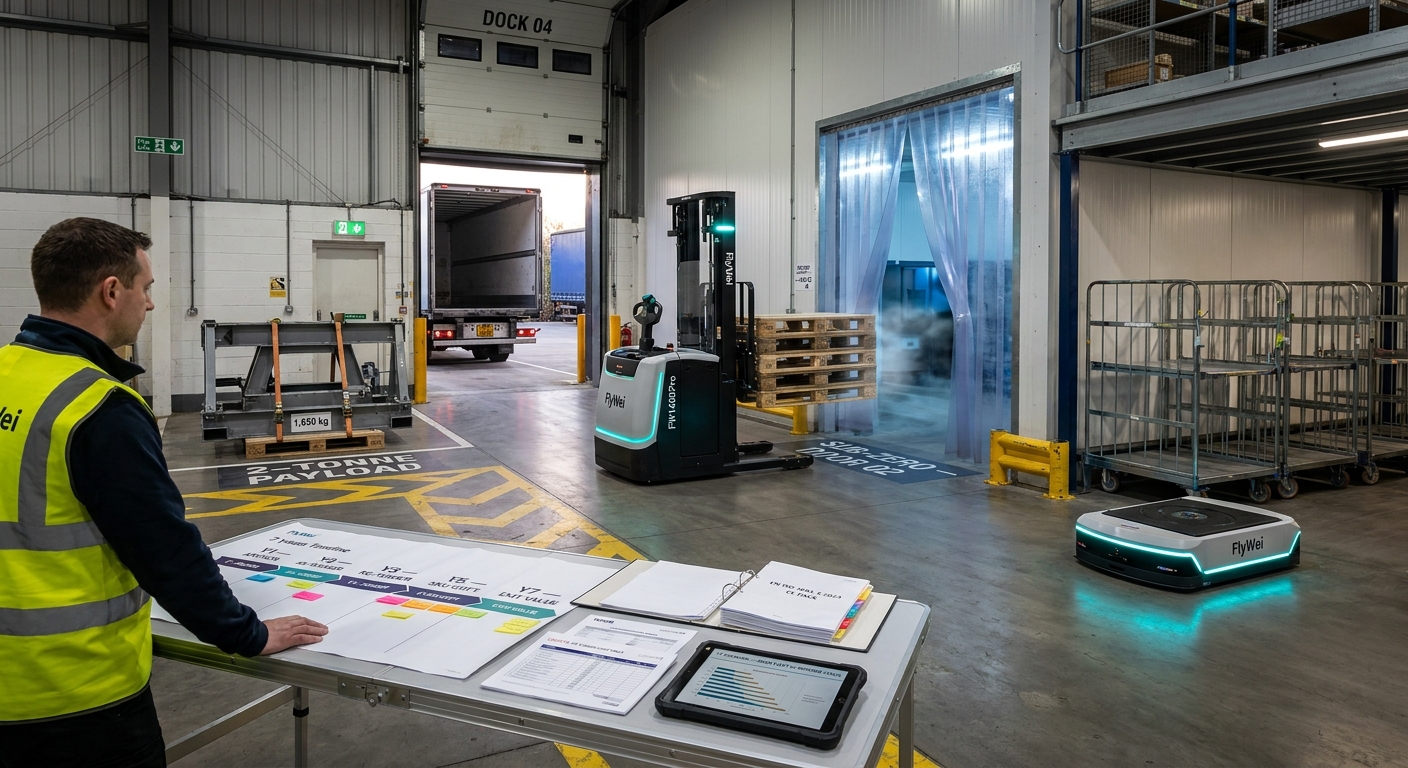
Cold-store derating, DACH harmonisation, mezz throughput, capex lifecycle, floor-vs-ceiling: five operations, one open-fleet lesson before Q3.
It is Friday afternoon. The capex committee meets at nine on Tuesday. The proposal in front of you is a seven-year bundled stack: hardware, software, slotting plan, all from one channel partner, all priced as a single line. The anchor contract under your building has eighteen months to run. Your agency-driver premium ran at thirty-seven per cent above standard in May. Two pallet-pedestrian near-misses sit open on the HSE log. You walk the aisle one more time before you sign the cover note, and you ask yourself the only question that matters: in three years, when the SKU mix has moved and the labour pool has tightened and the anchor has been re-tendered, what survives in this quote?
The through-line across this week's five briefings is simple: whatever your capex story tells the committee, the only number that will actually run your distribution centre in 2030 is the one your fleet still delivers after the SKU mix, the labour pool and the anchor contract have all changed at least once.
1. The lifecycle column your hardware quote doesn't have
Most capex committees are asked to underwrite a seven-year warehouse-robotics number using a quote that is functionally a list price. The hardware unit cost is in the document. The lifecycle services that decide whether the unit is still working in year five are not. Neither is the software refresh path. Neither is the spares-pool strategy. And, most expensively for a UK operator, neither is the EN ISO 3691-4:2023 safety case maintained against actual changes to the operating layout.
The Health and Safety Executive's published incident pattern is the input nobody likes to put in a capex paper. Vehicle-pedestrian collisions account for around a quarter of all fatal workplace injuries in the United Kingdom. An FMCG plant running three shifts of twenty-four-hour pallet flow carries a measurable share of that risk on every approved capex sheet, whether or not it is written down. The safety case is not a paperwork exercise; it is an operating cost line, and it is the line that most hardware-only quotes leave for the buyer to absorb in year three.
The question to bring into your next vendor meeting is not about the truck. It is this: show me the seven-year line items for the safety case, the software refresh and the spares pool (broken out per truck, per year) and tell me which of them are fixed and which float with my SKU mix. If the answer is a single bundled service-and-maintenance number with no detail underneath it, you do not have a lifecycle plan. You have a list price wearing a contract.
2. The fifteen-year call between a slab pour and an aisle retrofit
The second briefing this week framed the structural decision European FMCG operations directors are being asked to make right now: a fifteen-year capex call between floor-level autonomous forklifts that retrofit your existing aisle layout under EN ISO 3691-4:2023, and ceiling-mounted cube-storage AMRs that demand a slab pour and a fourteen-to-twenty-eight-week build-out before the first SKU moves.
The cube stack is excellent at one job. The retrofit fleet is acceptable at many. Read the prospectus of any anchor tenant that has run a UK distribution centre for fifteen years and you will struggle to find one whose SKU mix, peak profile and dock pattern in 2026 looks anything like the one the building was originally fitted for. The cube stack is brilliant when nothing changes. The arithmetic problem is naming a UK warehouse where nothing has changed in fifteen years.
The retrofit fleet does not promise the headline pick rate of a closed bundled stack on day one. It promises that the operation it is supporting can still be a different operation in year seven without writing off the floor. For an operations director facing a fifteen-year horizon under a three-year anchor contract, that asymmetry is the case.
The question for the vendor: if our anchor contract is re-tendered in year three and the slotting plan that comes back is a forty per cent reduction in full-pallet flow and a doubling of mixed-case pick, what does your slab pour cost us to convert, and how many weeks are we offline while we do it?
3. Your bottleneck is the trolley-puller, not the picker
The third briefing was the one warehouse managers will recognise fastest. On UK e-commerce mezzanine pick floors of roughly nine to twenty-three thousand square metres, peak-day throughput is not capped by picker speed. It is capped by trolley availability: by how fast a human trolley-puller can return empty wheeled carts to the pick face and remove built carts to the despatch lane.
The cost of that cap is not on the pick-rate dashboard. It is in the agency mark-up paid to cover the trolley-pulling shift in October and November. It is in the missed cut-off slots that quietly become a refund line two weeks later. And it scales the wrong way: every additional picker you bring on for peak adds a fractional trolley-pulling demand that the existing trolley-puller pool cannot absorb without a step-change in headcount.
Knee-height autonomous lifting robots take that step-change off the table. They lift, carry and lower wheeled carts, totes and sub-assemblies under their own power, on the existing mezzanine floor, without re-engineering the slab and without sterilising the pick face. They do one job, and the job they do is the one that was costing you peak.
The question for the vendor: on our actual peak day last November, what was our trolleys-per-picker ratio, and what would each minute of trolley wait removed have cost us in agency-shift hours saved?
4. One safety case, two CE-mark countries
The fourth briefing matters to anyone running, or thinking of running, a second site across the Channel. EN ISO 3691-4:2023 is now the single harmonised safety standard for driverless industrial trucks across all twenty-seven European Union member states. A truck CE-marked once enters service in Germany and Austria without country-by-country re-certification.
What that one paragraph quietly does to the UK operator's capex case is significant. It means the safety-case investment you make for your Midlands distribution centre is not a sunk cost the day you add a DACH site. It travels. The DGUV reporting overhead in Germany still applies. The thirty-to-forty per cent agency-driver premium running in DACH this year still applies. But the certification you have already paid for is portable in a way it has not been for the last decade.
The countervailing case, a fixed-automation rebuild, locks eighteen to twenty-four months of capex against an SKU mix that, on the evidence of the last three contract cycles, will not still be the mix when the line goes live. The same eighteen-month window will see two seasonal peaks, one anchor-contract renewal cycle and at least one labour-market shift. None of those are kind to a stack that has just been bolted to the floor.
The question for the vendor: if we add a second site in eighteen months, how much of the safety case carries, and how much of the CE pack do we have to redo from scratch?
5. The cold-store derating curve nobody costs
The fifth and final briefing was the one most likely to be missing from a UK procurement TCO model, because it does not appear in an ambient-warehouse spreadsheet at all. Cold-store autonomous pallet stackers run against three inputs that an ambient model does not capture: battery derating at sub-zero operating temperature, condensation cycles every time a truck crosses the strip curtain back into the warmer ambient air, and a twelve-week cold-store driver induction premium that does not exist in dry-goods recruitment.
Each of those three inputs is a line on the operator's running cost. None of them are on the manufacturer's data sheet. A capex committee that does not see them written down will quietly assume they net to zero. They do not net to zero. They are the reason the cold-store autonomous pallet stacker is, on a properly costed basis, the only UK cold-store materials-handling capex line that pays back without depending on the labour market staying calm, and it is also the reason a borrowed ambient TCO model will under-state its payback by a margin large enough to lose the case.
The question for the vendor: what is your published derating curve at minus twenty-five Celsius, what is your condensation-cycle maintenance interval at our door-cycle rate, and what is your cold-induction premium per driver assumption?
The arithmetic
- Around twenty-five per cent of UK fatal workplace injuries are vehicle-pedestrian: the safety case is operating cost per shift, not paperwork per year.
- Fourteen to twenty-eight weeks of build-out for a ceiling-mounted cube stack versus a day-one productive aisle for a floor-level retrofit on the slab you already own.
- Thirty to forty per cent agency-driver premium running in DACH and the UK this year: your throughput case cannot assume the premium falls in 2027.
- Eighteen to twenty-four months of capex locked when a fixed-automation rebuild meets an SKU mix that has already moved underneath it.
- Approximately £15,000 to £25,000 of residual value per truck at year seven on an open-fleet platform versus close to zero on a fully bonded stack: the line your capex committee will look at first when the exit value is what funds the next refresh.
What to do on Monday morning
- Pull the last eighteen months of vehicle-pedestrian near-misses and incidents off your HSE log, cost each one at the agency-shift rate of the lost hours, and put the total at the top of your next capex paper. That is your real safety-case line. The vendor's quoted figure is a placeholder until then.
- Ask your operations director for the slotting plan you will be running in 2028. If there is not one, your robot quote is being sized to a building that may not exist. Send it back and ask for a fleet sized to a contract horizon, not to today's pallet flow.
- Cost the cold-induction premium per driver and the agency mark-up per hour on your three peak weeks, then build both into the seven-year TCO before the next vendor walks through your door. The quote that survives that test is the only one worth signing.
If you'd like a quiet read of an open-fleet design tailored to your aisle width, payload mix and contract horizon: reply to this edition or drop a comment. No pitch deck, no channel partner, just the seven-year line items the bundled quotes leave out.