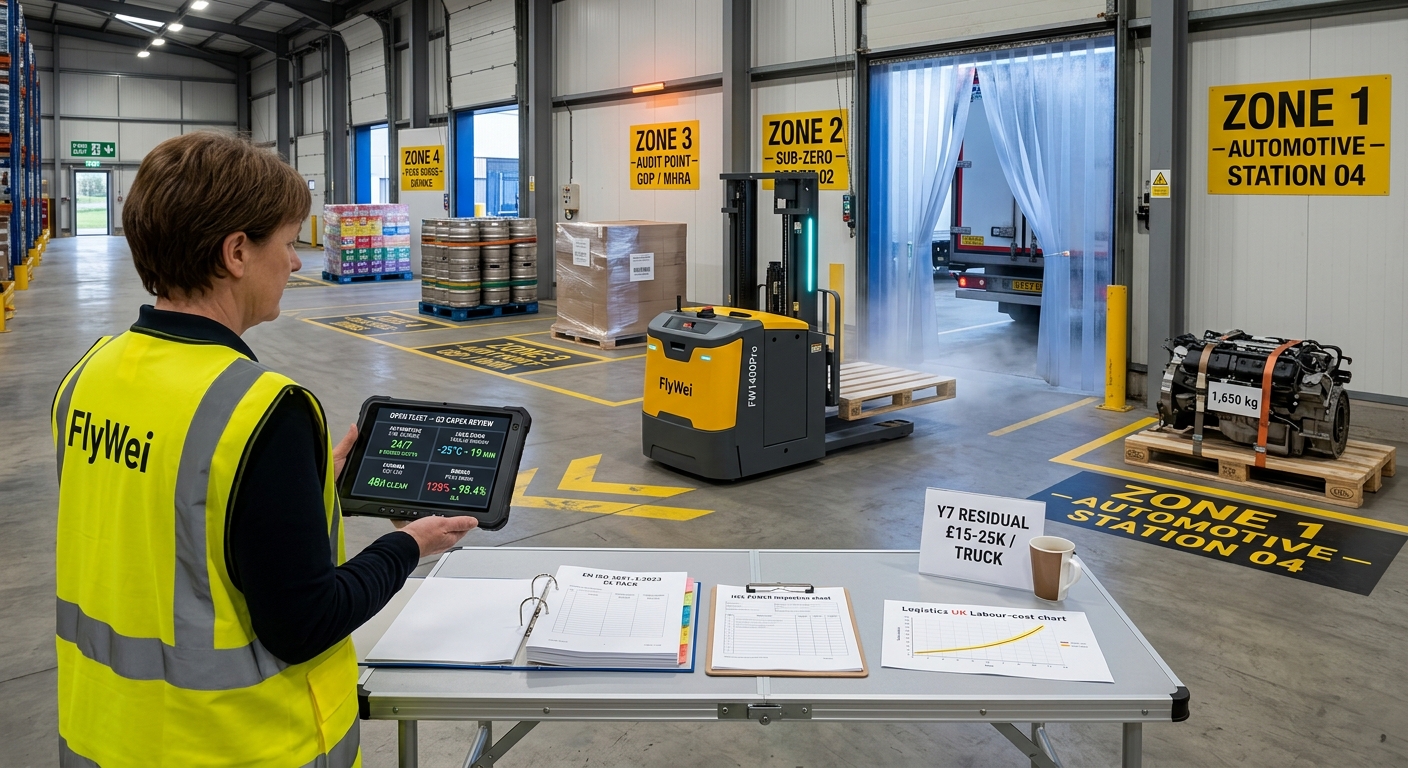
Line cadence, sub-zero, GDP audit, multi-site peak: four sector pressures landing on the same UK capex sheet this quarter. Why one open fleet wins.
A UK warehouse director walks into her Monday capex meeting in June with four pressures stacked in the same week. The 24/7 engine plant is one missed forklift shift away from fifteen to thirty minutes of starved line. The cold-store down the M1 is staring at a twenty-minute outbound trailer window and another summer of freezer-driver churn. The pharma DC has an MHRA GDP audit on the calendar and NHS Supply Chain SLAs paying for the building. The drinks network is forecasting a thirty-five to sixty per cent peak swing. The committee asks the same question on each capex line: what is your seven-year number, and what happens to it when the contract changes?
Across automotive line cadence, cold-chain trailer windows, pharma audit trails, drinks peak swings and the procurement maths underneath them all, the same fleet has to flex through four entirely different operating physics, and a single open-fleet design is the only answer that survives the seven-year capex sheet.
1. Line cadence is a forklift problem before it is a robotics problem
Engineering plant directors usually frame the autonomy question as a robotics question. It is not. It is a cadence-protection question, and on a UK automotive line running 24/7 the maths is brutal: a single missed forklift shift translates to fifteen to thirty minutes of starved line at component drop. On a high-value powertrain line the £-per-second is the only number worth taking into negotiation; everything else (footprint, charging slot, throughput-per-aisle) is downstream of it.
The reason a Plant Director rarely solves this on the existing payroll is that the agency forklift driver who covers a 03:00 no-show has not been inducted to the mixed-traffic risk assessment under PUWER. Every replacement is a designed safety case waiting to be re-signed by a Plant team that does not have time to design it. Autonomous forklifts hold cadence not because they go faster but because they go every shift, in the same lane, on the same documented safety case under EN ISO 3691-4:2023, without a fresh PUWER attestation each Tuesday morning.
The reason this matters now is that the autumn capex review at most UK automotive plants is being asked to underwrite a seven-year fleet. The fleet that wins is the one that flexes from the engine line to the gearbox sub-assembly aisle without a change-order, and that does not trigger a remediation invoice the first time the line plan moves a station three metres to the left.
Question to take into the next vendor meeting: when our forklift cover fails at 03:00, what is the documented failover behaviour of your fleet in the first six minutes, and is that behaviour already inside our PUWER risk assessment?
2. Cold-chain throughput is bounded by trailer windows, not by truck speed
Twenty minutes. That is the outbound trailer window a UK cold-store warehouse manager is holding through summer peak, and it is the planning constraint that breaks human freezer drivers long before it breaks any individual forklift. Glove changes, mandatory rest breaks at -25°C, seasonal re-training cycles and the simple physiological fact that a human cannot sustain pallet throughput in a freezer at the same rate they sustain it in ambient: the trailer window is held on paper and missed on the floor.
A cold storage autonomous forklift sustains pallet throughput at -25°C without rest breaks or glove changes. That is not the lever, though. The lever is that the same truck, on the same fleet manager, also handles the ambient receiving lanes and the chilled stage area without re-engagement, so the cold-store manager does not have to bond a separate stack for the freezer.
This is where the open-fleet argument moves from procurement to operations. A closed bundled stack quoted for cold-only is two fleets to manage, two safety cases, two sets of spares and two re-tender events. An open fleet that crosses the strip curtain between chilled stage and freezer chamber is one map, one safety case and one number against the twenty-minute window.
The reason this matters this quarter is that the summer-peak trailer window is already being missed at sites that did not specify cross-chamber behaviour in last year's quote. The remediation invoice arrives in July, not October.
Question to ask: at -25°C, what is the continuous duty cycle of the truck you are quoting between battery swaps, and what does that do to my outbound trailer turn on a peak Friday afternoon?
3. An audit trail is a fleet feature, not a paperwork bolt-on
For an MHRA-licensed Wholesale Dealer running a UK pharmaceutical distribution centre, the pallet movement log is not optional, is not generated after the fact, and is not allowed to break across a shift change. Every autonomous task issued, every pallet collected, every aisle traversed has to land in the audit log on the first attempt: time-stamped, signed, and unbroken. GDP audits do not award partial credit.
The Supply Chain Director's problem is that the variability inside the operator-driven baseline is exactly what an auditor circles in red. Shift handovers, manual paperwork, retrospective sign-offs: the audit risk lives there, and it lives there structurally. Autonomous forklifts are how a Wholesale Dealer Licence holder takes operator-shift variability out of the audited pallet movement, not by speeding it up but by making the movement and the log the same record.
The NHS Supply Chain SLA that pays for the building is inelastic. Late pallets are not absorbed; they are reported. The fleet that holds the SLA is the fleet whose audit log is its task log: same record, same source, same time-stamp.
This is why a closed bundled stack underperforms in pharma even when its raw throughput number is competitive. The audit interface is the deliverable, not the truck. An open-fleet design exports its task and movement log into the operator's existing quality system without a vendor-side translation layer, and that is what the auditor reads. A bundled stack that owns the log is an audit liability the day the contract changes.
Question for the next vendor meeting: show me your audit log for the last 48 hours of pallet moves, every entry, no sampling, and tell me exactly which field is the MHRA-acceptable time-stamp.
4. Peak swings break bonded stacks before they break people
A drinks Supply Chain Director runs a multi-site network (breweries, regional DCs, returnable keg flow) through 35-60% peak swings driven by the Six Nations, summer barbecue weather, the World Cup and Christmas. At 70% utilisation in October every fleet looks good. At 130% on a heatwave Tuesday with one site short of LGV-licensed forklift operators, the fleet that fails is the one that cannot lend capacity from a quieter site across the network.
Drinks supply chain automation in the UK is, at its core, the use of autonomous forklifts, latent-jacking AMRs and centralised fleet orchestration to hold service levels above 98% across multi-site networks during 35-60% peak swings, without depending on a shrinking pool of LGV-licensed forklift operators. The orchestration layer is the part the closed bundled stack quietly cannot do at the network level: it can run one site beautifully and treat the neighbouring site like a stranger.
The shrinking LGV-licensed operator pool is the second hidden line on the capex sheet. Wage inflation in regional DCs has outpaced the labour-cost chart Logistics UK publishes; agency cover at peak adds twenty to forty per cent on top. An open fleet that flexes between sites (same safety case, same operator interface, same orchestration) is the only architecture that holds 98% service through the swing without the agency line ballooning to swallow the savings.
Question to ask: at 130% network utilisation on a peak Tuesday, can I borrow capacity from another site's fleet on the same task interface within thirty minutes, or do I have to raise a change-order with your account team and wait for a quote?
5. The seven-year number is the only number on the capex sheet that matters
Vehicle-pedestrian collisions cause around a quarter of all fatal workplace injuries in the UK, according to HSE, and an FMCG plant running three shifts of 24-hour pallet flow carries a measurable share of that risk on every approved capex. The procurement committee that signs the cheque is signing a seven-year safety case, not a one-year throughput number.
The structural problem with hardware-only vendor quotes is that they hide the four numbers that matter: lifecycle services, software refresh schedule, spares strategy, and the ISO 3691-4 safety case. The four-number gap is where the seven-year exit value disappears. A bonded stack quoted at competitive year-one capex frequently lands at near-£0 residual at year seven, because the safety case, the software and the spares all belong to the vendor and not to the operator.
An open fleet inverts that. The truck is the operator's asset; the safety case is portable; the software interface is documented against an open standard; the spares strategy is multi-source. Residual at year seven on an open fleet of autonomous lift trucks should still carry £15-25k per truck after a contract change, and that is the number that lets a capex committee actually underwrite seven years rather than re-underwrite it every eighteen months.
The reason this matters before Q3 is that the procurement calendars for autumn signing are already in motion, and the seven-year residual line is the only line that distinguishes a fleet from a bonded stack on paper.
Question to take into the next vendor meeting: what is the year-7 residual value of the fleet you are quoting, in writing, with the exit assumptions documented, and what is the operator's cost to move that fleet to a different building if the contract changes?
The arithmetic
- Fifteen to thirty minutes of starved 24/7 automotive line per missed forklift shift; the £-per-second cadence cost dominates any fleet quote on a UK powertrain or gearbox line.
- Twenty-minute outbound trailer window at -25°C: the summer-peak planning constraint that human freezer drivers cannot consistently meet, and the cross-chamber behaviour every cold-store quote has to specify.
- Around 25% of fatal UK workplace injuries are vehicle-pedestrian collisions, per HSE; every approved warehouse capex carries a share of that risk on a seven-year horizon.
- 35-60% peak swings across a multi-site UK drinks network at 98% service level; bonded stacks do not flex network-wide, and agency LGV cover at peak adds 20-40% to the labour line.
- Year-7 residual on a bonded stack approaches £0; an open fleet of autonomous lift trucks should carry £15-25k per truck after a contract change: the only line that distinguishes a fleet from a stack on the capex sheet.
What to do on Monday morning
- Write down your single most expensive failure mode in £-per-second: starved line, missed trailer window, failed audit, lost SLA. That number is the only one your fleet quote has to clear. Carry it on one page to every vendor meeting this quarter.
- Pull your last twelve months of forklift cover: every no-show, every agency hour, every overtime line. Compare that total to the cost of a single autonomous truck-equivalent operating the same hours under EN ISO 3691-4:2023. The arithmetic, on most UK sites in June 2026, is now obvious enough to settle the capex argument in one afternoon.
- Ask your incumbent vendor for the year-7 residual value of the quote on the table, in writing, with the exit cost if you re-tender or change contracts. Their answer, or its absence, tells you in one sentence whether you are looking at a fleet or a bonded stack.
If your fleet has to flex across more than one of these operating physics this quarter (line cadence, sub-zero, GDP audit, multi-site peak) reply to this newsletter or comment below. We will send back a quiet read of an open-fleet design tailored to your operation: no slides, no sales call, just the arithmetic on one page.