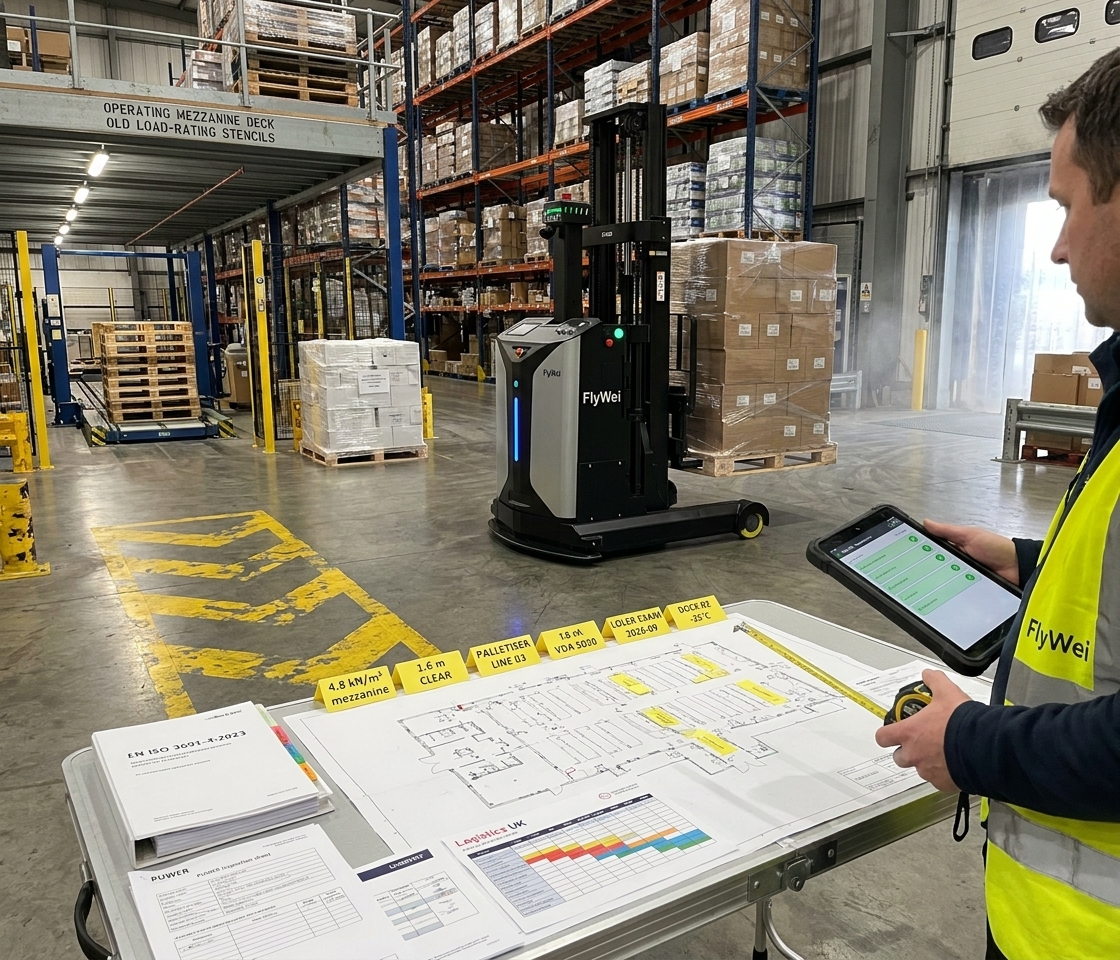
G2P picking, palletiser handshakes, narrow-aisle stackers, RaaS funding and drinks-calendar TCO — the single thread tying this week's reads together.
If you run a UK warehouse this quarter, you are not staring at a clean sheet. You are staring at racking your predecessor signed off in 2014, a mezzanine that creaks in two places, palletisers that have outlived their build-spec, a WMS upgrade trapped behind a finance freeze, and a labour budget that lost its margin two peaks ago. Vendors keep arriving with decks that assume you will rebuild the building around their robot. You will not. The decision in front of you is whether the next fleet bends to the aisle you already have, or whether the aisle bends to the next fleet — and that decision is shaping every cost line on next Friday's capex sheet.
The thesis for this edition is one sentence. Across five UK sector reads this week — e-commerce, FMCG, pharma, engineering and drinks — the operators winning the 2026 fleet decision are the ones treating the building as the constraint and the open fleet as the variable, not the other way round.
1. Pick the architecture that fits the mezzanine you have
E-commerce supply-chain directors are walking the same loop this quarter: a 4–5x peak surge is coming in October, the brownfield mezzanine cannot be ripped out, and the picking architecture decision is a six-figure commitment that has to live inside the slab and steel they already own.
A goods-to-person operation lifts e-commerce pick rates from 60–80 lines per operator-hour to 280–410 lines per operator-hour once it is bedded in. That is the arithmetic that justifies the spend. The question is whether you get there with a lifting AMR moving full totes to workstations on the existing mezzanine, or with a shuttle-and-aisle system that demands a new build footprint, a deeper slab and a cube allocation you simply do not have above the pick face.
A lifting-AMR approach respects the building. It works under the deck you already cleared, it shares the aisle with humans during off-peak, and it scales by adding units rather than steel. A closed bundled stack tends to be the opposite shape: a single integrator's racking, a single integrator's WCS, a single integrator's tote spec, and a future you cannot unwind without losing the asset.
The vendor meeting question to take in this week: what is the live load rating of my mezzanine deck along the busiest pick face, and which of these architectures sits inside that rating without a deck rebuild? If the answer is a deck rebuild, the six-figure capex has just become seven.
2. Orchestrate around the palletiser, not over it
Plant directors in UK FMCG plants are being pitched AI-orchestration as table stakes. The reality on their floor is heterogeneous palletisers from three different OEMs, a mid-life MES that nobody wants to touch before Q4, and an OEE number that cannot absorb a rip-and-replace robot rollout in either of the two cadence windows the year offers.
A modern robot fleet must orchestrate with existing palletisers, MES and dispatch — not replace them — if line cadence and OEE are going to survive the go-live week. That sentence is the whole point. It is also the line that closed-stack vendors quietly do not say.
An open fleet earns its place on the floor by speaking the protocols the line already speaks: VDA 5050 to the fleet manager, MQTT or OPC-UA up to the MES, REST handshakes down to the palletiser PLC. The robot picks up the pallet the palletiser puts down. The robot tells the MES it has the pallet. The MES tells dispatch. Nothing on the line gets replaced; one more participant joins the conversation.
The vendor meeting question to take in this week: which of those open protocols does the fleet you are being shown actually implement in production at a UK reference site — not on the roadmap slide — and can the integrator hand you the interface document this week, not after PO? A closed bundle will fold at that question. An open fleet answers it before you finish asking.
3. Reclaim the cube, not the slab
Operations directors in UK pharma are running multi-temperature DCs at 70–80% of their designed throughput. The reasons stack: lift-truck operator vacancies that will not fill at any plausible wage in regulated bays, GDP discipline that does not bend, and racking that already sits inside the LOLER thorough-examination clock. The temptation is a bigger building. The cost of a bigger building is two years and a board paper nobody wants to write.
Autonomous pallet stackers offer a different sentence. They run 1.6-metre clear aisles at ±5-millimetre placement accuracy. They let a UK pharma DC reclaim up to 25% of slab cube without rebuilding the racking — fully inside PUWER and LOLER duty-holder responsibility, because the duty does not transfer to the box on wheels. It stays with the operator unless the contract is written carelessly.
That last sentence is where 90% of the risk sits and is exactly where closed bundles get vague. The duty-holder line in a PUWER inspection is not a vendor problem and not a software problem. It is a contract problem. Reclaim 25% of cube and you keep that number only for as long as the contract holds the duty correctly.
The vendor meeting question to take in this week: in your draft service agreement, where exactly does the PUWER duty-holder boundary sit, and which named role on my side carries the LOLER thorough-examination record? If they cannot point at the clause and the role, you are not buying a stacker — you are buying an HSE visit.
4. Buy the outcome, not the asset
Engineering plant procurement leads are arriving at the 2026 capex committee with a number they cannot get past finance: £900,000-plus for an autonomous forklift and lifting-robot fleet, sat on a balance sheet that has already absorbed two years of working-capital pressure. The capex sheet is the wrong sheet.
A Robotics-as-a-Service line turns that fleet into a fixed monthly opex fee. Hardware, fleet-management software, maintenance, parts and on-site engineering cover all sit inside one line. The plant pays for hours of moved pallets, not the depreciation of a chassis. The line scales with output. The line shrinks if a programme moves. The balance sheet stays free for the things that actually have to sit on it.
The operational consequence is not just accounting. A monthly fee with a defined service level forces the supplier to keep the fleet up, because their revenue is the uptime. A capex asset on your books does the opposite — once the cheque clears, the supplier's incentive starts to drift. RaaS realigns it.
The vendor meeting question to take in this week: what is the Year 3 lift-out cost in your model, what does the monthly fee do if my volume falls 20%, and where is the SLA penalty if the fleet underperforms? The answer to those three questions is the difference between an opex line you can defend at committee and a capex commitment that becomes a stranded asset in 2029.
5. Match the financing to the calendar
Drinks distribution centres in the UK run a calendar nothing else in logistics runs. Peak demands more — more trucks, more drivers, more hours, more cube. Off-peak demands fewer. A five-year capex commitment fits neither half of the year, which is why fleet sizing for the drinks calendar has been broken for a decade.
AGV forklift cost in a UK drinks DC is best understood as a five-year total-cost-of-ownership figure, not a sticker price. Hire, leasing, full-service maintenance, energy, fleet-management software and the avoided cost of agency forklift drivers all sit inside the same procurement decision. Once you write all of them on one sheet, the capex line is the smallest number in the column.
This is where flex actually pays. Six autonomous trucks in October, three in February, with a contract that bends to the volume curve, beats eight capex-bought trucks parked half the year. The difference is felt in agency labour avoided in peak and depreciation avoided in trough — both numbers most fleet calculators leave off the page.
The vendor meeting question to take in this week: what does flex actually mean in your contract — can I scale the fleet down to off-peak without a punitive minimum charge, and is the agency-driver avoidance modelled in your TCO with named assumptions per shift? If the answer is "we will get back to you", they are selling a capex asset wearing an opex label. The drinks calendar will find that out for them by Q2.
The arithmetic
- A goods-to-person operation lifts UK e-commerce pick rates from 60–80 to 280–410 lines per operator-hour.
- Autonomous pallet stackers reclaim up to 25% of slab cube at ±5 mm placement accuracy without a racking rebuild — under PUWER and LOLER duty-holder responsibility.
- Robotics-as-a-Service converts a £900,000-plus fleet capex hit into a single monthly opex line, with hardware, software, maintenance, parts and on-site engineering cover bundled.
- An open VDA 5050 fleet sits alongside existing palletisers, MES and dispatch — no rip-and-replace — using the protocols the line already speaks.
- A five-year drinks-DC TCO captures hire, lease, full-service maintenance, energy, software and avoided agency labour in one number; the capex line is the smallest line on the page.
What to do on Monday morning
- Pull the load rating for your mezzanine deck and the two narrowest aisles on your slab, and take both numbers into every vendor meeting this quarter. The architecture choice is already half-decided by those two figures.
- Ask your MES owner which open protocols (VDA 5050, MQTT, OPC-UA) your existing palletiser line already speaks, and require the fleet integrator to hand you the interface document — not the roadmap slide — this week.
- Re-cut your five-year forklift cost into a single monthly opex line that includes agency cover, engineer call-out, software and avoided downtime, and compare it to the sticker capex. If the monthly line wins across three of five sectors of your business, the financing model has shifted underneath you.
If you'd like a quiet read of what an open-fleet design looks like inside your own racking, your own MES handshake and your own peak-and-trough calendar, reply to this newsletter or drop a note in the comments. No deck. No demo day. Just the arithmetic on the building you already have, done in your terms.