From Italian carrellisti audits to UK pharma reinspection cycles, the forklift refresh now follows the regulator's clock, not the asset register — and why that rewrites the buy.
It's a Tuesday in June 2026 and a UK supply chain director is staring at a wall that holds five clocks she didn't wind. Her LOLER thorough examination is due 12 September. A separate audit body has her down for reinspection inside fourteen months. Her Q4 peak forecast came in twelve points higher than last year. The plant up the road is bleeding Italian shifts because half the forklift cab seats are empty. And her finance director will only sign one sheet of paper this quarter — not a fleet refresh and a cold-room programme and a WMS migration. Five clocks, one budget line, one signature.
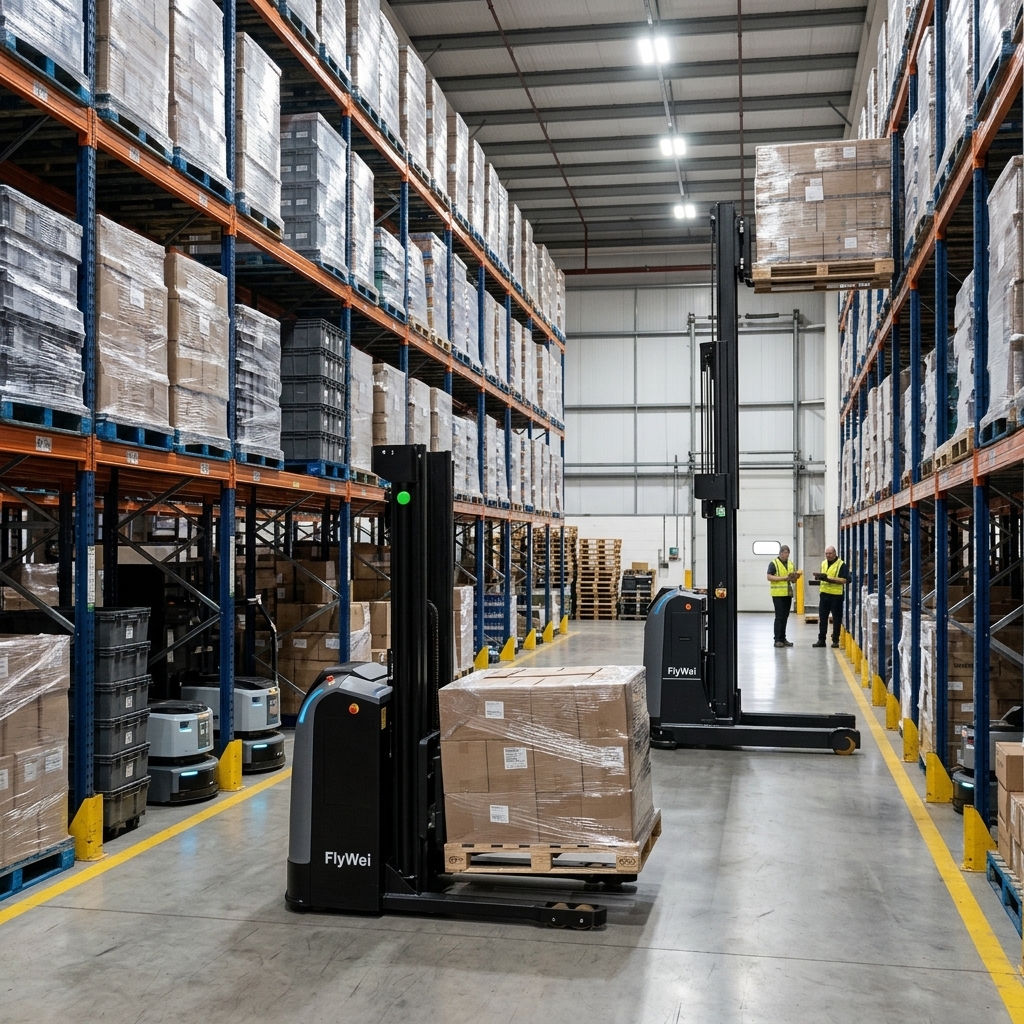
Across this week's reads — UK and Italy, FMCG and pharma and retail DC and e-commerce — the forklift refresh has stopped following the asset register and started following the regulator's clock, and that single change rewrites the buy.
1. The Clock on the Wall Is the Regulator's, Not the Depreciation Schedule
For two decades, fleet refresh was a depreciation decision. You bought a counterbalance, you ran it seven years, you sold the residual back to a tier-one channel partner, and you started again. The clock on the wall was the asset register's.
That clock has been replaced. Read this week's UK 2026 buyer's guide for autonomous forklifts and three regulators sit on the cover page: LOLER for the lifting-equipment thorough examination, PUWER for the work-equipment safe-use regime, and BS EN ISO 3691-4:2023 for the autonomous-truck conformity pack. Each one carries its own cadence — LOLER on twelve months, PUWER continuously, ISO 3691-4 on the certificate that follows the truck for the whole of its life. Cross the Channel and the Italian equivalent reads the same way in a different language: D.Lgs 81/08 enforcement is tightening on manual-forklift near-misses, EN ISO 3691-4 governs the autonomous class, and the Italian audit body cares less about how long you have owned the truck than about whether the truck on the slab today can be evidenced against the standard today.
That is a different conversation from the one a UK supply chain director was having in 2022. A truck on a seven-year asset clock cannot answer it; a truck on a refresh cycle aligned to the regulator's clock can. The question a director needs to put to her next vendor is not "what does the truck cost" but "what is the documented refresh path that keeps the conformity pack current through the next two audit cycles, in writing, before I sign?"
2. Pharma Now Buys on a 36-Month Horizon
The pharma read this week is the bluntest example. A UK pharma procurement team cannot fund both an autonomous-forklift fleet refresh and a GDP cold-room programme out of the same 2026 capex pot — and the inspecting body reinspects the operation on a 24-to-36-month rhythm. An outright-purchased fleet, bought on a seven-year horizon, is stranded between software generations by the time the third reinspection comes round: the trucks still work, but the conformity evidence the auditor wants is two cycles behind the published standard.
The fix in the article is a three-year operating lease that resets the fleet exactly when the regulator next walks the floor. That is a treasury decision before it is a fleet decision: the capital that would have been parked in a depreciating asset is now freed for the cold-room programme the same audit is judging in the same week. One pot, two answers, both compliant.
The implied moat sits behind it: a three-year lease only works if the fleet is vendor-portable. If the truck is locked into one supplier's fleet manager, into one supplier's WMS shim, into one supplier's spares chain, then refresh at month 36 becomes a re-platforming exercise — and the capital you freed for the cold room is consumed by the migration instead. If the fleet runs on an open VDA 5050 stack with a UK-stocked spares cabinet, refresh at month 36 means swapping mast cylinders and seal kits, not changing supplier.
The next vendor meeting question: "Show me, in writing, the cost of a fleet lift-out at month 36 and the cost of a mid-life upgrade — which is cheaper, and how much cheaper?"
3. Retail DC: Zone by Zone, Not Slab by Slab
The retail-distribution read covers a 400,000 sqm-class UK DC trying to scale Q4 peak without committing the slab to monolithic fixed automation. The Logistics UK position is hard to argue with at board level: 67 per cent of multi-site UK retail operators ranked labour availability as the largest single disruption risk for 2026. You cannot solve that with a twelve-month tender for a bolted-in goods-to-person bundle, because the bolted bundle arrives after peak, consumes the slab for the next decade, and removes the option to renegotiate the lease.
The article's prescription is zone-by-zone deployment of autonomous mobile robots, sequenced against the BS EN ISO 3691-4 documentation pack. Three zones at the Q3 cut-off; two more between peak and the New Year reset; the rest the following year. Each zone earns its own labour swap, gets its own conformity evidence on file, and survives a renegotiation with the landlord because nothing is bolted to the floor.
This is the same regulator-clock logic in a different sector. In retail, the clock is Q4 peak plus the lease event. The zone approach lets the fleet expand or contract against both — and against the labour curve Logistics UK is publishing — without a single irreversible slab commitment. It also lets the supply chain director keep the option of a lift-and-shift when the building changes hands, which the bolted-in alternative does not.
The question for the next vendor meeting: "Map your roll-out plan against my next two peaks and my next lease renewal; show me what I can lift out in 90 days without surrendering my deposit."
4. The E-Com Brownfield Maths Decide the Truck Class
The e-commerce read closes the loop on the question of which truck. A UK e-com director was choosing between a lifting AMR and a shuttle-based goods-to-person rack, inside a brownfield mezzanine, against a forecast 4-to-5x peak surge. The numbers in the piece are concrete: e-commerce pick rates lift from 60-80 lines per operator-hour to 280-410 lines per operator-hour after deployment — a 3.5-to-5x productivity step on the slab the operation already has.
The mezzanine is the constraint. A shuttle-based goods-to-person rack wants a clean envelope, a deck rebuild, and a fresh slab survey before it can even be specified. A lifting AMR rides the floor and the mezzanine the operation already has, including the painted load-rating stencils from the 2014 fit-out. For a brownfield with a 4-to-5x peak surge, a six-figure capex mistake on the wrong architecture is a single-year-margin event — and it cannot be reversed inside the same peak.
The cross-read with the UK forklift guide — which sets out three distinct autonomous truck classes (mast-mounted counterbalance, narrow-aisle reach, flat-floor AMR) — is the point. The director's question is not "should I robotise" but "which of the three classes maps onto my building, my mezzanine load rating in kN/m², my Week-47 throughput target, and my conformity pack?" The Italian read makes the same point in a country where the load ratings are written in kN/m² as a matter of course and the audit body is D.Lgs 81/08, not LOLER. Same three truck classes, different regulators, identical decision.
Next vendor meeting question: "Which of the three classes does my building actually allow — and on what slab and mezzanine evidence in writing?"
5. The Single Spec That Survives All Four Reads
If the regulator sets the clock, the mezzanine sets the truck class, the audit sets the lease term, and the peak forecast sets the zone roll-out, then the only fleet spec that survives all four conversations is the open one.
Open here is operational, not philosophical. It means a fleet manager that speaks VDA 5050 to anything on the floor — including the legacy diesel trucks the operation is still depreciating from the last refresh. It means a WMS interface documented on a published schema, not buried inside a closed bundled stack. It means a spares cabinet stocked in-country, with part numbers the operation owns, not a parts queue routed through a single supplier's portal. And it means a conformity pack — BS EN ISO 3691-4 in the UK, EN ISO 3691-4 in Italy — that travels with the truck if the truck moves sites, not with the bundle.
The closed bundled alternative is faster to install and slower to live with: every refresh becomes a migration, every audit becomes a vendor escalation, every peak becomes a capacity argument with a sales engineer who is two countries away. The open fleet pays for itself the first time the regulator asks for the next conformity pack and you have it in a binder on the table without picking up the phone.
Next vendor meeting question: "What can I lift out in 90 days, and what stays mine — in writing?"
The Arithmetic
- 3.5-to-5x pick-rate step on the existing slab once goods-to-person picking is layered onto a brownfield mezzanine: 60-80 lines per operator-hour rises to 280-410 lines per operator-hour after deployment.
- 67 per cent of multi-site UK retail operators rank labour availability as the largest single 2026 disruption risk — Logistics UK position, board-level evidence, hard to argue with.
- 24-to-36 months is the pharma reinspection cadence the UK operation is judged against; a seven-year asset clock is two cycles out of phase by year five.
- 2,000 kg is the heavy-class lift threshold an EN ISO 3691-4 autonomous truck can hit on a Lombardy or Emilia slab today, with no driver in the cab and the fleet manager docking to plant WMS via VDA 5050.
- One capex pot funds either a fleet refresh or a GDP cold-room out of 2026; a 36-month operating lease on a vendor-portable fleet lets it fund both, on the same single sheet of paper finance will sign.
What to Do on Monday Morning
- Pull your three audit dates. LOLER thorough examination, PUWER review, and any sector-specific reinspection (pharma GDP audit, food-grade inspection, equivalent). Write the three dates on a single A4 sheet and put them in front of finance before your next capex paper goes in. The dates decide the financing route before the vendor does.
- Walk your mezzanine with a tape measure, not a brochure. Note the clear aisle width to the millimetre, the load rating in kN/m² from the painted stencils, and the closest dock door distance in metres. Those three numbers, on one piece of paper, decide which of the three autonomous truck classes your building actually allows before any vendor brochure is opened.
- Get a written 90-day lift-out cost from your current automation supplier. If they cannot put a number on the page within a fortnight, you do not have an open fleet — you have a bundle dressed as one. That single number, or the absence of it, is the most important data point you will collect this quarter.
If any of those three numbers come back ugly, reply to this edition or drop a comment for a quiet, off-record read of an open-fleet design tailored to your operation — your aisle, your audit dates, your peak, on the slab you already have.