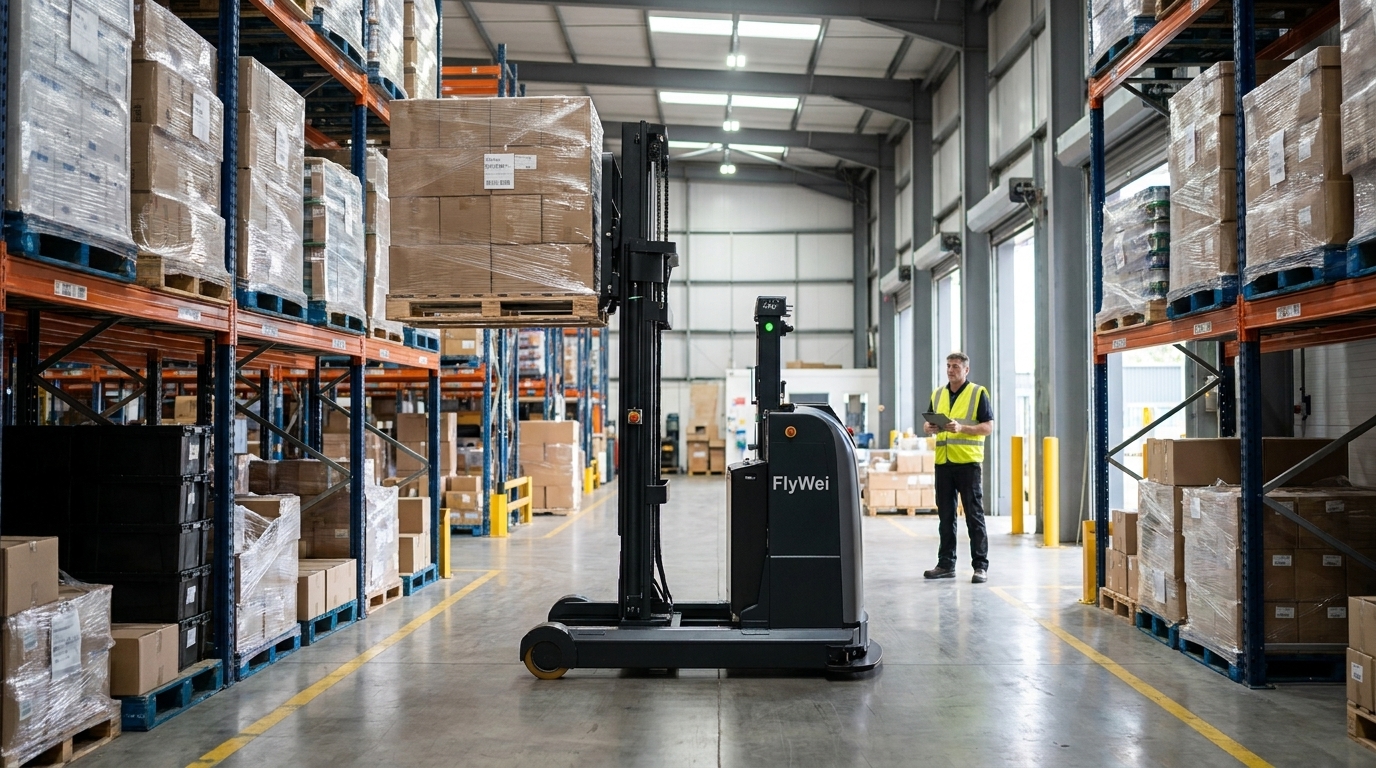
From UK FMCG to Italy's Tier-1s, the Hungary–Slovakia corridor and the parts-wash room — labour shortages and the audit clock, not feature lists, close the deal.
You are an operations director in the West Midlands. It is Thursday morning, the Week-47 peak is twenty-one weeks away, and your insurance broker has just emailed asking — politely, but for the second time — about the LOLER summary for your reach trucks. Two of your three night-shift forklift drivers have given notice this month. The agency you have used since 2019 is now quoting £19.40 an hour for an FLT operator, weekend uplift on top, and even at that rate they cannot fill the second cab on the parts-wash bay. Your finance director wants a single Q1 paper. You have one shift to write a brief that nobody on the board has read before but everyone on the board has heard about.
This week's four articles all describe the same thing from different aisles: across the UK, Italy, the Hungary–Slovakia automotive corridor and the wet-bath corner of an engineering plant, the autonomous forklift conversation has stopped being about robotics and started being about what the audit, the labour market and the leasing contract leave you no choice but to do.
1. The driver shortage is no longer cyclical
The numbers landed in two languages this week. The Italy piece describes a structural carrellisti gap that the Lombardy, Veneto and Emilia DCs have been carrying for three peak seasons; the corridor piece describes the same shortage at the OEM and Tier-1 plants feeding the EV programme on the Hungary–Slovakia line, where takt time is now policed to the second. The UK number, which you already know, sits behind both: agency rates for an FLT operator have not retreated since 2023, and the catchment for a competent reach-truck driver inside a 25-mile radius of any Midlands DC is now roughly half what it was at the last refresh cycle.
What the corridor piece adds is the consequence. When an EV body shop runs at 58-second takt, a forklift that is late twice an hour is no longer a labour problem; it is a line problem, and the cost is measured in takt loss, not in £/hour. The piece quantifies this around three to five corridor plants where leasing rates collided with EV programme capex in the same quarter — exactly the collision your finance director is asking you to solve in your Q1 paper.
The piece you already know — the UK Buyer's Guide — is the same picture turned ninety degrees. Three truck classes, BS EN ISO 3691-4 paper, VDA 5050 on the fleet manager, leasing on a 3, 5 or 7-year curve. The labour market did the arithmetic; the buyer's guide is just the spreadsheet.
Operating question for your next supplier meeting: at what cycle time does your current manual fleet stop absorbing driver absence, and how do you measure that today?
2. The audit clock now sets the refresh date
The Monday edition — "The Clock the Forklift Runs On" — pulled together a pattern across Italy, the UK and the pharma reinspection cycle: the regulator now decides when the asset is refreshed, not the asset register. Three of the six articles approved this week return to that point. The Italy piece names D.Lgs 81/08 enforcement and the fact that manual-forklift near-misses are now a top-three audit finding. The UK Buyer's Guide names LOLER, PUWER and BS EN ISO 3691-4 in the same sentence as the Q1 capex paper. The parts-wash piece names the PUWER/LOLER liability that sits on every shift where someone is lifting a wet steel basket out of a degreaser.
The implication for the brief sitting on your desk is simple, and it is the line that will get the brief past your CFO. The depreciation curve of your current fleet is no longer what dictates the refresh date. The audit cycle does. If your insurance broker is already asking for the LOLER summary in June, your Q1 paper is not really about throughput — it is about reducing the population of audit-exposed manual lifts before the next inspection. Phrasing it that way converts a robotics question into a liability question, which finance directors know how to underwrite.
One real-feeling number: a single fatality, or a single life-changing injury, in or around a forklift now exposes a UK warehouse operator to legal and insurance consequences typically running into seven figures before reputational damage. Around a quarter of UK workplace fatalities each year still involve transport in or near workplaces — the HSE number that anchors every audit conversation in the country.
Operating question for your next risk-committee meeting: where in your operation is the next manual-handling near-miss most likely to come from, and what would removing the driver from that station cost, in £ per month, on a 60-month lease?
3. The wet-bath corner — the lever you have not priced
The article on automated parts-washing machine loading and unloading is the one most operations directors overlook, because the parts-wash bay rarely shows up on the dock-throughput dashboard. It is also the lever with the cleanest business case in the building. Manual loading of an industrial parts-washer or vapour degreaser starves a long-cycle machine — a basket sits for fifteen minutes while the operative finishes another task — exposes a labourer to a high-centre-of-gravity wet steel basket, and creates a PUWER liability on every shift.
The choreography described is straightforward: an autonomous forklift or AGV pulls a wet steel-mesh basket vertically out of the wash, parks it on a drip station, picks the next clean fixture, and feeds it in. No driver. No manual lift over chest height. The wash machine stops being starved. On a three-shift plant, that single change typically reclaims 35–45 minutes of degreaser uptime per shift, which on most UK engineering plants compounds into 6–8% extra throughput on the constrained machine before any other change.
The reason this lever is undervalued is that nobody on the procurement side owns the parts-wash bay. The maintenance manager owns the machine, the production manager owns the throughput, the safety lead owns the manual handling. The autonomous forklift is the only intervention that lands a single line item on all three balance sheets at once.
Operating question for your next plant walk: which of your long-cycle machines is starved by manual loading today, and how much of your overtime bill is paid because of that single bottleneck?
4. Leasing finally underwrites the residual-value risk
The leasing article is what makes the brief land on your CFO's desk in a form they will sign. Until this year, the lock on autonomous forklift adoption in UK retail and FMCG DCs was not the truck — it was the residual-value risk on a lithium-battery driverless fleet that had no five-to-seven-year finance precedent. Underwriters did not know what to charge. Boards did not know what to underwrite.
The procurement piece names what changed. The lease now bundles hardware, fleet software, maintenance, parts and updates into a single monthly line across 3, 5 or 7 years, and the underwriting is now backed by structured residual-value cover that did not exist in the 2023 round. The article frames this as a 36-month payback brief, which is exactly the window your finance director will quote you when you walk in next week. The headline arithmetic, in round UK numbers, is a six-figure capex problem converted into a four-figure monthly opex line, sized to one shift's avoided agency cost plus one audit cycle's avoided manual-handling exposure.
What this changes operationally is the shape of the pilot. A 60-month bundled lease on a single truck against a single station — the parts-wash bay, the dock-to-stack run, the long-cycle wash machine — now sits inside the same monthly opex envelope your CFO already approves for the agency shift it replaces. You do not need a fleet decision in Q1; you need a station decision.
Operating question for your next finance review: at what monthly opex line does your CFO stop asking about residual value and start asking about throughput? That number is now lower than it was twelve months ago.
The arithmetic
- Agency FLT operator rate, Midlands radius, weekend uplift included: about £19.40/hr — roughly £40k/year on a single weekend-loaded shift line.
- Constrained parts-wash machine, manual loading: 35–45 minutes of starved uptime per shift on a three-shift plant; 6–8% throughput uplift when reclaimed.
- LOLER/PUWER non-conformance window: the insurance broker review now lands roughly six months ahead of the next inspection cycle, not after it.
- Lithium driverless lease, UK retail DC sizing, 60-month term: bundled into a single monthly opex line that sizes to roughly one shift's avoided agency cost plus the audit-exposure delta.
- UK workplace transport fatalities still account for around 25% of all workplace fatalities — the HSE number that anchors every audit conversation.
What to do on Monday morning
- Pull the LOLER summary your broker asked for, count the lifts that touch a manual cab, and circle the three stations with the highest near-miss density on the last twelve months of incident reports. That is your candidate list — not your refresh list.
- Ask your plant manager for last quarter's degreaser or wash-machine uptime, and how much of the gap is loading-related rather than mechanical. If you have not measured this, that's the meeting.
- Email procurement and ask for one 60-month bundled-lease quote on a single-truck pilot covering one of the three stations on your candidate list. Not a fleet. One truck. One station. Sized to one shift's avoided agency cost plus the audit-exposure delta. That is the paper your CFO will sign.
If your Q1 paper has to satisfy your CFO, your insurance broker and your plant director in one document, reply or comment below and we'll send you a quiet read of an open-fleet design tailored to your specific bay — not a sales deck, an operations brief.