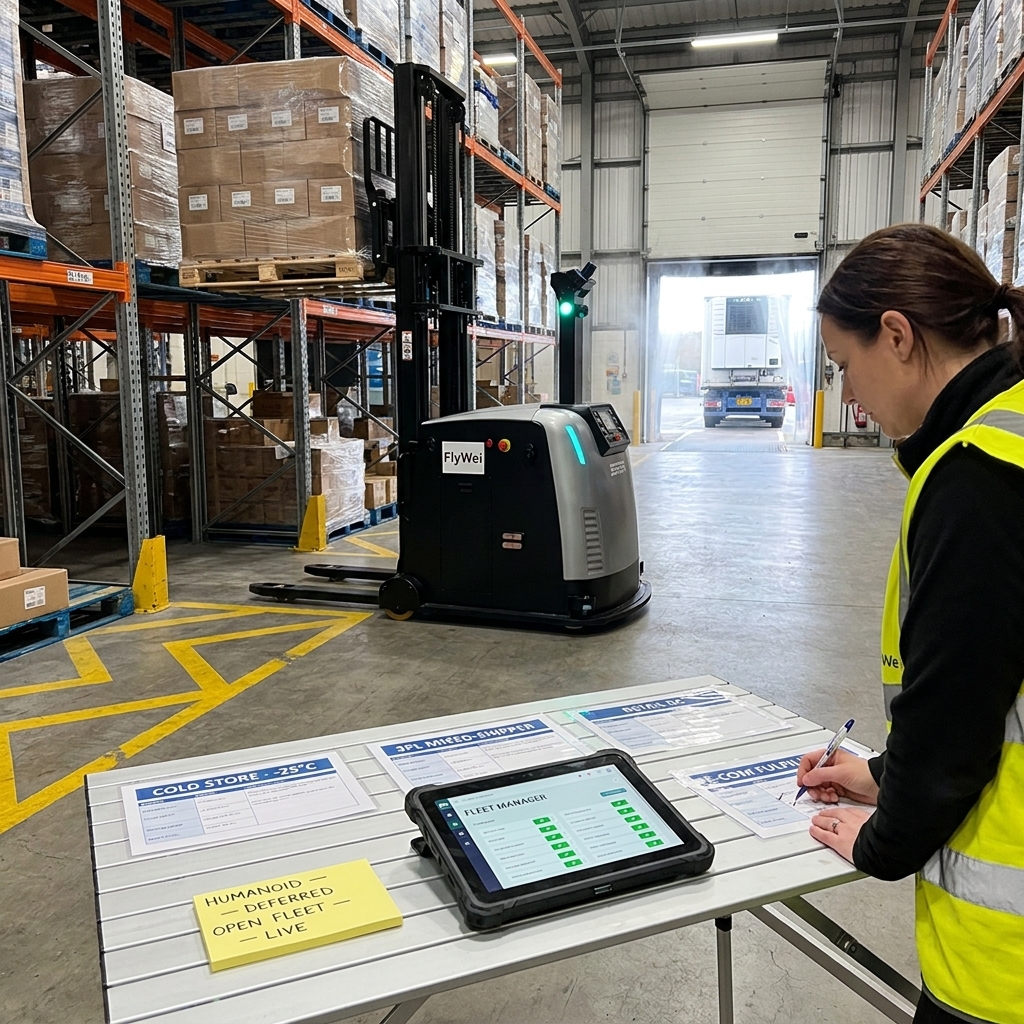
Cold store, 3PL, retail DC, e-com — what a UK ops director commits now, what she defers, and why the answer is a fleet, not a truck.
You are the operations director of a mid-sized UK warehouse this Thursday morning, and three things are all true at once. A cold-store dock has lost two night-shift stacker drivers in a fortnight, and agency is quoting you £24.80 an hour to backfill. A board member who saw a humanoid demo on a flight last week is asking whether you can defer the 2026-27 automation capex programme until the humanoid ships. And the reach truck you spec'd last October has slipped into Q1. Every one of those pressures is real, and none of them stands still. The question isn't which robot to buy. It's which fleet to run.
Across this week's four operational reads — cold-chain, 3PL, retail DC, e-commerce — the same lever keeps winning: an open, certified, orchestrated fleet on the building you already have.
1. The cold aisle no one wants to staff
At −25°C, end-of-line palletising is the shift no operator wants and no HSE inspector overlooks. The workplace transport section of HSE's own guidance still treats manually-driven trucks in cold environments as a live cold-exposure hazard, and PUWER 1998 duty-of-care puts the burden squarely on the operator, not the manufacturer. Two chilled-food plant directors we've been reading this week both put the number at roughly 12–18% OEE gained at the discharge point once the mast cab is unmanned — but only when the truck is running the full 24/7 duty cycle at chamber temperature, not when it's a warm-air handoff.
Two things that don't survive contact with a real cold aisle: consumer-grade lithium chemistry (charge cycles collapse below −10°C without proper pre-conditioning) and cold-set stretch wrap validated at ambient (a spec that passes on the QA bench shears at −25°C on a rectangular pallet's leading corner). The playbook that's converging: purpose-built cold-rated stackers, factory-conditioned batteries, opportunity charging in an ambient buffer bay, and a wrap spec you validate on the coldest wall of your own chamber before the vendor ships anything to your slab.
The question to bring to your next stacker vendor meeting: "Show me your PUWER 1998 evidence pack for continuous −25°C duty at 24/7 across a full winter — not the demonstration rig on a promo video."
2. The 3PL orchestration ceiling
The Q4 2026 UK 3PL reality is that no single shipper's volume alone will underwrite a driverless-truck programme. What actually underwrites it is one supply chain director sequencing mixed-shipper flows across one fleet — and that only works if the orchestration layer is genuinely open. This week's 3PL read makes the point sharply: an automated forklift under ISO 3691-4 is not a labour-replacement project, it's an orchestration project. The buying unit is the software that gives you audit-grade evidence across shippers, not the truck itself.
The economic tell is a leasing structure that keeps the capex IRR intact while the orchestration layer earns its keep on shipper-KPI visibility. If your operating model has three shippers on the same slab, and each shipper's contract has a different service-level obligation, the fleet-manager screen you buy has to hold three vertical KPI columns without you writing bespoke ETL for each shipper's report. That's the ceiling — and the ceiling is a software choice, not a truck choice. The UK 3PLs who get this in 2026 are the ones who spec the open orchestration layer first and the truck second, because the truck is the easy part.
The question to bring to the vendor: "Show me the fleet-manager screen with three shipper columns already populated from a live VDA 5050 feed on a working slab — not a slide deck, not a lab demo."
3. The retail DC peak that already happened
Retail DCs of 150,000 sqft and up across the UK Midlands and North West have already run out of pickers before they run out of orders this year — that is the point this week's retail-DC warehouse-manager read makes, and it lands hard. Mixed-SKU peak absorption used to be solved by adding pedestrian pallet-truck headcount at £16–£18 an hour blended. In 2026, agency premiums on the same shift have pushed that to £22–£26 an hour, and the applicants aren't there at any price on a Tuesday in Q4. A compact autonomous mobile robot — a lifting robot in the sub-500 kg class that slides under a wheeled cage or dolly, jacks it a few centimetres off the deck, and moves it across the DC — buys you throughput at a fixed monthly cost you can defend line by line at the capex committee.
The trap is treating the fleet like a like-for-like picker replacement. It isn't. It's a decoupling layer between your pick face and your dispatch lanes, and the operational lever is what you STOP asking humans to do — the fifteen-metre-plus pedestrian pallet walks, the empty-return legs, the between-wave rebalancing that eats an hour a shift per picker. If your compact fleet is only doing what a pedestrian was doing, one for one, you bought the wrong shape. The point of the fleet is to change what a picker's day looks like, not to remove one.
The question to bring to the vendor: "In our aisle plan, which four pedestrian tasks disappear on day one, and which two only disappear once wave-planning ties in?"
4. The humanoid question your board will ask
A humanoid demo went viral this quarter, and there's a very good chance a board member is going to ask whether the 2026-27 automation capex programme should slip until the humanoid ships. Here is the operational answer that survives the committee. As of mid-2026, no humanoid robot holds notified-body certification to ISO 3691-4 for autonomous industrial-truck duties in a UK warehouse. Purpose-built AMRs and autonomous forklifts have been shipping under PUWER 1998 duty-of-care on UK slabs for over five years, with the CE evidence packs to prove it. A humanoid on your slab today is an experimental asset — brilliant for a lab, uninsurable at scale on a duty-of-care basis inside a working DC operating to a shipper SLA.
That is not the same as "no humanoids, ever." It is the disciplined move: commit purpose-built now for the operational levers you can defend to your committee, and keep humanoid optionality open by insisting on an open orchestration layer that a certified humanoid could plug into later — the same VDA 5050 fleet manager, the same MES handshake, the same operator screen, the same audit trail. The board wants certainty AND optionality. An open, certified fleet gives you both. A closed bundled stack gives you neither, and will be the sunk cost you are apologising for in 2028.
The question to bring to the vendor: "If a humanoid is certified to ISO 3691-4 in 2028, can it register as a device on your fleet manager without a software fork?"
5. The capex arithmetic that closes the committee
Here is what the multi-site chilled cold-chain read gave us this week, and it generalises. A defendable AMR-plus-forklift payback model in a UK cold-chain warehouse typically lands inside 30 months when a mixed fleet runs at least 18 hours a day across chilled and ambient zones. Below 18 hours, the number softens quickly. The reason is arithmetic, not marketing: leased trucks earn their monthly cost by displacing agency premiums at every hour of the duty cycle, and the marginal displaced hour is the last one you add on the roster.
The committee-safe framing is not "will it pay back?" — every deck says that. It's "under what utilisation floor does the payback break?" Bring the floor to the committee, not the ceiling. And bring the number as a monthly opex line, not as a capex line, so it lives in the same P&L conversation as the agency spend it displaces. That single framing move turns a two-hour capex debate into a fifteen-minute opex swap, which is the only version of the paper that gets signed at the first sitting.
The question to bring to the vendor: "What is the utilisation floor under which our payback slips beyond 36 months, and which two operational levers move that floor?"
The arithmetic
- Agency-shift premiums on UK warehouse floors this quarter are running £22–£26 an hour blended, up from £16–£18 in 2024.
- A mixed AMR-plus-forklift fleet at 18+ hours daily duty cycle typically pays back inside 30 months in a UK cold-chain DC.
- OEE at the −25°C end-of-line palletiser lifts roughly 12–18% once the mast cab is unmanned on a full 24/7 duty.
- Zero humanoid platforms hold ISO 3691-4 notified-body certification for UK warehouse duties in 2026.
- Purpose-built AMRs and autonomous forklifts have been shipping under PUWER 1998 duty-of-care on UK slabs for over five years, with CE evidence packs.
What to do on Monday morning
- Walk your coldest aisle with the plant engineer and mark, on the drawing, the exact discharge points where a manually-driven truck is still absorbing −25°C exposure. That is your PUWER-defensible shortlist and it takes 40 minutes.
- Pull the last four weeks of pedestrian pallet-truck movement data and highlight the walks over fifteen metres and the empty-return legs. Those are the pedestrian tasks your lifting-robot business case has to make disappear on day one.
- Book thirty minutes with your capex-committee chair before the next paper lands, and pre-agree the utilisation floor under which the payback breaks. Bring the floor into the paper, not the ceiling. Committees sign floors; they argue ceilings.
*If any of the four reads above landed close to home — the cold aisle, the 3PL orchestration ceiling, the retail DC peak, or the humanoid question at the board — reply to this newsletter, or leave a comment below. I'll send back a quiet, one-page open-fleet design read tailored to your operation. No slide deck, no vendor demo, no follow-up sequence. — FlyWei