Five reads: how UK warehouses flex 3x Q4 throughput with a mixed autonomous fleet you bolt onto a live floor — without a shutdown or the agency phone.
The Q4 forecast lands. The agency doesn't answer.
Every UK ops director I've spoken to this quarter has the same Monday-morning problem sitting on their desk. The Q4 forecast came in from the commercial team on Friday. It says 30-50% more pallets, 3x kegs in the drinks bays, roughly a doubling of case picks between the last week of October and the second week of January. It says nothing at all about how to move them.
The agency you used last autumn has quietly lost half its counterbalance-certified pool to a large e-commerce fit-out down the M1. The rate they're quoting for a peak-season temp is up 22% year-on-year, and even at that number they won't guarantee coverage on the 22:00-06:00 wave — which is exactly the wave that clears the racking so the day shift can pick against a clean face at 06:30. Board has said no to another rate rise and no to a six-week floor closure to retrofit. So the operational question this Monday is very tight: how do you take an extra third of throughput onto the slab you already own, without more people you can't hire and without the shutdown you can't have.
The through-line of the five approved articles this newsletter draws from is one sentence: the UK warehouse no longer flexes peak by hiring — it flexes peak by orchestrating a mixed fleet of autonomous machines you bolt onto a live site.
Below is the operator's read of what changed, what the arithmetic looks like now, and three things you can do about it this week.
1. The labour pool isn't returning — plan around that, not against it
The forklift-driver shortfall isn't a 2022 hangover you can wait out. HSE data continues to put forklift movement at the top of the workplace-injury table for warehousing, which means every new certified operator is expensive to train, expensive to insure, and expensive to lose. Logistics UK's own tracking shows the certified counterbalance pool has stopped shrinking but has not recovered to 2019 levels, and the median age of the pool has crept up another year. The pipeline of new B1/B2/D1 tickets is not filling faster than the retirement curve. That's not a cyclical squeeze; it's structural.
That means the honest planning assumption for the next three peaks is: you'll have roughly the pool you have now, at higher rates than last year, and the overnight wave will be the hardest slot to fill. Everything else follows from that assumption. If it holds — and every director I've spoken to says it holds — the question stops being "how do I hire more drivers?" and starts being "how much of the movement can happen without a driver at all?"
Ask your next vendor: how many certified operator-hours does your proposal remove from my rota per week, and how do you evidence that in month one?
2. The mixed fleet is a fleet, not a truck
The mistake I watch directors make most often is treating this as a truck-purchase question — one autonomous counterbalance, one reach truck, tick the automation box, go home. That reading loses because peak throughput isn't a single-machine problem. It's four different flows on the same slab at the same time.
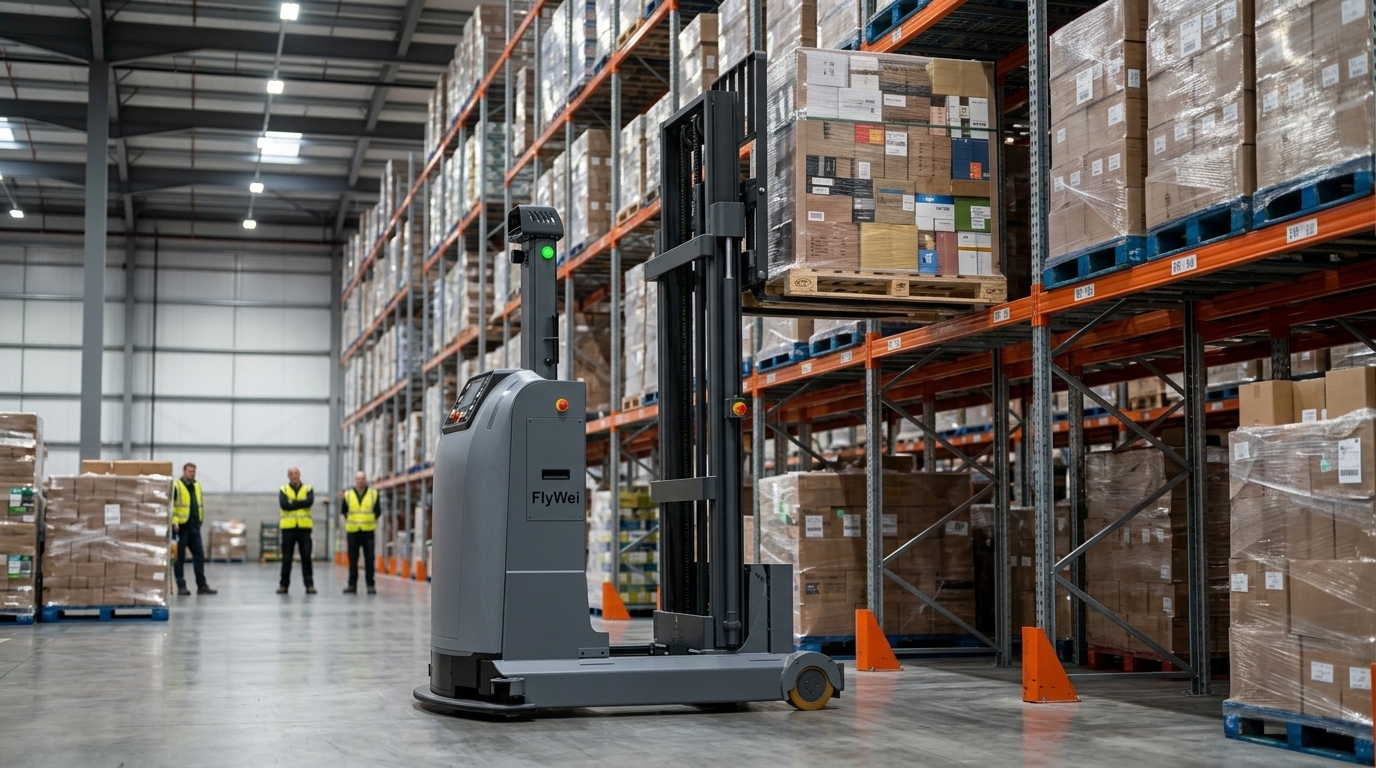
The five articles converge on the same fleet mix: driverless counterbalance forklifts for the trailer-to-rack pallet flow, latent-jacking lifting AMRs (compact units that slide under a wheeled cage or dolly and jack it a few centimetres off the deck) for the mixed-SKU cage flow between goods-in and the pick face, tote-carrying AMRs for the goods-to-person picking cell that compresses picker walking miles, and — in drinks — heavy-lift driverless machines rated up to 1,000 kg for the keg and full-pallet lift. None of those on their own solves the peak. Together, orchestrated as one fleet under one orchestration layer, they do.
The orchestration layer is where the deal actually lives. If each truck talks its own protocol to its own proprietary controller, you have four islands, not a fleet, and the peak-wave choreography breaks the moment one island falls behind. A fleet-manager that speaks a common interoperability protocol — VDA 5050 is the one your vendor should be able to name unprompted — is what lets you run fixed-lane pallet flow and free-navigation cage flow on the same slab at the same instant, and it's what lets you add a second brand of AMR next year without ripping the first one out.
Ask your next vendor: which VDA 5050 version does your fleet manager speak, and can I add a truck from another supplier to the same fleet without a rewrite?
3. You bolt it onto the live floor — the shutdown is the old answer
The capex committee's blocker is nearly always the same: a six-week floor closure to retrofit is a no. Peak is coming. You can't close.
The good news in the field-tested playbooks from last week is that the six-week closure is a legacy assumption. A live UK ambient FMCG distribution centre can now onboard an autonomous fleet on a rolling basis — a fixed-lane corridor gets marked out on Monday, one truck runs in supervised mode from Tuesday, a second truck joins the fleet by end of week, and the 22:00-06:00 replenishment wave is being partly covered by machines within the fortnight. No dark hall, no ripped-up racking, no six-week shutdown.
The precondition is a WMS handshake that isn't hostile to being added to. Your existing warehouse system needs to accept an order-drop from an external fleet manager over a documented interface, and it needs to return task-completion events on the same interface. If it can, the fleet slots in as another set of hands your rota can dispatch to. If it can't, the honest answer is: the WMS is the constraint, not the trucks — and that constraint is usually a configuration project of days, not a re-platforming exercise of quarters.
Ask your next vendor: on a live floor with an existing warehouse system, how many operational days from purchase order to first machine-picked pallet — and what's the integration path, in weeks not months?
4. The overnight wave is where the money is
Every one of the five reads circles back to the same shift: 22:00 to 06:00. It's the wave that clears the racking overnight so the day shift picks against a full face. It's the hardest slot to fill from the agency now, and the one where a single sickness call collapses the plan.
An autonomous fleet doesn't get tired at 03:00. It doesn't call in sick on the second night. It doesn't need a canteen break at 02:30 and a taxi at 06:15. The overnight replenishment wave — pallets from the reserve to the pick face, cages from goods-in to the mezz, empty totes back to the wash — is the flow with the highest labour-cost-per-move in the modern UK DC, and it's the flow where an autonomous fleet is closest to break-even on day one.
The arithmetic that matters here is per-shift, not per-year. If your overnight cost per move is £2.10 today (blended agency rate plus supervisor cover plus loss-of-productivity from the sickness curve) and an autonomous fleet takes that to £0.90 per move on the corridor it's assigned to, the payback window on that corridor is a fraction of a peak season. You don't need the whole DC autonomous to get the money. You need the overnight replenishment corridor autonomous first, and everything else at your own pace.
Ask your next vendor: run the model for the 22:00-06:00 wave in isolation — what's the cost per move today, and what does it become on the corridor you'd deploy first?
5. It has to survive the audit, or the deal dies at the safety officer
The last article in the set was the most read internally, because it names the thing that kills the majority of these deals in the last mile: the safety and compliance audit. Every UK ops director I've spoken to has watched a fleet proposal that made board-level sense die on the safety officer's desk because the machines couldn't evidence conformity to EN ISO 3691-4:2023, or because the PUWER 1998 inspection regime for a driverless truck hadn't been documented, or because the risk assessment for a shared pedestrian-and-machine aisle wasn't in the pack.
Everything you buy this year needs to arrive with the CE pack, the ISO 3691-4:2023 declaration, the PUWER inspection template, and a signed-off shared-aisle risk assessment. Non-negotiable. If a vendor cannot put those four documents on your safety officer's desk in the first sales meeting, the deal will die there in month six. Ask early. Ask before price.
Ask your next vendor: put the CE pack, the ISO 3691-4:2023 declaration, a PUWER inspection template, and a shared-aisle risk assessment on the table at the first meeting — before we talk price.
The arithmetic
- 30-50%: the peak-season throughput uplift a UK FMCG plant is being asked to absorb this autumn without additional certified agency drivers.
- 3x: the Q4 keg-and-pallet throughput a UK drinks distribution centre needs to flex over six-to-eight weeks, against a counterbalance-driver pool that hasn't returned to 2019 levels.
- Up to 1,000 kg per unit: the load a driverless heavy-lift mobile machine now shifts under its own power, without a certified operator in the cab.
- 22:00-06:00: the overnight replenishment wave that costs the most to cover with agency labour and is the fastest corridor to autonomy in cost-per-move terms.
- Days, not weeks: the time from purchase order to first machine-picked pallet on a live UK ambient DC floor, when the warehouse-system integration is documented and the fleet manager speaks a common protocol.
- Top of the HSE table: where forklift movement continues to sit in the workplace-injury data for warehousing — the risk quietly removed every time a driverless truck runs the aisle instead of a driven one.
What to do on Monday morning
- Isolate one overnight corridor. Not the whole DC. Pick the 22:00-06:00 replenishment corridor that has the highest cost-per-move and the smallest number of pedestrian interactions. Model the cost today. Model the cost with two driverless trucks and one lifting AMR on it. Take that single number to your capex committee — not a whole-site business case. Corridors get funded; whole-site programmes get deferred.
- Audit the warehouse-system handshake. Get your warehouse-system vendor on the phone this week and ask, on the record, whether your instance can accept an order-drop from an external fleet manager and return task-completion events on the same interface. If yes, get the interface documented. If no, book the configuration project now — that lead time is your critical path, not the trucks.
- Pull the four safety documents forward. Before you take a single pitch, ask every vendor on your shortlist to send the CE pack, the ISO 3691-4:2023 declaration, a PUWER inspection template and a shared-aisle risk assessment. Any vendor who can't send those in a week is not ready to be on a UK slab this autumn. That single email will shorten your shortlist faster than any RFP.
If you'd like a quiet read of what a mixed open fleet looks like on your specific overnight corridor — the trucks, the AMRs, the orchestration layer, and the four safety documents — reply to this edition or drop me a comment. No pitch, no slide deck. One page, your numbers, your slab.