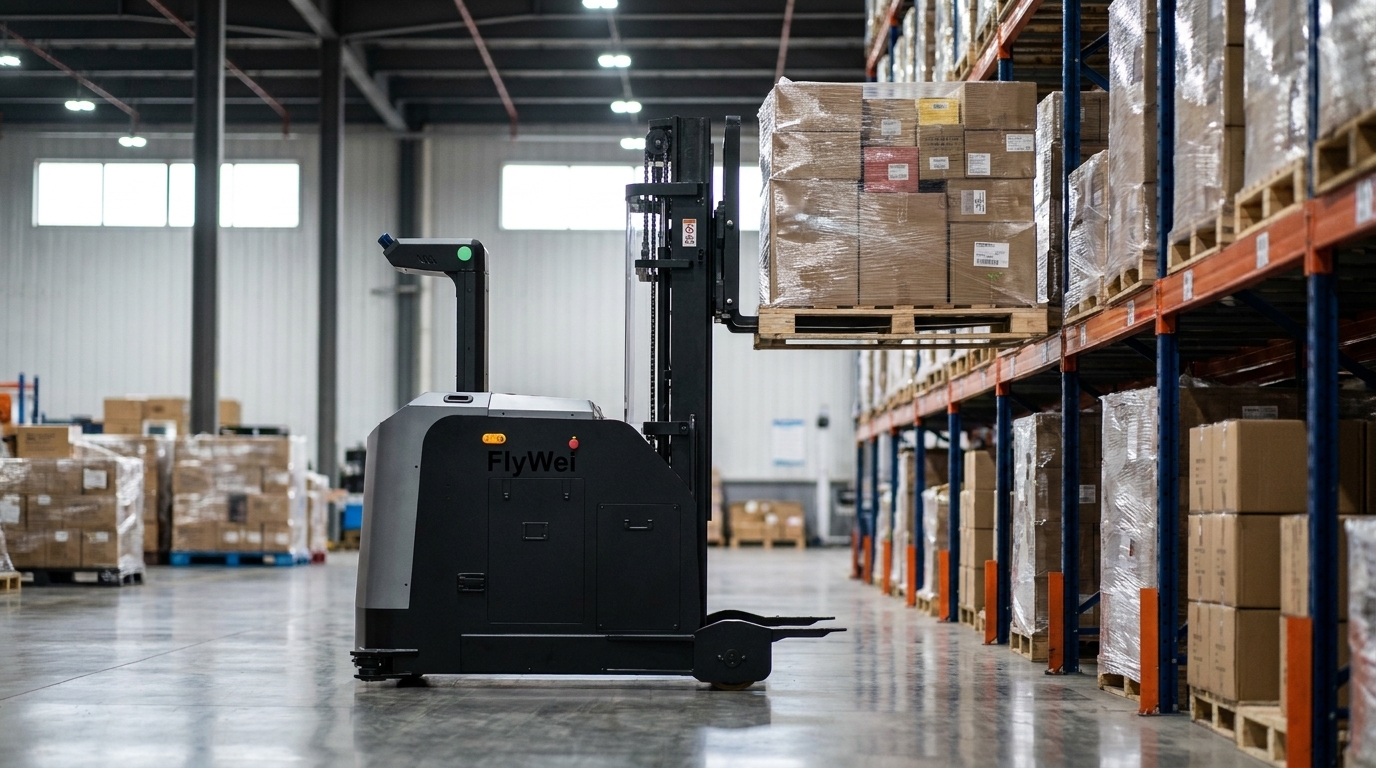
Five reads on the four shapes your capex form isn't asking about — payment, footprint, service, climate — plus one install plan for a live 24/7 slab.
You've had a signed capex request on your desk since Friday for two new counterbalance trucks, and the finance director wants to know why the number is 40% bigger than last year's ask. The honest answer is that your peak swings 30% over your core, your racking is close to full, and your Q4 agency spend has quietly eaten the margin that used to justify the buy in the first place. The capex form has one line for a truck price. It has no line for the shape of your demand, no line for the shape of your footprint, and no line for the shape of your service contract. That's the problem — and the past few days of pieces on The Open Aisle have all been arguing the same thing from different angles.
The truck was never the unit of purchase. The fleet's shape is.
Five reads this week — a UK drinks distributor sizing capacity for peak, a warehouse manager choosing cube storage against a floor AMR retrofit, a 3PL operations director inheriting a contract site, a Swedish cold-chain manager fighting -20C and the Öresund, and a paper-and-packaging DC retrofitting driverless forklifts into a 24/7 live aisle — and every one of them ends up at the same shape question. Below, the four shapes your current capex form isn't asking about, plus one on install — and how each one changes what you sign.
1. The Payment Shape
The UK drinks distributor's demand curve looks like two bumps a year — the June-to-September heatwave push and the six-week Christmas ramp. Between those bumps, in Q1 and late Q4, a fleet sized to peak sits at roughly 60-65% utilisation. If your capex committee approved twelve counterbalance trucks last year to cover the summer heatwave, three to four of them are running below 40% utilisation right now, in July, before autumn kicks in properly. On a five-year book-value schedule that costs somewhere between £38,000 and £46,000 a month in idled chassis depreciation and maintenance floor — before you count the yard footprint they're parked on.
The lever underneath is not the truck spec — it's the invoice cadence. A leased fleet lets you commit to your core (say, twenty trucks) all year, then rent an eight-truck overlay for the twelve highest weeks. The overlay costs a premium of roughly 15-20% per machine-week over the base rate, but you never pay for the four months you don't need it. On the numbers that leaves you, at fleet level, about 12-14% cheaper across the year for the same peak coverage — with the added advantage that the overlay can be resized in either direction next season, and you're not asking the capex committee for a fresh single-year approval each spring.
Ask your vendor: what's your machine-week rate for a twelve-week seasonal overlay, and how much notice do you need to size it up or down between seasons?
2. The Footprint Shape
You've got a proposal on your desk to convert 4,500 sqm of your current pallet-racking floor into a grid-based cube storage system. The pitch reads well — concentrating small-item SKUs into roughly a third of the footprint that pallet racking would consume, freeing 3,000 sqm for either revenue-generating throughput or an outright sublet. The catch is the civil works window: six to eight months of concrete cure, structural steel, fire suppression re-approval and pick-face commissioning, during which the affected footprint is not receiving anything.
Contrast that with a floor AMR retrofit across your live racking. From site survey to first productive shift, four to six weeks. You don't recover the footprint — the pallet aisles stay pallet aisles — but you recover the labour cost of running them, and you stay open the whole time. For a distribution centre whose small-item SKUs are less than roughly 40% of pick lines, the retrofit's payback per square metre wins comfortably. Above 40% small-item, the grid starts pulling ahead — if, and only if, you can survive a season of receipts you can't reallocate to another site.
The framework isn't cube-good versus floor-good. It's whether your SKU mix and your ability to absorb a season of downtime pass together. PUWER 1998 and BS EN ISO 3691-4:2023 apply to both options in different ways — the grid triggers a fresh CDM notification, the floor retrofit triggers a modified-aisle inspection — and the sequence of those approvals is often what actually sets the payback clock, not the vendor's build week.
Ask your vendor: give me the sqm-per-order-line rate for each of my three top movers, at real pick velocity in my building — not the brochure velocity.
3. The Service Shape
If you're an operations director on a UK 3PL contract site, you've probably inherited at least one slab whose flatness measured ±12mm in the reach aisle rather than the ±8mm the spec assumed. You're running three shifts, five clients' WMS instances, and a lease term on the fleet that was fixed at five years when your longest client contract is three-plus-two. Every gap between those lines is a service-shape problem the truck price didn't cost.
The three-shift 3PL sites that sustained above 96% availability in 2026 did it not by buying better trucks but by writing a service contract with three specific lines: a dedicated spare-machine buffer (typically one spare per twelve productive machines), an on-site engineer inside two hours, and a fleet-orchestration layer that doesn't depend on any single vendor's enterprise WMS dialect. That last one matters more than it sounds — if your orchestration only speaks one client's stack, you can't take on a fourth client without a six-month integration project, and the fourth client is where your margin sits.
The trade against a straight capex buy: your monthly service line is fixed, your peak-season overtime spend drops out, and your uptime KPI becomes the OEM's problem. On the sites we've seen, the fixed monthly figure lands roughly 22% below the previous year's blended cost of ownership including agency overtime — but only if the SLA is written with MTTR under 90 minutes, not just an availability target.
Ask your vendor: show me the last three months of MTTR by machine class on a fleet the size of mine, not the blended fleet average across everyone.
4. The Climate and Corridor Shape
Sweden's Nordic distribution centres run into three things at once. The driver shortage — which the Swedish industry body puts north of 4,500 open HGV and MHE seats in 2026 — compounds a -20C to -25C cold-chamber reliability question that de-rates lithium batteries by roughly 30% per cycle, and that in turn compounds the Öresund cross-border cycle-time question every time a trailer heads Danish-side for a cross-dock.
The frame that works, under BS EN ISO 3691-4:2023, is counterbalanced, reach and stacker trucks that navigate independently on repetitive dock-to-stock, cross-dock and cold-storage cycles — leaving the manned trucks for the one-off, mixed-SKU, ambient-only jobs where a human is genuinely faster. The cold-chamber design has two tells: the battery-cycle rating has to be published at -20C ambient, not lab-25C, and the service contract has to name a cold-chamber downtime clause. Neither is standard on a UK-sourced spec sheet, and both quietly determine whether you make cycle-time on the January nights when demand actually spikes.
If your operation crosses a border on the same shift — Öresund, Dover, or Holyhead — the corridor shape shows up as a full extra shift of dwell time when the fleet can't work through the customs handover. The design answer is to hand off the trailer, not the fleet.
Ask your vendor: what's your battery-cycle rating at -20C ambient, and what does your service contract say about cold-chamber downtime in a 24/7 cycle?
5. The Install Shape
The UK paper-and-packaging DC that added driverless forklifts to a 24/7 live aisle didn't stop the line for it. It couldn't — the customer's SLA is on the pallet, not the aisle. The retrofit ran aisle-by-aisle, one shift at a time, at the least-loaded window in the wave. Week one was a safety survey and operator briefing. Week two and three was chevron floor-marking, comms drops and the first PUWER 1998 inspection of the modified aisle by HSE-competent persons. Week four was the first productive shift on a single retrofitted aisle, running alongside manned trucks in the adjacent aisles.
The gain from installing at 04:00 rather than 14:00 was roughly 15% of shift productive time reclaimed across the retrofit, and — more importantly for the ops director — zero customer-facing risk on the days the aisle was going in. The trade-off is that the OEM has to be willing to cost a shift-by-shift install plan rather than a two-week shutdown. A supplier who will only cost the shutdown is a supplier you can't use on a live 24/7 site — regardless of how good their brochure trucks are.
Ask your vendor: give me a day-by-day install plan for a live site running three shifts, and name the shift you cost against.
The Arithmetic
- On a 40-truck fleet peaked for summer and Christmas, running Q1 at 62% utilisation costs roughly £42,000 a month in idled chassis before maintenance-floor overhead.
- A six-to-eight-month civil works window for grid storage is a full season of receipts unavailable to reallocate; a four-to-six-week floor AMR retrofit costs you two shifts of throughput per aisle instead.
- 96%+ availability on a three-shift 3PL contract site means MTTR under 90 minutes — anything longer eats the client's dwell-time SLA before it eats yours.
- A cold-chamber battery de-rating at -20C is the difference between one and two swap cycles per shift; every extra swap costs 22 minutes of productive truck-time on the nights that matter.
- Retrofitting a live aisle at 04:00 rather than 14:00 saves roughly 15% of shift productive time and 100% of the customer-facing risk on install days.
What To Do On Monday Morning
- Pull your fleet's monthly utilisation for the last twelve months. If Q1 utilisation is below 65% of Q4, your capex form is asking the wrong question — ring the channel and ask for a machine-week rate for a twelve-week seasonal overlay before you sign a fresh outright purchase.
- Walk the aisle you were going to squeeze more racking into. Measure the floor flatness with a 4m straight-edge across three points. If it's outside ±8mm anywhere along the pick face, the cube proposal in your inbox is quietly assuming a slab you don't have — and the civil works quote will grow when the surveyor arrives.
- Open your service contract to the availability page. If the number reads "target 95%" without a stated MTTR, that's a marketing line, not an SLA — call your account manager and ask for last quarter's MTTR by machine class on a fleet the size of yours, not the blended fleet average.
If you'd like a quiet read of what an open-fleet design would look like on your slab — one that priced payment shape, footprint shape and service shape as three separate lines — reply to this note or drop a comment below. We'll come with a spreadsheet, not a demo.