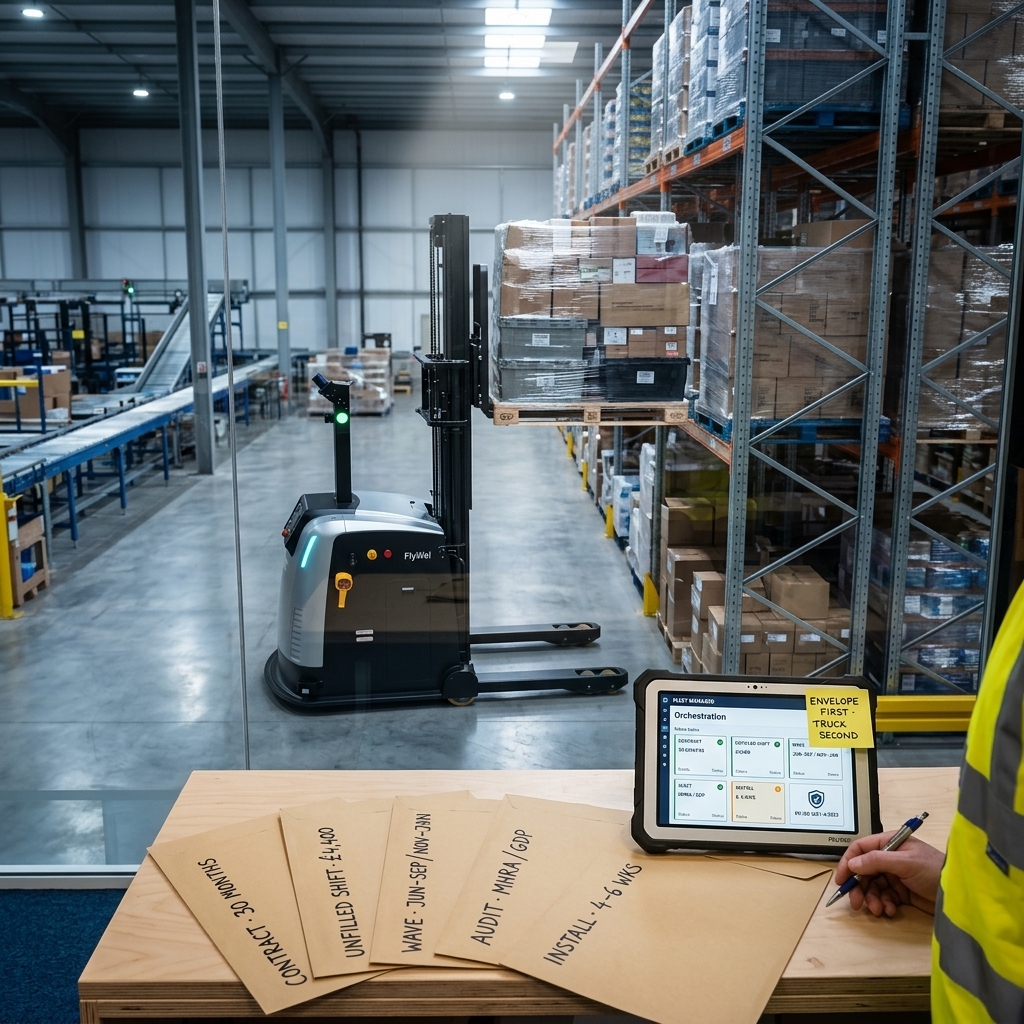
Contract length, shift-cost line, seasonal curve, MHRA compliance line, install window — reshape these before you shop for a robot.
On a Wednesday afternoon in July, a UK warehouse director hands the finance office a business case for four autonomous forklifts. It comes back on Friday with the same three questions it came back with in March, and in November before that. The trucks aren't the problem. The board can see the trucks. What the board can't see is the mismatch between the envelope the trucks have to fit inside — the contract, the shift cost, the seasonal curve, the audit cycle, the install window — and the shape the trucks actually have. That mismatch is where every warehouse-automation case in this country quietly dies.
This week's reads are five envelopes; reshape each one before you touch a spec sheet, and the case writes itself.
1. The contract envelope: 30 months vs 90 months
A modern autonomous counterbalance forklift is a 90-month asset. That is not a marketing number; it is the number the finance director will get from a discounted-cash-flow model when they run it themselves. The average client contract at a British 3PL is 30 months. Sometimes 24, occasionally 36; the median sits at 30. That is a three-to-one mismatch, and it is the reason capex-purchased trucks keep turning up on the stranded-asset list at the year-end review.
The old answer was to lease the truck from a tier-one MHE channel partner, on the vendor's paper, in the vendor's stack. That gets you off the balance sheet, but it doesn't fix the mismatch — it just moves it to somebody else's spreadsheet, and then shows back up in the pass-through pricing at contract renewal. The 2026 answer is different. Full-service leasing on the fleet layer, not the truck layer, means the operator sizes for their core demand — the volume that will still be there in Q1 — and takes overlay units for the wave. When the wave passes, the overlay comes off. When the client contract turns over, the fleet flexes with it.
Question to ask in your next vendor meeting: "Can I return twenty per cent of the fleet at the end of month 30, without a termination fee, if I lose a shipper?" If the answer is a version of "not without renegotiating the whole contract" — you are still shopping the wrong envelope.
2. The shift-cost envelope: £3,600 – £5,200 per unfilled shift
Most FMCG procurement teams still evaluate autonomous forklifts against a benchmark called "the cost of a driver." That is the wrong number. The number that carries the capex case in front of a finance director is not the fully-loaded driver cost. It is the cost of an unfilled counterbalance shift.
In a UK ambient FMCG DC in mid-2026, that number sits at £3,600 to £5,200 per shift. It is made up of three lines. Overtime cover, at time-and-a-third or time-and-a-half. Missed dispatch windows, which show up as service-level penalties on next month's shipper invoice. And elevated incident exposure — because the shift you filled with an agency driver you'd never met at 6am is the shift where the HSE-mandated PUWER pre-use checks get done in ninety seconds instead of six minutes, and the shift where the near-miss report gets written. Multiply £4,400 by the number of unfilled shifts you had in the last twelve weeks, and that is the number a 2026 procurement case has to solve for.
Once that number is on the page, the payback maths change. A single autonomous truck that covers roughly 1.7 shifts a day, five days a week, at £4,400 per unfilled shift avoided, pays back inside twenty months on the shift-cost line alone — before you count damage-rate reduction, before you count throughput uplift, before you count anything the vendor's spec sheet promises.
Question to ask in your next vendor meeting: "What is the number of unfilled counterbalance shifts our site logged in the last quarter, and how many of those would a five-truck autonomous fleet have covered?" If nobody in the room can answer, the case isn't ready yet.
3. The seasonality envelope: buy for the wave, not the peak
If you are a UK drinks distributor, your utilisation chart is two-humped: a summer heatwave hump from mid-June through early September, a Christmas hump from mid-November through the first week of January, and troughs on either side of both. If you buy your MHE fleet to the top of the summer hump, you own thirty to forty per cent idle capacity across Q1 and Q4. That idle capacity is a real number on the depreciation schedule; the finance committee will not sign it off twice.
The fleet operators who are winning the 2026 committee are buying to the wave, not the peak. They size the owned core to the trough. They lease an overlay for the two humps, on twelve-week rolling terms, with a return date in the contract before the first truck arrives on site. The fleet manager treats the overlay units and the core units as the same fleet — same orchestration layer, same status telemetry, same interface into whatever enterprise WMS is upstream. The overlay leaves in October, the depreciation schedule stays honest, and the damage rate on 4-high palletised cases and kegs — normally the first casualty of an untrained peak-cover agency operator — never spikes in the first place.
There is no quiet quarter in UK drinks. There is a wave and there is a trough, and the fleet has to breathe with both.
Question to ask in your next vendor meeting: "What is the shortest lease term you offer on overlay units, and what is the notice period for return?" Twelve weeks and thirty days is the shape the wave is asking for.
4. The audit envelope: compliance line, not cost line
In an MHRA-regulated UK pharma DC, robot servicing is not a maintenance cost line. It is a compliance line, and the difference shows up in the audit report, not the maintenance ledger. An unplanned autonomous-forklift outage in a temperature-controlled pick window doesn't just cost you the pick — it breaks the Good Distribution Practice audit trail, forces manual workarounds with their own PUWER exposure, and lands on the next MHRA inspection as a gap in the qualification file.
That reframes the service contract entirely. The right service SLA for an MHRA site is not "response within four hours." It is "the fleet is qualified as a continuous system, and the service partner holds the qualification evidence current, indexed to the batch record." That is a different conversation, with a different kind of service partner. The tier-one MHE channel isn't set up for it. A specialist open-fleet servicing partner with a UK-based field team and a documented GDP-adjacent servicing protocol is.
The same discipline applies, in different vocabulary, to any regulated food-safe or cold-chain site. The audit is the invoice item. Treat it as one, or find yourself explaining the same maintenance ledger to the finance director on Friday and the inspector on Monday.
Question to ask in your next vendor meeting: "Show me the servicing protocol for a batch-recall-triggered inspection — who signs, on what template, into which file?" If the answer is a service-desk ticketing screenshot, you are still in a cost-line conversation, not a compliance-line one.
5. The install envelope: four weeks vs eight months
The tension inside every 2026 e-commerce warehouse manager's inbox is the same: the racking is maxed, the cube-based storage proposal is on the desk, and there is a Q3 deadline on the business plan for extra capacity. A grid-based ASRS retrofit will consolidate small-item SKUs into roughly a third of the floor area pallet racking would consume. Marvellous. It will also require six to eight months of civil works — resin floors up, new slab in, mezzanines rebuilt — during which the live operation runs at reduced capacity or moves to an overflow site.
A floor-AMR retrofit over the existing live racking, by contrast, can go from initial survey to first productive shift in four to six weeks. It does not consolidate the footprint. It does not reshape the SKU. But it lands productivity onto the slab you already have, without asking the operation to stop breathing.
The point is not that one is better than the other. The point is that the install window is a first-class variable in the business case, and it has to be sized against the operational tolerance for disruption, not against a vendor timeline. A four-week retrofit that closes a capacity gap in Q3 beats a nine-month civil programme that closes a bigger gap in Q3 next year, every time the CFO does the maths.
Question to ask in your next vendor meeting: "From signed order to first productive shift on our live slab — what is the calendar, and what does it cost my operation in disrupted throughput?"
The arithmetic
- 3-to-1 — the mismatch between the median UK 3PL client contract length (30 months) and the useful economic life of a modern autonomous counterbalance forklift (90+ months).
- £3,600 – £5,200 — the fully-loaded cost of a single unfilled counterbalance shift at a UK ambient FMCG DC in mid-2026 (overtime cover + service-level penalty + incident exposure).
- 30 – 40% — the share of a drinks DC's owned MHE fleet that sits idle in Q1 and Q4 when the fleet is sized to the summer/Christmas peak instead of to the core-plus-overlay wave.
- 6-to-8 months vs 4-to-6 weeks — civil-works window for a cube-based grid retrofit vs a floor-AMR retrofit over live UK racking; both real, both auditable, both sized against the same Q3 pressure.
- ~20 months — payback on a single autonomous counterbalance truck when the business case is built on the unfilled-shift-cost line, before damage-rate reduction or throughput uplift is counted.
What to do on Monday morning
- Pull last quarter's unfilled-shift log. Not the cost of a driver. The cost of a *shift you didn't fill*. If your ops director can't produce that number by end of Monday, that is your first job of the week — the business case is downstream of that spreadsheet.
- Print your last twelve months of MHE utilisation as a single line chart and lay it on the finance director's desk. Ask them to draw the "core" line across the trough with a pen. Whatever they draw is the *owned* fleet. Everything above it is an *overlay* conversation, not a capex conversation.
- Ask your current service partner for the servicing protocol that would apply in the event of a batch-recall-triggered inspection, or a HSE-triggered PUWER review. Whatever comes back tells you whether you're in a cost-line conversation or a compliance-line one. Both are legitimate. Only one belongs in the audit file.
If any of this is the shape of a conversation you're already having internally, reply to this edition or drop a comment — we'll send you a quiet, no-pitch design for an open-fleet layer that fits the envelope your operation is already inside. One PDF, one call, then you decide.