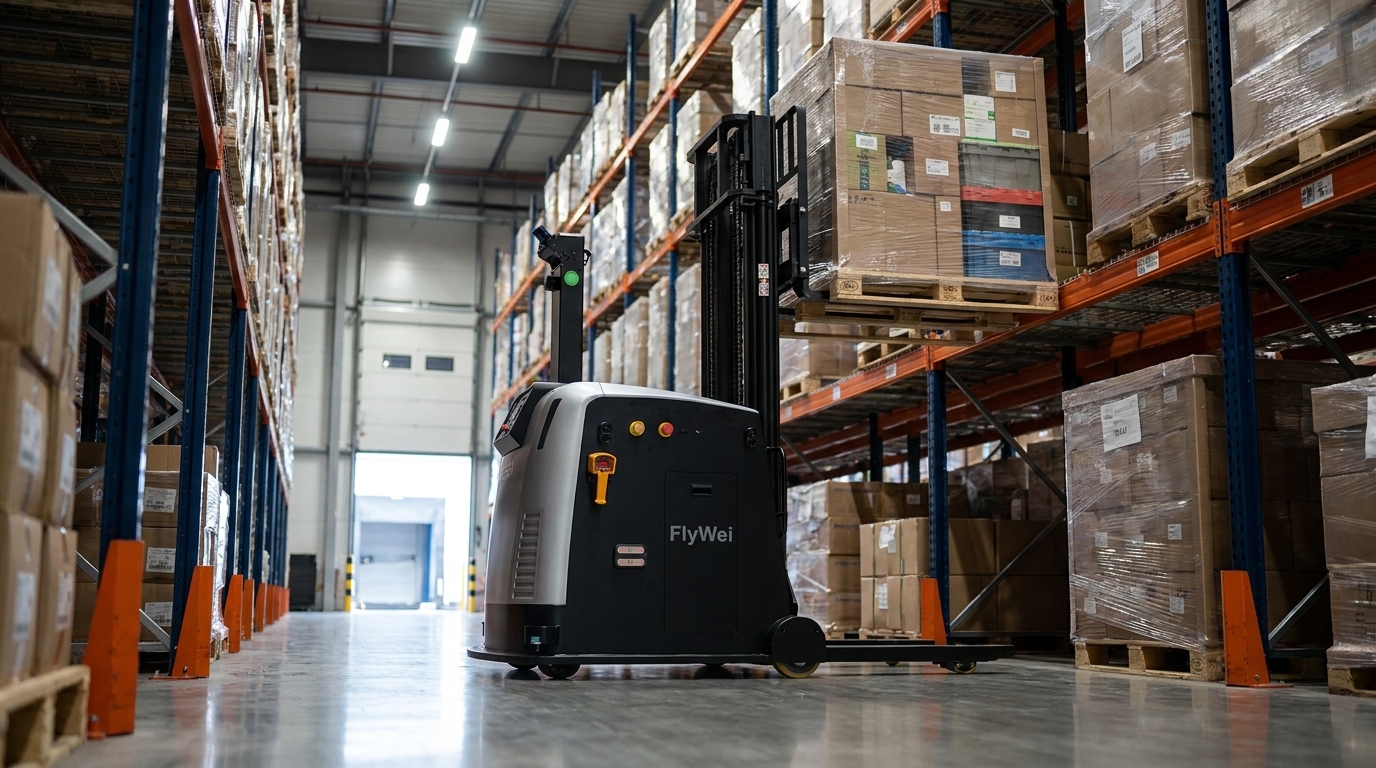
Illustrative sector scenario: this case study is a representative application, not a specific FlyWei client. All figures are indicative engineering capability ranges rather than project results. FlyWei does not publish confidential customer details.
Agricultural machinery distribution is unlike almost any other warehousing operation in the UK. Demand is brutally seasonal, the parts range spans a plough coulter to a tractor bonnet, and every hour lost during spring cultivations or the harvest window has an outsized commercial impact on the dealer network. This illustrative case study looks at how a vendor-neutral autonomous forklift and AMR deployment would typically be scoped for a UK agricultural machinery parts operation, and what a mid-sized distributor should expect from a phased rollout.
Operation profile
- Operator type: a UK regional agricultural machinery parts distributor supplying a dealer branch network and larger arable farms
- Facility footprint: in the region of 8,000–15,000 m² across a main parts hub plus an adjacent yard for whole goods
- Shift pattern: typically single day-shift outside the season, extending to 12–16 hour operation across spring drilling (March–May) and harvest (August–October)
- Throughput band: indicatively 400–1,200 order lines per day off-season, spiking 2–3× during peak windows
- SKU mix: heavy palletised castings, filters, hydraulics, wearing metal, tyres, plus low-turn spares held on very long tails
At-a-glance application snapshot
Typical configurations we would design into a scenario like this — indicative capability envelope, not project results:
- Payload class: autonomous counterbalance and reach trucks in the 1.4–3.0 tonne range, matched to the heaviest routine pallet
- Lift height: typically up to around 6 m for stacker classes and up to 10 m for high-reach applications, which covers most agri-parts racking
- Aisle profile: narrow-aisle-capable variants suited to the 1.6–2.2 m aisles common in retrofitted agricultural machinery stores
- Autonomy stack: SLAM-based navigation, 2D safety laser scanners and SIL 2 functional-safety forklift controllers for shared human/robot zones
- Runtime: in the region of 8–10 hours per charge with opportunity charging on shift breaks — feasible for continuous peak-season operation
- Fleet orchestration: the M4 platform with VDA 5050 interfaces to co-ordinate mixed vehicle classes and future manufacturers on one map
The challenge
Agricultural machinery parts operations are shaped by three recurring problems.
Demand is spiky, not steady. A distributor that ticks along comfortably in January can hit two or three times its daily line count once cultivation and harvest arrive. Hiring a matching flex workforce for a two- to three-month window is difficult, particularly in rural catchments where reach-truck licences are scarce and drivers can often earn more on the farms themselves.
Loads are heavy and awkward. Diff housings, PTO shafts, wheel weights and cultivator legs behave nothing like a fast-moving consumer good. Handling errors are expensive both in stock damage and, more importantly, in near-miss incidents around picking benches and dealer collection lanes.
The long tail is enormous. Dealers must be able to obtain a spare for a twenty-year-old baler on a same-day basis. That drives a warehouse layout with a small population of very fast movers alongside a long back-tail of slow-turn SKUs that still need reliable retrieval whenever they are called.
The solution — a vendor-neutral system design
FlyWei is an independent UK systems integrator, so the design starts with the flow, not the label on the truck. For a UK agricultural machinery parts operation we would typically specify a mixed fleet drawn from the strongest manufacturer for each duty, orchestrated by a single fleet manager.
- Yard and inbound: autonomous counterbalance forklifts in the 2–3 tonne class to break down inbound trailers of whole goods and heavy parts, moving them into the parts hub without a driver on the tarmac in poor weather.
- Bulk put-away and replen: autonomous reach trucks (roughly 1.4 tonne class, high-reach) topping up pick faces from bulk pallet positions and running quietly through the night.
- Goods-to-person picking: lifting AMRs bringing long-tail bin storage to a fixed pack station, so a picker never walks a two-hundred-metre aisle for a single low-turn spare.
- Controls and safety: SIL 2 autonomous forklift controllers plus safety laser scanners for mixed human/robot zones such as the trade counter and dealer collection lanes.
- WMS and ERP integration: orchestration hooks into the parts WMS and dealer ordering ERP, so priority dealer orders can preempt background replenishment work without human intervention.
How a deployment runs
Our engineers typically start a project like this with a two-day site survey: aisle scans, floor-flatness checks, WMS interfaces mapped, and a walk-through of yard traffic patterns with the operations manager. That feeds a digital-twin simulation to right-size the fleet against modelled peak demand — a critical step in agri, where the January picture is misleading. From there, a phased rollout normally begins with one or two vehicles on a well-defined loop (bulk-to-replen is a common first target), followed by a live-ops handover to the customer's shift leaders, and a scale-up before the next peak window opens.
Typical results
Outcomes in this sector are usually a blend of ranged and qualitative, and any specific figure would need to be modelled from your own baseline:
- Peak-season overtime and agency spend typically falls as autonomous vehicles cover the incremental hours.
- Yard-to-store travel time generally reduces as trucks work continuous loops with minimal idle time.
- Damage incidents on heavy castings and tyres tend to drop where robots handle the routine longest-distance moves.
- Operators are typically redeployed to higher-value tasks — dealer counter, quality inspection, kitting — rather than reduced.
- Night-shift running becomes feasible without recruiting a night crew, which is often the deciding factor for a rural site.
What to consider for your site
A short checklist we hand to procurement teams evaluating this scenario:
- What is the ratio of peak to off-season throughput? Anything above 2× makes automation strong on payback drivers alone.
- Are aisles wide enough for a stacker or reach class today, or would racking need adjustment?
- Where does the WMS boundary sit — do dealer orders already carry a priority flag the fleet manager can read?
- Which loops are safest to automate first (bulk replen, yard-to-goods-in) and which should stay manual for now?
- Is a lease-vs-buy conversation live? Full-service leasing shifts an agri-driven capex question into an opex one that aligns with the season.
Explore next
Relevant FlyWei pages for an agricultural machinery parts scenario:
- Autonomous forklifts — counterbalance, reach and stacker classes for heavy parts flow
- Lifting robots and AMRs — goods-to-person for long-tail spares
- Robot controllers — SIL 2 autonomous forklift controls for mixed human/robot zones
- Sector solutions — how mixed fleets are scoped for spiky, seasonal demand
- Leasing — flexible 3-, 5- and 7-year terms suited to seasonal cashflow
Talk to an independent integrator. FlyWei is a vendor-neutral UK systems integrator of autonomous forklifts and AMRs across multiple manufacturers. If you run a UK agricultural machinery parts operation and want to know whether automation is realistic before the next drilling or harvest window, book a free site survey and we will walk your building with you — no obligation, and no committed manufacturer bias.