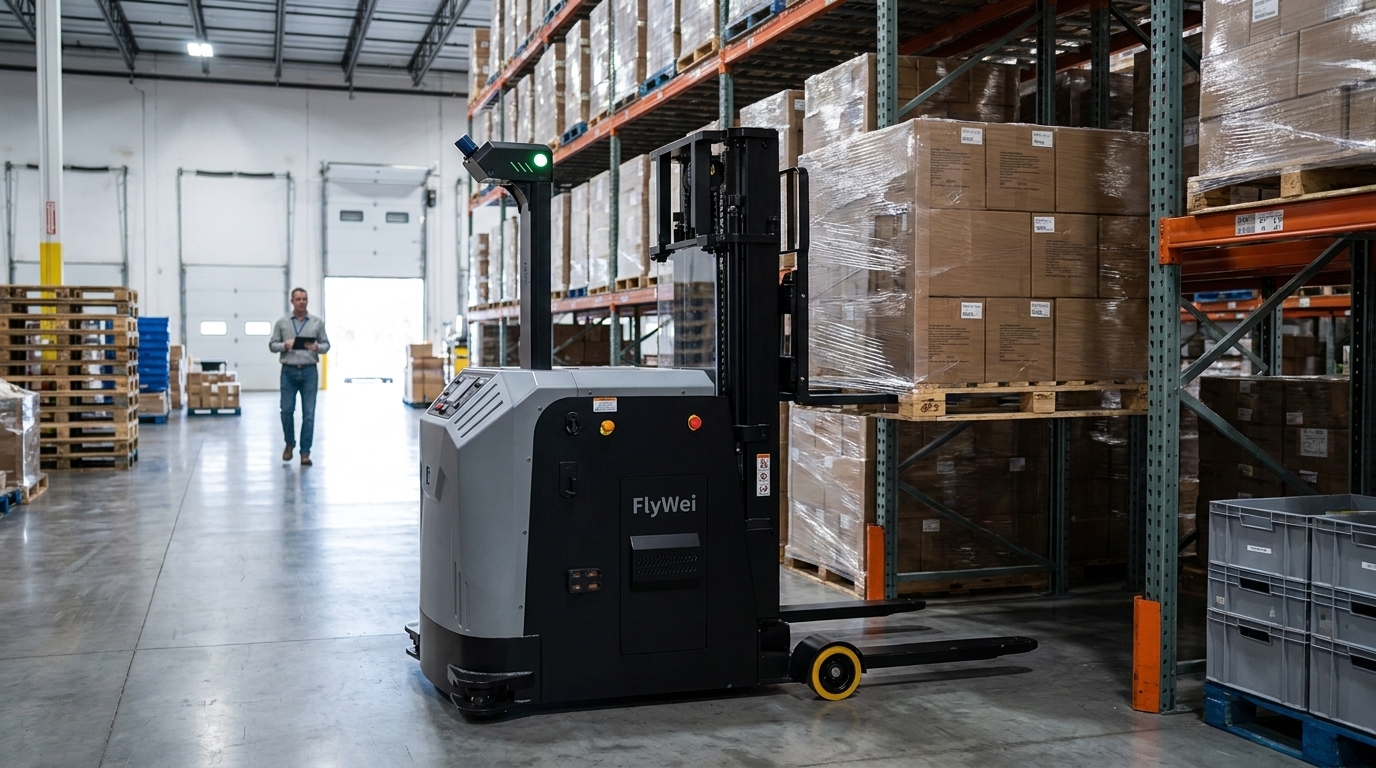
Bakery and snacks warehouses run to a clock that never quite stops. Ovens finish batches through the night, wrappers roar into the small hours, and short-shelf-life pallets need to be off the line and onto a trailer before the next production run overwrites the buffer. Autonomous forklifts and AMRs are increasingly used across UK bakery and snacks sites to keep that flow smooth without pinning three shifts of counterbalance drivers to a single move. This case study is an illustrative walk-through of how FlyWei — an independent, vendor-neutral UK integrator — typically approaches such a project, so operations and engineering teams can picture what a phased deployment looks like on their site.
Illustrative scenario — this article describes a representative UK bakery and snacks operation, not a specific named client. Any figures cited are indicative engineering capability ranges rather than measured project results.
Operation profile (illustrative)
- Operator type: a mid-sized UK bakery and snacks producer supplying grocery multiples, convenience retail and foodservice.
- Site footprint: in the region of 8,000–15,000 m² combined production and finished-goods warehousing under one roof.
- Shift pattern: continuous 24/7 running on the bread and morning-goods lines; two to three shifts on biscuits, crisps and snack packing.
- Throughput band: typically several hundred to a few thousand pallets per day across ambient and temperature-controlled zones.
- Racking mix: block-stacked short-life stock, drive-in racking for cased snacks, and adjustable pallet racking up to roughly 6–10 m for finished goods staged for despatch.
At-a-glance application snapshot
- Robot classes: autonomous counterbalance forklifts and pallet stackers for pallet flow; low-profile jacking AMRs for tote, tray and dolly movement between packing lines.
- Payload range: typically 1.4–3 tonnes per pallet unit; lifting AMRs in the region of 300–600 kg for tray and tote work.
- Lift height range: typically 1.6–6 m for autonomous stackers, up to around 10 m using an autonomous reach configuration for finished-goods put-away.
- Travel speed: typically 1.5–2 m/s, throttled down in mixed-traffic hygiene zones.
- Runtime: generally 8–10 hours per charge, with opportunity charging supporting round-the-clock operation.
- Navigation and safety: SLAM-based LiDAR navigation, safety-rated laser scanners, and open VDA 5050 messaging for multi-vendor fleet orchestration.
The challenge in a UK bakery and snacks environment
A handful of pressures recur across bakery and snacks sites, and any automation design has to answer all of them together rather than one at a time:
- Very short shelf-life on the bread side. Fresh loaves and morning goods can lose a day of sell-by every hour they sit at the end of a line. The manual pallet move from wrapper to despatch buffer is often the real pinch point, not the oven or the wrapper.
- Persistent labour scarcity on nights. UK bakery operators consistently report difficulty recruiting and retaining night-shift counterbalance drivers, and premium rates make every marginal pallet expensive on a Tuesday at 03:00.
- Allergen and hygiene segregation. Nut, gluten, dairy, sesame and other allergens have to be strictly separated. Routes and staging lanes need to be provably deterministic, not driver-improvised on a busy shift.
- Peak surges. Christmas, Easter, back-to-school, and heatwave-driven snack peaks can roughly double throughput for a fortnight. Fixed conveyor and shuttle systems struggle to flex; a rented human fleet flexes but at a rising cost.
- Retail-ready mixed pallet builds. Multiples increasingly want cross-category retail-ready pallets — a workload that suits AMR-based goods-to-person or robot-assisted layer picking rather than a driver chasing a paper pick note.
- Flour dust and wash-down zones. Any robot has to cope with sensible ingress ratings, the occasional damp floor near the CIP zone, and calibration in a slightly dusty environment.
The solution — a vendor-neutral system design
FlyWei operates as an independent integrator rather than a single-manufacturer reseller for precisely a scenario like this: no one robot family is best at every move on a bakery site, and the best long-term result usually blends manufacturers under one orchestration layer. A typical vendor-neutral design combines:
- Autonomous counterbalance forklifts in the 2–3 tonne class for line-end pallet pick-up, transport to the despatch buffer and trailer loading. Continuous night running is generally where these earn their keep first.
- Autonomous pallet stackers and driverless narrow-aisle trucks for finished-goods put-away into adjustable pallet racking up to around 6 m, with autonomous reach trucks handling the higher-bay work up to about 10 m.
- Low-profile jacking AMRs for tote, tray and dolly flow between primary packing, secondary packaging and outfeed — the kind of short, repetitive move that ties up trolleys and people on every bakery site we survey.
- A multi-vendor fleet manager that talks to every robot on the floor through the open VDA 5050 standard, so the operator is not locked to a single manufacturer for future expansion, spares, or a change of mind three years in.
- Integration into the existing WMS, ERP and PLC layer — order releases, line status, batch codes and despatch waves all drive the fleet, rather than the fleet running as an island alongside the real business systems.
How a deployment typically runs
- Free site survey. Independent FlyWei engineers walk the floor, map current pallet movements by time of day, and identify the top three to five candidate routes where autonomy pays back fastest. Traffic, floor condition, dust, floor loadings, IT interfaces and fire-lane constraints are all in scope.
- Simulation. Movement data is played through a fleet simulator to size the robot mix. This is generally where a bakery client first sees the difference between one heroic forklift working flat out and a smaller fleet flexing gracefully to peak.
- Phased pilot. Typically two to four robots are deployed on the highest-value loop first — often line-end to despatch buffer at night — with human operators still in the mix for the day shift.
- Progressive rollout. Additional routes, robot classes and integrations are layered in agreed waves so each stage delivers a measurable operational gain before the next investment is committed.
- Live operations and service. UK-based support, remote diagnostics, planned maintenance and spares are managed by FlyWei as a single point of contact, regardless of which manufacturer built which robot on the floor.
Typical results (indicative and qualitative)
- Operators are typically redeployed from night-shift counterbalance driving into higher-value roles — line-end quality, changeover support, despatch checking.
- Deterministic routing tends to reduce allergen cross-contact risk versus improvised driver routes, because the fleet manager can simply refuse a move that crosses an allergen boundary.
- Night-shift running becomes routinely feasible without premium recruitment, which flattens the labour cost curve during peak weeks.
- Peak-week flex generally improves because adding a robot to an existing fleet is quicker than onboarding a temporary driver, and does not depend on the local labour market.
- Line-end buffers tend to run leaner because pallet clearance becomes predictable rather than driver-dependent, which frees floor space that was previously acting as a shock absorber.
Any specific figure — pallet moves per hour, throughput lift, labour hours saved — depends heavily on the site's baseline and product mix. FlyWei publishes those numbers only after a site survey and simulation for the actual operation; anything else would be marketing rather than engineering.
What to consider for your bakery or snacks site
- Which single loop — line-end to despatch buffer, ambient store to trailer, packing to secondary packaging — is your most predictable and most under-resourced today?
- Are you already running 24/7 on bread lines, or are you underusing the night on snacks lines because of labour cost rather than production capability?
- Is your allergen segregation currently procedural (driver-enforced) or physical (routing-enforced)? Autonomous fleets can make it the latter by default.
- What is your peak-week throughput as a multiple of average? A fleet-based, driverless design earns its money on precisely that ratio.
- Do you want to own the fleet outright, lease it over 3–7 years, or run robotics as an operating cost? FlyWei supports each of those commercial routes.
Learn more
Related pages on our site:
- Autonomous forklifts, pallet stackers and reach trucks
- Lifting robots and AMRs for tote and tray flow
- Safety-rated AMR and autonomous forklift controllers
- Solutions by intralogistics application
- Autonomous forklift and AMR leasing in the UK
Book a free site survey. Because FlyWei is an independent, vendor-neutral integrator rather than a manufacturer, the initial survey is genuinely diagnostic — recommended robots come from whichever manufacturer best fits your bakery or snacks site, not from a fixed catalogue. Get in touch to arrange a walk-through with a UK engineer.