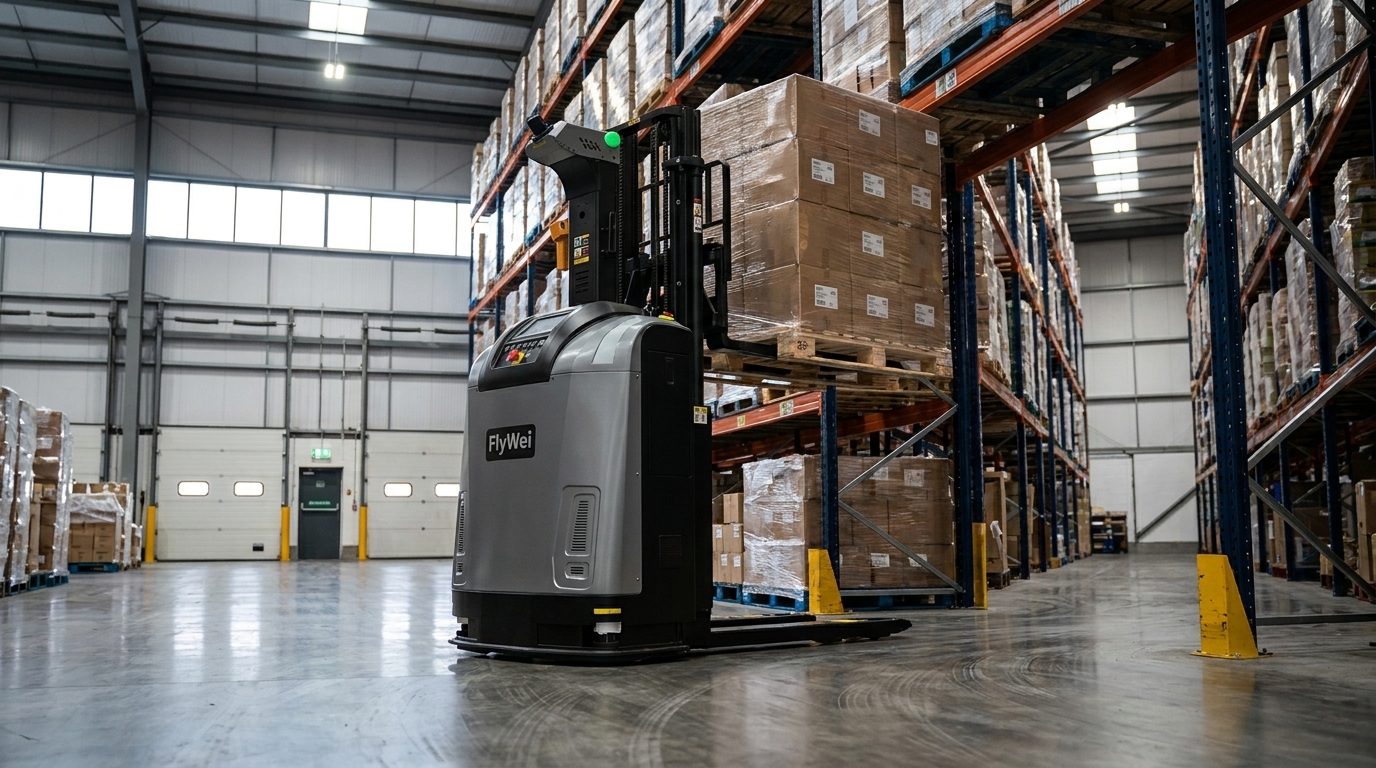
Beer and cider are heavy, awkward, sometimes cold, and — during festival and Christmas peaks — needed in every quantity all at once. For a UK brewery running a bottling line, a keg wash and a small distribution yard from one site, the intralogistics job is not glamorous but it is decisive: pallets of empties in, pallets of finished goods out, dozens of times a shift. This illustrative case study looks at how a mid-sized UK brewery typically automates that flow using autonomous forklifts and AMRs sourced across multiple manufacturers, and what a phased rollout usually looks like on the ground.
Illustrative scenario. This case study describes how autonomous forklift and AMR automation typically works for a UK brewery operation. It does not describe a specific FlyWei client, and any figures given are indicative capability ranges rather than project results.
Operation profile
- Sector: Beverage & brewing — cask, keg and bottled beer or cider.
- Site: A UK regional craft brewery with an on-site bottling and kegging line, chilled bright-beer tanks and an ambient finished-goods warehouse.
- Approximate scale: in the region of 30,000–60,000 hectolitres per year; typically 8,000–15,000 pallet moves per month across production, warehouse and dispatch.
- Shift pattern: commonly two production shifts, plus a lighter night shift for line cleaning, keg wash and pre-picking.
- Physical constraints: mixed floor conditions (wet zone around the bottling line, warmer racking area, chilled cellar) and aisle widths that were never designed for a full-size counterbalance.
At-a-glance application snapshot
The figures below are indicative capability ranges for the class of autonomous forklift and AMR usually chosen for a brewery of this size. They describe what the equipment is designed to do, not a promised project outcome.
- Payload class: typically 1.4–3.0 tonne autonomous pallet trucks for empty kegs and finished pallets; 400–1,000 kg lifting AMRs for tote-scale ingredient and small-parts moves.
- Lift height: commonly 1.6–6.0 m for stacker variants used to feed racking and rework buffers.
- Travel speed: in the region of 1.2–2.0 m/s in shared aisles, slowing automatically in mixed-traffic and wet zones.
- Runtime: typically an 8–10 hour continuous shift with opportunity charging between waves; LiFePO₄ battery chemistries are the norm.
- Aisle width: narrow-aisle autonomous stackers can operate from about 1.6 m; very-narrow-aisle designs go tighter still where racking already exists.
- Environment: engineered for wet-floor conditions around bottling and keg wash, and for the moderate temperature swings between cellar and ambient store.
The challenge
Breweries are one of the harder places to run manual forklifts safely. Floors get wet around the line. Kegs — full or empty — are heavy and roll if mishandled. Pallets of glass bottles are unforgiving. The typical pain points a brewery operations manager will recognise:
- Labour scarcity and shift cover. Trained counterbalance drivers are hard to hire in every UK region, and the night keg-wash shift is often the hardest to staff.
- Manual pallet-handling risk. Kegs, glass and shrink-wrapped stacks create musculoskeletal risk that no amount of PPE fully removes.
- Line starvation and dispatch delays. When one driver is on break, the bottling line waits or the loading bay backs up — and both costs are usually hidden inside the shift report.
- Seasonality. Summer festivals, sporting events and Christmas each spike keg demand in ways temporary labour cannot always cover.
- Traceability. Batch and best-before tracking must survive every internal move, which paper-driven handling tends to break under peak load.
The solution — vendor-neutral by design
As an independent UK integrator, FlyWei starts from the process rather than from a single manufacturer''s catalogue. A brewery of this size typically ends up with a mixed fleet:
- An autonomous pallet truck or automated guided forklift — often a driverless 1.4–2.0 tonne stacker — moving empty kegs from the wash to the fill line and finished pallets from the line to the ambient store.
- A narrow-aisle autonomous stacker for the racking bays, chosen for aisle-width compatibility rather than badge.
- A smaller lifting robot or AMR for ingredient totes, closures, labels and small-parts kitting between the store and the line.
- A functional-safety controller and fleet manager that speaks to the site WMS/ERP and the bottling-line PLC, so pallet identities and batch codes travel with each move.
Because FlyWei is not tied to one OEM, the class of truck for each task is chosen on capability — payload, mast height, aisle width, wet-floor rating, battery chemistry — rather than on what any single manufacturer happens to sell. That vendor-neutral posture is what usually separates a working brewery deployment from a stalled one.
How a deployment typically runs
- Site survey. A free FlyWei survey walks the brewery end to end: floor conditions, aisle geometry, bottling-line cadence, keg-wash cycle, cellar chill zones and dispatch bay flows.
- Simulation. Movements are modelled against real shift data so the mix of trucks, charge stations and routes can be sized before any hardware arrives.
- Phased rollout. Automation usually starts on the most repetitive, lowest-variability leg — commonly the finished-pallet loop from line to ambient store — and only then extends to keg wash, dispatch and ingredient handling.
- Live operations. Fleet manager, WMS and line PLC exchange status continuously; human forklift drivers are redeployed to higher-value tasks (line changeovers, dispatch marshalling, quality checks).
- Scale. Additional units are added seasonally or as new SKUs land, without reworking the software layer.
Typical results
- Manual handling of full kegs and glass pallets is typically reduced substantially, particularly on night and weekend shifts.
- Line-starvation events generally fall as the pallet-to-line loop becomes deterministic.
- Night-shift running for the keg wash and pre-picking becomes feasible without additional headcount.
- Batch and best-before traceability tends to improve as each move is system-logged rather than paper-logged.
- Operators are usually redeployed rather than displaced — moving from repetitive pallet cycles to line supervision, dispatch and quality roles.
None of the above are fixed numbers: they describe the direction of travel a brewery of this profile typically sees. A site survey turns them into a defensible business case for a specific brewery.
What to consider for your site
- Which loops are the most repetitive today — and therefore the easiest first candidates for automation?
- Where does the bottling line actually stall, and is the root cause pallet supply or something upstream?
- What is the wet-floor and chill map of your site, and does it constrain truck class choice?
- Do your existing racks and aisles suit narrow-aisle or very-narrow-aisle automation?
- Is the operation more suited to long-term leasing than outright purchase, particularly if seasonal peaks drive the sizing?
- Which of the sector solutions most closely mirrors your bottling, kegging and dispatch flow?
Talk to an independent integrator
FlyWei is a UK systems integrator of autonomous forklifts and AMRs. We are vendor-neutral: we specify and integrate the class of truck each task actually needs, across manufacturers, and we back the result with a UK service footprint. If you would like an independent read on where automation could earn its keep in your brewery, book a free site survey and we will walk your site with you.