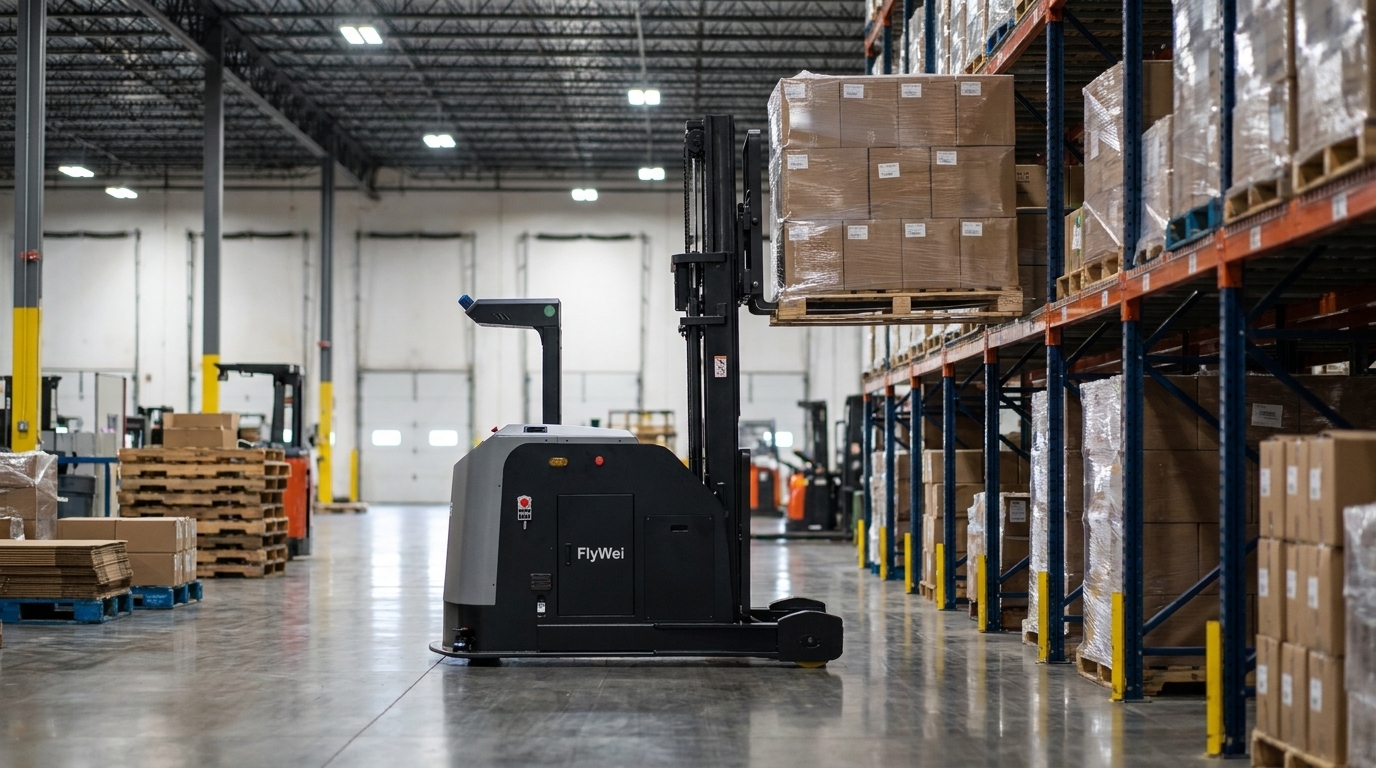
Chilled dairy distribution is one of the least forgiving corners of UK intralogistics. Pallets are heavy, throughput is time-critical, temperatures sit somewhere between +2 °C and +8 °C, and every extra minute a pallet spends outside its temperature band puts a shelf-life clock under pressure. It is also one of the sectors where autonomous forklifts and driverless pallet trucks now earn their place fastest — not by removing people, but by removing the repetitive, cold, high-mileage moves that no operator wants to spend a twelve-hour shift doing.
Illustrative scenario: This case study describes how FlyWei typically integrates autonomous forklifts and automated pallet handling for a UK dairy chilled distribution operation. It is a representative example based on our engineering experience; it does not describe or identify any specific FlyWei client, and any operator details and figures should be read as indicative capability ranges rather than a real project result.
Operation profile
- Operator type: A mid-sized UK dairy chilled distribution centre serving supermarket regional DCs and independent retail customers.
- Site footprint: Approximately 8,000–15,000 m² of chilled warehousing, plus a small ambient staging area.
- Temperature bands: Chilled +2 °C to +8 °C, with a small +10 °C to +14 °C dispatch buffer.
- Shift pattern: Two full production shifts with a third overnight replenishment and dispatch window.
- Pallet throughput band: In the region of 800–1,600 pallet moves per 24 hours across inbound, put-away, replenishment and dispatch.
- Predominant load: Full and mixed standard pool pallets of shrink-wrapped dairy — milk, yoghurt, cream, cheese, butter.
At-a-glance application snapshot
- Fleet class typically deployed: A mix of autonomous counterbalance forklifts (2–3 tonne capacity band), driverless pallet trucks (1.5–2 tonne band) and, where the racking suits it, narrow-aisle autonomous pallet stackers.
- Typical lift heights covered: Ground level to around 6 m, occasionally 8–10 m in high-bay chilled zones.
- Typical travel speeds: In the region of 1.5–2 m/s on straight main aisles, dropping to sub-1 m/s in cross-aisles and pick faces.
- Runtime between opportunity charges: Typically 4–8 hours on lithium iron phosphate (LFP) batteries; opportunity-charged during natural dwell.
- Aisle widths supported: From wide 3.5 m mainlines down to narrow-aisle 1.9 m configurations, depending on truck class.
- Cold-chain suitability: Sealed drives, condensation-managed control cabinets and rated lubricants for continuous chilled duty.
The challenge every UK dairy DC recognises
Dairy chilled sites share a familiar shape of pain. Manual pallet drivers are hard to recruit and harder to retain — chilled conditions, night shifts and repetitive counterbalance work push turnover well above the wider warehousing average. Peak load is unforgiving: a supermarket wave of orders can double dispatch throughput inside a two-hour window, and every pallet late from the chill store bleeds into the transport slot behind it. Yard congestion at inbound tips the same balance the other way at 05:00.
Alongside the labour picture, chilled dairy DCs typically face three structural constraints:
- Temperature integrity. Every pallet that dwells on a marshalling lane is a pallet drifting up the temperature graph.
- Traceability. Batch codes, best-before windows and rotation rules make FEFO (first-expiry-first-out) discipline non-negotiable.
- Space. Chilled cubic metres are expensive; racking density and aisle width are usually already tight.
The solution: a vendor-neutral autonomous fleet built around the site
FlyWei is an independent UK integrator of autonomous forklifts and AMRs — we are not tied to any single robot manufacturer. That matters in dairy because no single truck class handles every move on a chilled site well. A typical dairy design pulls from several manufacturers to match each move to the right robot:
- Autonomous counterbalance forklifts for inbound tipping and dispatch marshalling, where full-pallet lifts of 2–3 tonnes off trailers are the norm.
- Driverless pallet trucks (AGV forklifts) for the long, repetitive horizontal moves between chill stores, pick faces and marshalling lanes.
- Narrow-aisle autonomous pallet stackers where racking density matters more than reach height, typically for chilled ambient overflow and cheese maturation stock.
- Latent-jacking AMRs where dolly and roll-cage flows feed a goods-to-person pick station for the mixed-dairy pick line.
All of these plug into a single fleet manager and a single interface to the existing WMS, so operators, planners and the QA team see one live picture of the chilled floor regardless of the robot brand underneath. Integration is where our vendor-neutral posture usually pays off: rather than pushing the site into a proprietary orchestration layer, we adapt to whatever WMS, ERP or PLC stack is already running the DC — VDA 5050 where it fits, direct APIs where it does not. Nothing about the fleet locks the operator into a single supplier for the next refresh cycle.
How a deployment typically runs
- Free site survey. Our engineers walk the chilled aisles, log floor flatness and joint conditions, measure aisle widths cold and warm (dairy DCs move noticeably between empty and stocked states), and time the current manual pallet cycles.
- Simulation and truck selection. We simulate the target pallet flow against several truck-class combinations and settle on the smallest fleet that meets peak dispatch — not the biggest.
- Phased rollout. A first live pod usually covers one repetitive route — often chill-store-to-marshalling — running alongside manual trucks for four to six weeks. Once the pod is stable, additional routes are added in fortnightly increments.
- Live operations and continuous tuning. Fleet behaviour is tuned against real pallet mix, real yard patterns and real temperature dwell data.
- Scale-out. Once one shift is stable, we typically extend across the third overnight window first — because that is where the labour scarcity bites hardest.
Typical results a UK dairy operator can expect
Because this is an illustrative scenario, the outcomes below are described as capability ranges and qualitative shifts rather than single-point numbers:
- Chilled travel time typically falls on the repetitive routes as autonomous trucks run at consistent speed and take consistent paths.
- Night-shift running becomes genuinely feasible without a full complement of drivers, which for many dairy DCs is the deciding factor.
- Operators are usually redeployed from repetitive counterbalance work into higher-value tasks — QA checks, break-bulk picking, exception handling and yard coordination.
- Peak-dispatch resilience typically improves: the fleet does not slow down when a wave hits, so the transport-slot cascade behind it holds.
- Pallet damage and near-miss reports generally trend downwards as consistent lift geometry replaces variable manual technique.
- Temperature dwell on marshalling lanes usually shortens because dispatch pods keep running while the manual team focuses on order build.
What to consider for your own dairy site
If you are evaluating autonomous pallet handling for a chilled dairy DC, a short readiness checklist usually saves months of scope drift:
- Is your floor flatness within the tolerance band an autonomous truck expects, particularly at chill-store thresholds and dock levellers?
- Do your aisles run cold-and-loaded at the widths on the drawings, or has racking crept in over years of stock growth?
- Is your WMS able to expose real-time move requests, or will orchestration need a middleware layer?
- Where is your labour scarcity worst — night dispatch, weekend replenishment, holiday cover? That is usually where the first pod pays back fastest.
- What is your realistic peak-dispatch profile, not your average? Fleet sizing lives at peak.
- Are you funding the fleet as capex, or would a leasing arrangement better fit a chilled-site refresh cycle?
Our engineers typically start a UK dairy project with a free on-site survey and a written recommendation — including whether autonomous forklifts are the right answer at all. Sometimes the honest answer for a chilled site is a hybrid deployment with fewer robots than a single-manufacturer brochure would suggest; a vendor-neutral integrator can tell you that without a quota to defend.
Read more about our capability across chilled and dairy sites on our autonomous forklifts, lifting robots and controllers pages, or see how UK operators are structuring the commercials on our leasing page and across the wider solutions library.
Book a free site survey. Talk to an independent UK integrator about how autonomous forklifts and driverless pallet trucks could fit your dairy chilled operation — no manufacturer bias, no obligation, just an honest engineering view of your floor.