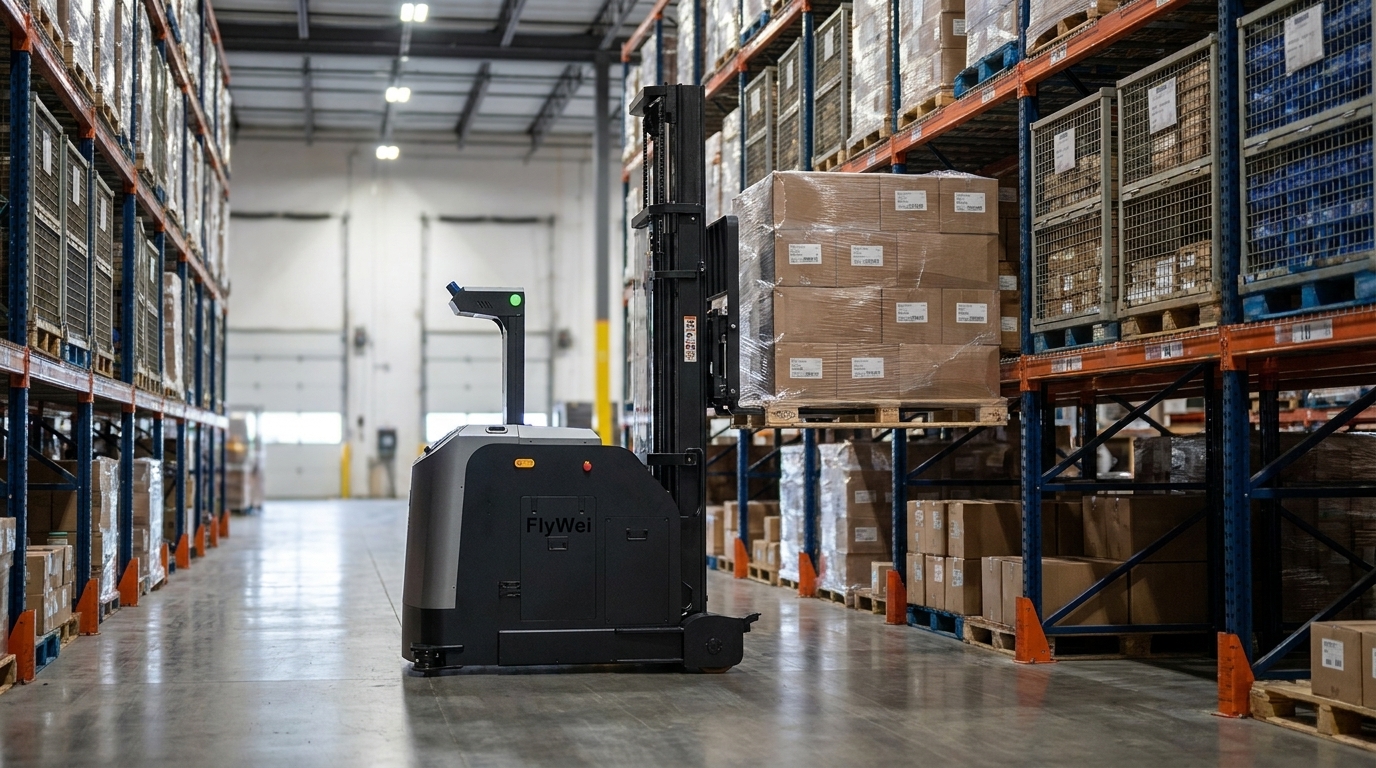
Illustrative case study. This article describes a representative UK paper, print and packaging operation to show how autonomous forklift and mobile robot automation typically works in the sector. It is not a named-client reference; figures shown are indicative capability ranges, not project-specific measurements.
Few production environments generate as much internal transport work — per square metre, per shift — as a paper, print and packaging site. Reels come off the goods-in dock at 800–1,500 kg apiece, converting lines swallow them faster than a manual forklift fleet can feed them, and every finished pallet of cartons, labels or folding boxes has to be walked from the end of a press to a shipping lane that never stops moving. On a 24/7 site, the same three or four counterbalance trucks and reach trucks make thousands of near-identical trips a week — and the operators driving them are among the hardest UK material-handling roles to hire and retain.
The pattern below shows how an independent, vendor-neutral UK integrator like FlyWei Robotics typically approaches that problem: a mix of autonomous forklifts, driverless pallet stackers and lifting AMRs chosen across multiple manufacturers to match the actual loads, the actual aisles and the actual WMS — rather than the catalogue of a single OEM.
Operation profile (illustrative)
- Sector: UK paper, print and packaging — folding cartons, corrugated packaging and reel-fed print
- Site scale band: a mid-sized converting and finishing plant, in the region of 12,000–25,000 m² under one roof
- Shift pattern: continuous three-shift, five to seven days a week, with two annual peaks (Q3 back-to-school stationery, Q4 fast-moving consumer goods packaging)
- Throughput band: a few hundred inbound reels per week and several thousand outbound pallets, mixed sizes
- Existing kit: manual counterbalance trucks, reach trucks and pedestrian pallet trucks — no fixed conveying between the presses and the shipping bays
At-a-glance application snapshot (typical / indicative ranges)
- Autonomous counterbalance forklifts rated for 1.4–3 tonne payloads, appropriate for standard UK paper reels and stacked-pallet handling
- Autonomous reach trucks capable of lifting to approximately 6–10 m, matched to typical UK reach and narrow-aisle racking
- Autonomous pallet stackers for cross-shop movement, working in aisle widths of roughly 1.8–2.5 m
- Continuous runtime bands of 8–10 hours per charge, with opportunity charging supporting 24/7 operation
- Onboard 3D and safety LiDAR delivering Cat 3 / PL d compliant person detection at production-floor speeds
These are engineering capability ranges, not measured project results. Actual figures depend on load mix, aisle geometry and WMS behaviour, and would be modelled during a site survey.
The challenge: a plant that never stops, and a labour pool that keeps shrinking
Paper, print and packaging sites have a particular flavour of intralogistics pain. Reels are heavy, awkward and expensive to damage. Presses and die-cutters cannot be starved of substrate for more than a few minutes without a real cost. Finished pallets stack up at the end of every converting line, and the shipping bay wants them in a specific despatch order that changes with every trailer. Layered on top is a workforce challenge — night-shift forklift operators are among the hardest UK material-handling roles to recruit for — so the maths of simply adding one more manual truck rarely balances.
Common pressure points our engineers typically see on a site walk:
- Reel-to-press feed that depends on one or two experienced drivers who know the running order by memory
- End-of-line pallet build-up where a completed pallet sits under a press waiting for the next available truck
- Damage costs from tight-aisle manoeuvring around finished cartons and print work
- Peak-season overtime and agency cover that quietly cost more than a dedicated automation fleet
- Silo of MHE data — no single view of what each truck actually did last shift
The solution: a vendor-neutral autonomous fleet
Because FlyWei is an independent UK systems integrator — not tied to any single autonomous forklift manufacturer — the fleet design starts with the loads and the layout, not a product catalogue. In a typical paper, print and packaging deployment, three complementary vehicle classes tend to earn their place:
- Autonomous counterbalance forklifts (1.4–3 tonne) for reel handling at goods-in and reel-to-press moves. Reel clamps or roll cradles are specified per site.
- Autonomous reach trucks (up to ~10 m) for putaway of finished pallets into high racking, working the same aisles a human reach truck would.
- Autonomous pallet stackers and lifting AMRs for the long, repetitive point-to-point runs between converting lines, quality-hold areas and the despatch bay.
All vehicles share a single fleet-management layer, with a documented integration path into the common WMS, ERP and PLC systems found in UK print plants (SAP, Manhattan, Blue Yonder, Oracle and mid-market platforms alike). Safety architecture is designed to Cat 3 / PL d using industry-standard multi-plane LiDAR, so the fleet can share aisles with people, manual pedestrian pallet trucks and, where necessary, human-driven trucks throughout the transition period.
Because the design is vendor-neutral, a counterbalance truck from one manufacturer can sit inside the same fleet controller as a reach truck from another and a lifting AMR from a third — each chosen because it happens to be the best fit for that specific task, not because it was in the same brochure.
How a deployment typically runs
- Free site survey. An engineering visit maps aisle widths, floor conditions, racking, dock activity, WMS/ERP touchpoints and dust and humidity exposure.
- Simulation and fleet sizing. A digital twin of the flow — reels in, presses fed, pallets out — sizes the fleet to the shift pattern, not just the peak hour.
- Phased rollout. A first cell (commonly end-of-line to bulk store, or reel-to-press) proves the integration; further vehicles are added as tasks are handed over.
- Live operation. The fleet runs unattended overnight and alongside operators on day shift; a live dashboard reports mission counts, utilisation and battery state of every truck.
- Scale and lease options. Additional trucks — often from a different manufacturer within the same fleet controller — can be added under a full-service lease so capex is not a barrier to expansion.
Typical results (qualitative)
Paper, print and packaging operators that automate this way generally see a similar shape of change:
- Night and weekend intralogistics that run without dedicated drivers, freeing scarce operators for skilled roles on the production floor
- More consistent press feed, because the autonomous fleet does not tire, forget or take breaks
- Fewer damaged cartons and reels from tight-aisle manoeuvres
- A visible reduction in peak-season overtime and agency cover
- A single data record of every load moved on site — useful for continuous-improvement and OEE teams
No single-point figures are quoted here on purpose: real numbers depend on the site, the SKU mix and the WMS. What we can commit to is that the sizing simulation names the range you should expect before you sign anything.
What to consider for your site
- Are more than 30% of your forklift moves the same trip, repeated many times per shift?
- Do you run three shifts and struggle to fill night-shift driver rotas?
- Is damage to reels or finished cartons a recurring quality-cost line item?
- Do you have a WMS or ERP that already knows where a load should go — but no automation to move it?
- Would a full-service lease (fleet plus software plus service plus swap-outs) be commercially cleaner than a capital purchase?
If two or more of these are yes, an independent site survey is usually the fastest way to answer whether the numbers work at your address.
Related FlyWei pages
- Autonomous forklifts — counterbalance, reach and pallet-truck fleets
- Lifting robots and AMRs — jacking, tote and roll-cage handling
- Robot controllers — safety-rated fleet controllers
- Sector solutions — intralogistics for UK operators
- Leasing and Robotics-as-a-Service — 3, 5 and 7-year lease options
Talk to an independent integrator. FlyWei is a vendor-neutral UK systems integrator — we specify autonomous forklifts and AMRs from multiple manufacturers to match your loads, your aisles and your WMS. Book a free site survey and our engineers will walk your floor, model the flow and tell you honestly whether automation pays back at your site.