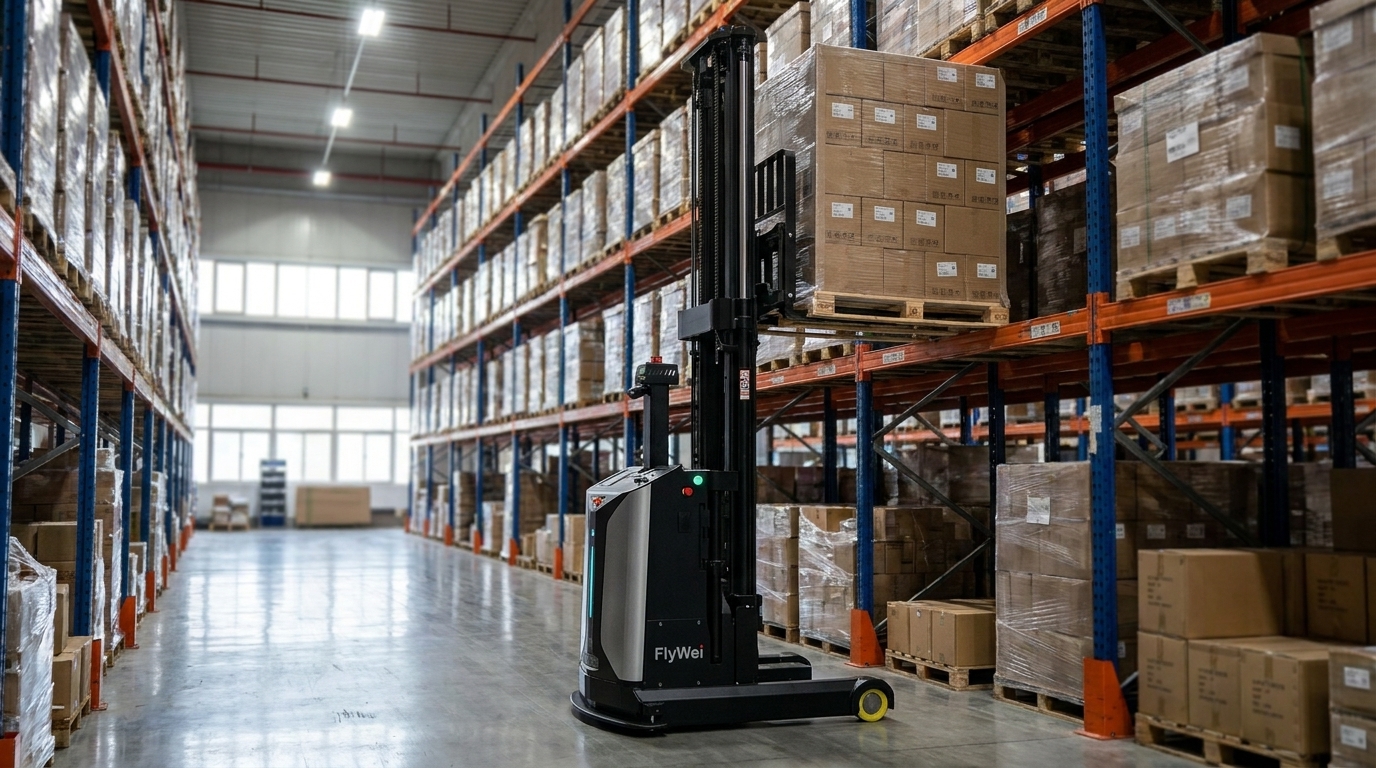
Beauty and personal care distribution has a mix that few sectors match: small, high-value SKUs; fragile glass and pressurised packaging; strict batch-and-lot control; sharp seasonal peaks; and a constant churn of new launches and gifting bundles. Move any of that badly and the damage line, the customer complaints and the labour bill all climb together. This is an illustrative look at how a vendor-neutral autonomous forklift and lifting-robot programme typically plays out for a UK beauty and personal care operation — the shape of the design, the way the rollout runs, and the kinds of outcomes that are realistic to plan for.
Illustrative scenario: the operator described below is a composite persona, not a specific FlyWei client. Numbers are engineering capability ranges, not project results.
Operation profile (illustrative)
- Operator type: a UK third-party or in-house distribution centre serving beauty and personal care brands (skincare, colour cosmetics, haircare, fragrance, personal wash and gifting bundles).
- Scale band: in the region of 15,000–40,000 m², 6,000–20,000 active SKUs, and 12,000–40,000 order lines per day depending on peak.
- Shift pattern: typically two-shift weekdays through most of the year, stepping up to 24/5 or 24/6 through Q4 gifting and Mother''s and Father''s Day peaks.
- Throughput band: pallet movements in the low thousands per day, with a heavy internal tote and carton flow between VNA reserve, pick faces, value-add stations and dispatch.
At-a-glance application snapshot
- Autonomous counterbalance and reach trucks: typical payloads 1.4–3 t, lift heights up to about 10 m, aisle widths from wide reserve down to VNA.
- Autonomous pallet trucks and stackers: 1.0–2.0 t payload class, generally used for horizontal moves, dispatch marshalling and low-level replen.
- Lifting AMRs (goods-to-person, roll-cage, tote): 150–600 kg base robots and 400–1000 kg jacking units for shelf, rack and cage moves at people-safe travel speeds (typically up to around 1.5 m/s in shared areas).
- Runtime: multi-shift running on opportunity charging is the norm; expect robots to be productive most of a shift, with brief top-ups rather than long swap-outs.
- Environment: ambient warehouse, hygiene-clean floor finish, occasional cold-cure or fragrance-store zones handled as separate cells.
These are indicative capability ranges — sizing depends on real cycles, layout and packaging profile.
The challenge
A beauty and personal care warehouse rarely fails on volume alone; it fails on the combination of pressures. Six recurring themes come up on almost every site survey:
- Fragility and shrinkage. Glass fragrance bottles, pressurised aerosols, pump-action containers and premium cartons damage easily. Every extra manual touch is an opportunity for a mark, a dent or a leak.
- Peak amplitude. Gifting seasons, promo mechanics and influencer-driven launches can push daily volumes to two or three times the trough, and agency labour is expensive and scarce.
- Small, dense, mixed picking. Order lines are typically small units picked from a huge active range, with frequent value-add (bundle building, promotional over-labelling, celebrity-collab packaging).
- Regulatory and batch control. COSHH classification for aerosols and flammables, cosmetic batch-and-lot traceability, allergen and expiry management, and returns and destruction routines all constrain the flow.
- Safety around people. Value-add and pick stations are people-dense; any moving equipment near them has to be predictable, quiet and demonstrably safe.
- Estate constraints. Many UK beauty DCs are older sheds with mixed floor conditions, low door thresholds and narrow aisles — greenfield-style automation is often not on the table.
The solution: a vendor-neutral automation cell
FlyWei is an independent UK systems integrator, so a beauty and personal care design is rarely a single-machine story. The typical shape is a small fleet of complementary autonomous vehicles from more than one manufacturer, chosen on fit rather than badge, and stitched together by a common fleet manager talking to the site''s WMS or ERP:
- Autonomous counterbalance or reach trucks for pallet moves between goods-in, reserve, replen and dispatch — sized to the site''s real aisle geometry rather than a spec-sheet ideal.
- Autonomous pallet trucks and stackers for horizontal shuttle work, dispatch marshalling and cross-dock loops, freeing manned trucks for the exceptions.
- Lifting AMRs for goods-to-person picking and roll-cage or tote transfer between pick faces and value-add stations — the class where mixed-SKU beauty work tends to earn its keep.
- A safety and control layer — safety-rated controllers, laser scanners and a fleet manager — that lets vehicles from different manufacturers share aisles, chargers and traffic rules under a single operational picture.
- WMS, ERP and PLC integration: orders flow from the WMS, batch and lot data flows back, and MHE hand-offs (conveyors, lift tables, dock doors) are handled by the same layer.
Because FlyWei is not tied to one OEM, the vehicle mix can be tuned to the site''s genuine constraints — old floors, narrow doors, cold cells, ATEX zones — rather than forcing the site to fit one manufacturer''s catalogue.
How a deployment typically runs
- Free site survey. Our engineers walk the shed, log aisle widths, floor conditions, dock geometry, sprinkler layout and current MHE cycles. No cost, no obligation.
- Data pull and simulation. WMS extracts — order lines, SKU cube, batch behaviour, hourly profile through peak — feed a simulation of proposed vehicle counts and routes. This is where fleet sizing is defended, not guessed.
- Pilot cell. A single loop, for example dispatch marshalling or goods-to-person picking for a defined SKU band, goes live under close supervision with clear success criteria.
- Phased rollout. Additional vehicles and loops are added in planned waves, each tied to a measurable operational gain and to labour redeployment rather than layoffs.
- Steady-state operation and scale. The fleet manager runs the mixed fleet day to day; FlyWei support handles updates, safety re-validation and seasonal capacity boosts (often via short-term lease uplift into peak).
Typical results (ranged, qualitative)
- Damage and shrinkage tend to fall as manual touches on fragile SKUs are replaced by predictable, cushioned robot moves.
- Peak absorption improves: the same core team can generally sustain higher lines-per-hour through gifting peaks without proportional agency labour.
- Night and weekend running becomes feasible for replen and dispatch marshalling, smoothing the day-shift load on people-dense pick faces.
- Operators are typically redeployed from repetitive truck driving into value-add, QA and exception handling — usually a better job as well as a better cost line.
- Safety incident rates around MHE trend downward as predictable, sensor-led vehicles replace mixed manual traffic in shared aisles.
- Estate life is extended: automation lets an older UK shed absorb more volume before a new build is on the agenda.
Every figure here is an engineering-defensible range, not a project-attributed fact — real outcomes are sized in the simulation stage against your actual data.
What to consider for your site
- Do you have clean WMS data for at least one peak-and-trough month? If not, that is the first workstream.
- Which cell — dispatch marshalling, goods-to-person, replen, or value-add feed — has the loudest labour and damage pain? Start there.
- Are aerosols, flammables or fragrance stores segregated cleanly, or will the automation design need to respect ATEX and COSHH boundaries?
- Is your floor flat and clean enough for autonomous vehicles, or does the survey need to flag remediation before pilot?
- What does your peak look like in 2027 and 2028? Fleet sizing should be honest about growth, not just today''s steady state.
- Own, lease or a mix? A vendor-neutral integrator can structure the commercial as capex, full-service lease or a hybrid — a free site survey is the fastest way to compare.
If you would like a vendor-neutral view of how an autonomous forklift and lifting-robot programme could work in your beauty and personal care operation, book a free site survey with an independent UK integrator — you will get a costed, honestly-sized proposal rather than a single manufacturer''s pitch. Explore the underlying kit on our autonomous forklifts, lifting robots and controllers pages, see typical designs on solutions, and compare commercial models on leasing.