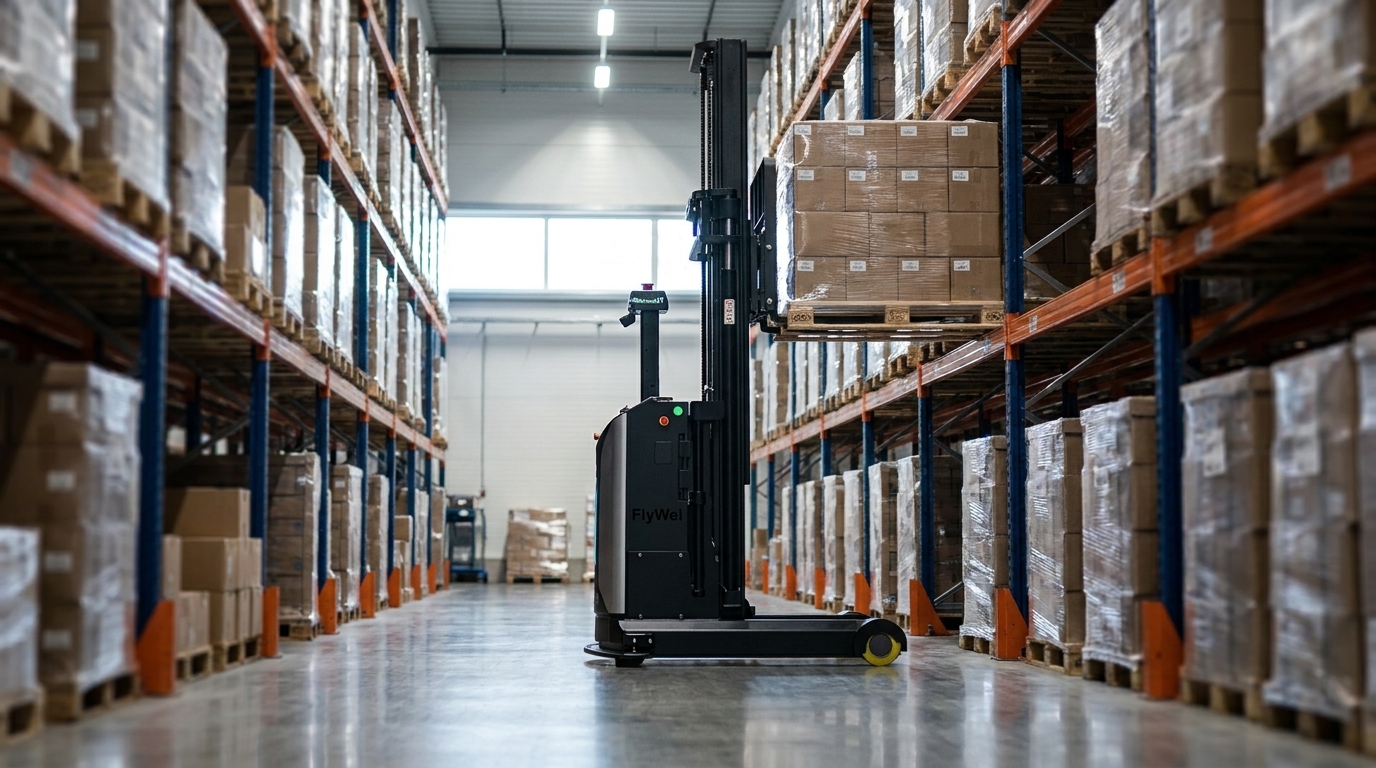
Illustrative case study — this article describes a representative UK medical devices & life sciences operation, not an identifiable named client. Any figures are typical engineering ranges, not project-specific claims.
In medical devices and life sciences, the hardest part of automating internal transport is rarely the robot. It is the paperwork behind it. Every pallet of sterile-barrier stock, every kitted procedure tray and every component tote carries a lot number, an expiry and an audit trail a regulator may one day ask to see. So when a UK device manufacturer considers autonomous forklifts or lifting AMRs, the first question is rarely “can it lift it?” — it is “what does this do to my validated systems, and can I still prove where everything went?” This is an illustrative view of how such a project typically comes together.
Operation profile
The illustrative operator here is a UK contract manufacturer and distributor of Class II medical devices — diagnostic consumables, single-use surgical items and kitted procedure trays — supplying hospital groups and export distributors from a single UK site. It is a high-mix, low-volume business: many part numbers, modest quantities, unforgiving traceability.
- Footprint: typically in the region of 12,000–25,000 m², combining a controlled production area with a conventional bulk and pick store.
- Shift pattern: commonly two production shifts with a longer warehouse day, five to six days a week, plus periodic validation and cleaning windows.
- Throughput band: broadly 300–900 pallet movements per day, alongside several thousand component and kit picks.
- Systems: an established ERP with a validated warehouse module, often supported by an MES on the production side — none of which the business wants to re-validate.
At-a-glance application snapshot
Indicative capability bands for the equipment classes that usually suit this environment. These are typical engineering ranges across the market, not a quotation for any one site.
- Autonomous pallet trucks and stackers: payloads typically 1.0–3.0 tonnes; lift heights commonly 1.6–6 m, with reach-truck classes extending to around 10 m.
- Lifting and jacking AMRs: payloads generally in the 150–1,000 kg band for totes, trolleys and roll-cages.
- Travel speeds: usually in the region of 1.0–2.0 m/s, routinely de-rated in shared pedestrian zones.
- Aisle requirements: narrow-aisle classes typically operate from around 1.6–2.0 m; counterbalance classes generally need 3.5–4.2 m.
- Positioning: laser or natural-feature navigation, with repeatability at pick and drop typically in the region of ±10 mm.
- Runtime: commonly 6–10 hours per charge with opportunity charging between tasks, so a fleet can generally cover a full shift pattern.
The challenge
Device operations tend to arrive at automation with a recurring set of pressures, and they are not the ones a generic warehouse brochure addresses.
Traceability that survives the handover
A manual move is logged when someone scans it. An automated move must log itself — reliably, every time, including when it fails. If a robot lifts a pallet and the confirmation never reaches the ERP, the operation has a phantom location and a quality investigation. Traceability is the deliverable, not a by-product.
Validated systems nobody wants to touch
The warehouse module is validated, and change control is slow and expensive by design. Any proposal beginning “first, we replace your WMS” is usually dead on arrival, whatever its technical merit.
High mix, low volume, unpredictable peaks
Theatre schedules, tender wins and recalls all create short, sharp demand spikes on a site engineered for steady flow, and fixed-track solutions struggle to absorb that variability.
Scarce labour and fragile packaging
Gowning- and quality-trained staff are hard to recruit and expensive to keep; using them to walk pallets to the production airlock is a poor use of a scarce skill. Meanwhile sterile-barrier packaging is unforgiving — a knock that would be cosmetic in general distribution can render a load unsaleable and trigger a deviation report.
The solution: vendor-neutral system design
FlyWei is an independent integrator rather than a manufacturer, so the design starts from the loads and the data, not from a catalogue. In an operation of this shape, the specification usually splits three ways.
Pallet work — bulk store to production airlock, finished goods to despatch staging — generally suits autonomous forklifts: driverless pallet trucks for horizontal transport, automated stackers or reach classes where racking height demands it. Where existing aisles are tight, a narrow-aisle class often avoids the cost of re-racking a building.
Component and kit flow — totes, trolleys and roll-cages between stores, kitting benches and assembly cells — is typically better served by lifting robots and AMRs, including goods-to-person arrangements that bring stock to a seated, gowned operator instead of walking that operator around a store.
The control layer is where a vendor-neutral position earns its keep. Different manufacturers are genuinely better at different things, and a site that commits to one badge for every task usually over-specifies some moves and under-serves others. Because fleet control can be built around open interfaces — VDA 5050 is the common standard for command and control between a fleet manager and vehicles from different suppliers — a mixed fleet can run under one traffic policy and one set of business rules, with the controller and safety layer specified to match rather than inherited by default.
Integration is deliberately conservative. The existing ERP or warehouse module stays the record of stock; a fleet management layer sits beneath it, takes work over a documented interface or scheduled exchange, converts it into missions, and writes back completions so stock moves as pallets move. Failed or abandoned moves raise an exception for a person rather than posting silently — the part that matters to a quality function.
Our engineers usually start a life sciences project by asking to see the exception paths, not the happy path. How a system behaves when a load is mis-presented, a network link drops mid-mission or an aisle is blocked tells you far more about whether it will survive an audit than any throughput figure.
How a deployment typically runs
- Free site survey. Floor condition, aisle widths, door and airlock interfaces, pallet and tote quality, pedestrian routes, and what the existing systems can expose and accept.
- Data and readiness review. Locations uniquely identified, stock balances trusted, interface scope agreed on both sides — automating on top of unreliable master data multiplies errors rather than removing them.
- Simulation. Routes, traffic and charging modelled against real order profiles, including peak days, to size the fleet before anything is bought.
- Phased rollout. One well-understood route first, running alongside manual operation, with validation impact scoped narrowly around the interface.
- Live operation. Handover to the site team, with exception handling rehearsed before volume increases.
- Scale. Further routes and vehicle classes added under the same control layer, which is where a multi-manufacturer approach pays back.
Typical results
What follows is qualitative and directional rather than a claimed project result.
- Repetitive transport legs move to machines, and gowning- or quality-trained staff are typically redeployed to kitting, inspection and documentation.
- Travel time inside the building generally falls, and flow between stores and production becomes more predictable across the shift.
- Every automated move produces a timestamped record, so stock accuracy tends to improve simply because confirmations stop depending on someone remembering to scan.
- Extended running becomes feasible on straightforward legs, taking pressure off peak-day scheduling.
- Handling damage to sterile-barrier packaging typically reduces, since approach speeds and lift profiles are consistent rather than operator-dependent.
What to consider for your site
- Can your existing system expose open work and accept confirmations, or will an interim scheduled exchange be needed?
- Which moves are genuinely repeatable, and which need a person’s judgement?
- How narrow are your worst aisles, and what is the floor like at the joints and thresholds?
- What does your validation and change-control process require for an interface of this kind?
- How are exceptions surfaced today, and who owns them at 2am?
- Is the commercial route ownership or a leasing arrangement? The payback drivers here are usually labour redeployment, damage reduction and extended running hours.
- Would a single-manufacturer fleet force you to over-specify some tasks? Compare the classes across our sector solutions.
Talk to an independent integrator
FlyWei is a vendor-neutral UK systems integrator: we specify and integrate autonomous forklifts and AMRs from multiple manufacturers, so the recommendation follows your loads, aisles and systems rather than a single product line. If you are weighing up automation for a medical devices or life sciences site, the sensible first step is a free site survey — an honest view of what would automate well, what would not, and what your existing systems can support.