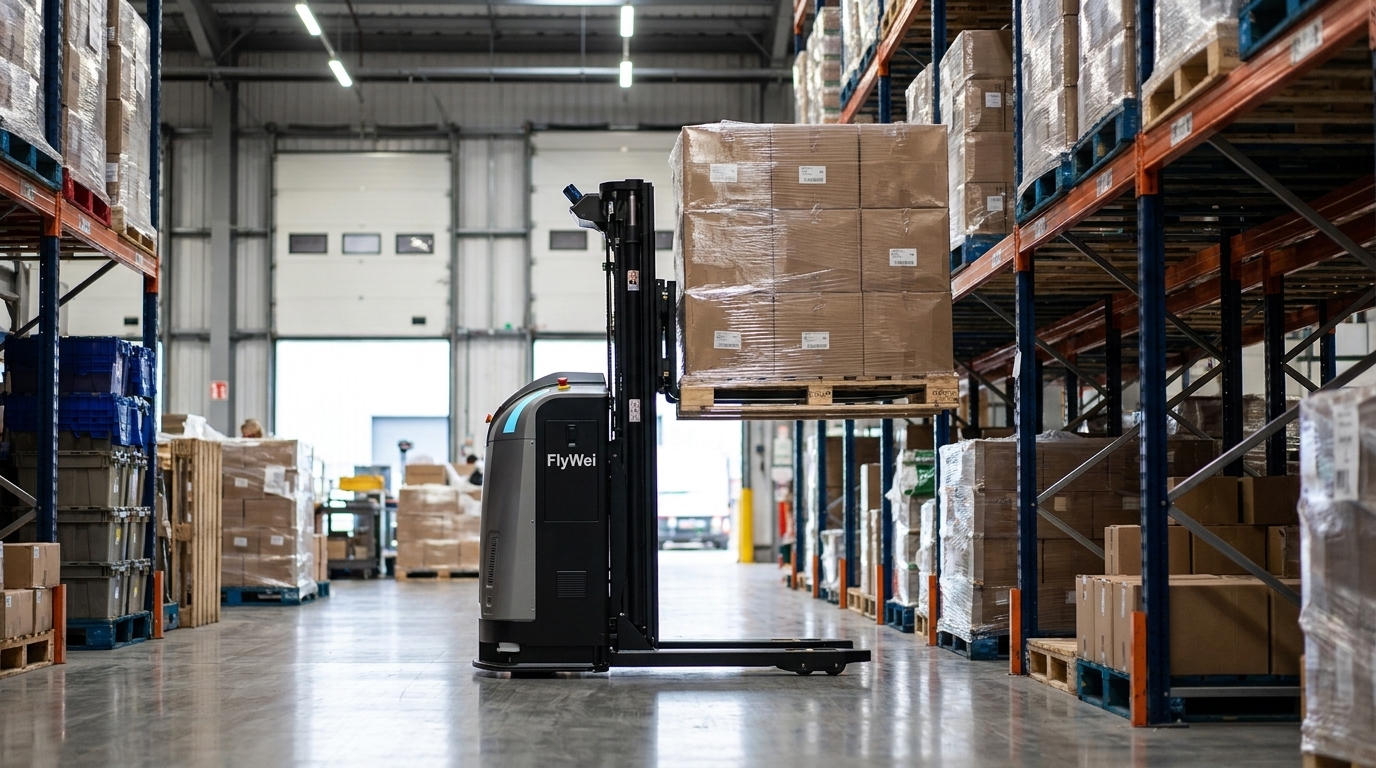
This is an illustrative sector application scenario based on typical UK fresh produce operations — not a specific named client project. FlyWei does not publish confidential client references. The operator profile below is a composite; figures are FlyWei capability ranges, not project outcomes.
Few UK intralogistics environments swing as hard as a fresh produce packhouse. Volumes lurch with the harvest, temperature bands are non-negotiable, aisles are shared with pallet trucks and staff on foot, and every extra hour a pallet spends in the yard shows up as shelf-life lost at the supermarket end. In this illustrative case study we walk through how an autonomous forklift and AMR deployment typically works for a UK fresh produce operation — where the biggest wins usually sit, how the system is designed vendor-neutrally, and what a phased rollout looks like from site survey to steady-state.
Operation profile
Persona: a mid-sized UK fresh produce grower-packer running a packhouse and chilled distribution centre in the Midlands or East of England. All bands below are indicative of the sector, not a real client.
- Product mix: mixed salad, top fruit, brassicas and soft-fruit punnets in returnable plastic crates (RPCs) and Euro pallets, destined for supermarket regional distribution centres.
- Site footprint: a packhouse hall in the region of 6,000–12,000 m², plus a chilled dispatch chamber held at 2–4 °C.
- Shift pattern: typically two production shifts through the packhouse, with a night shift for dispatch consolidation during seasonal peak.
- Throughput band: in the order of 400–1,200 pallet movements per day at peak; roughly a third of that off-peak.
At-a-glance application snapshot
The figures below are typical FlyWei capability ranges for the equipment classes most operators of this profile deploy — indicative, not project outcomes.
- Autonomous pallet trucks: payloads typically in the region of 1.5–3 tonnes, laden travel speeds in the region of 1.5–2 m/s, aisle widths from around 2.5 m upwards depending on truck class.
- Autonomous stackers and reach trucks: lift heights typically in the region of 3–10 m, suitable for very narrow aisle racking layouts down to roughly 1.6 m wide.
- Lifting AMRs (latent jacking / rotary): payloads typically in the region of 150–1,000 kg for tote, roll-cage and small-load carrier handling — the class of vehicle that makes goods-to-person moves practical inside a packhouse.
- Runtime: typically an 8–10 hour shift on a full charge, with opportunity charging at natural handover points.
- Environment: equipment specified for chilled operation from around 2 °C upwards, with heated LiDAR housings and condensation-tolerant electronics where the site transitions in and out of chilled zones.
The challenge
Fresh produce packhouse and distribution operations sit at the intersection of several pressures that rarely apply together in other sectors:
- Peak seasonality. UK strawberry, salad and brassica seasons can more than double a site's daily pallet movements for a few weeks. Fixed-headcount driver pools struggle to flex up and down at that speed.
- Labour scarcity. Counterbalance and reach-truck drivers are increasingly hard to recruit and retain, especially for chilled and night-shift roles.
- Cold and condensation. Repeated transitions between ambient hall and chilled chamber punish sensors and batteries not designed for the duty cycle.
- Mixed traffic. Line-side operators, palletising cells, cleaners and manned forklifts all share floor space with any automated equipment.
- Shelf-life pressure. A pallet that sits in dispatch overnight loses value at the retailer's inbound door. Any queueing between packing lines and outbound bays translates directly into commercial risk.
The solution: a vendor-neutral autonomous fleet
Because FlyWei is an independent UK systems integrator, we start from the flow — not from a particular manufacturer's product sheet. For a fresh produce operation of this profile, a typical mix is:
- Autonomous pallet trucks moving finished pallets from end-of-line to dispatch marshalling, and empty pallets and RPCs back to line-side.
- Autonomous stackers or reach trucks putting away and retrieving bulk pallets in chilled block-stack or narrow-aisle racking.
- Lifting AMRs for tote and roll-cage moves inside the packhouse — feeding punnet lines, moving trim and waste, and shuttling QC samples.
- A single fleet manager orchestrating trucks and AMRs across multiple manufacturers over a common interface (VDA 5050 where supported), integrated to the site's WMS/ERP and packhouse MES.
The vendor-neutral angle matters most here in two places. First, in procurement: you are not locked into whichever OEM you started with when volumes double in year three. Second, in safety-critical equipment selection: chilled-rated reach trucks, functional-safety controllers and sensor suites are chosen for the duty cycle, not because they came bundled with the fleet.
How a deployment typically runs
- Free site survey. FlyWei engineers walk the packhouse and DC, map floor markings, aisle widths, chilled boundaries, dock configuration, WMS/ERP touchpoints and current pallet-move counts.
- Flow simulation. Candidate moves are simulated against realistic peak and off-peak profiles to size the fleet and identify pinch points before any capital is committed.
- Phase one pilot. A small mixed fleet — typically two to four vehicles — tackles the highest-volume, lowest-risk route first, often end-of-line to dispatch. Runs alongside the manned fleet with clear demarcation.
- Integration hardening. WMS/MES handshakes, charging strategy, exception handling and safety zones are tuned during live running.
- Scale-up. Additional trucks and AMRs are added by route as confidence grows; the orchestration layer absorbs new vehicles without re-architecting.
Typical results
Outcomes vary widely by site, but across UK fresh produce operations we typically see:
- Smoother dispatch cadence, as pallet flow from packing lines to outbound bays stops being gated by driver availability at handover.
- Night-shift feasibility, because autonomous trucks are content to run consolidation moves through the low-cost hours without a full driver roster.
- Redeployed operators, typically moved into higher-value roles: QC, line-side pack changes, load planning, or driving during genuine flex-up periods.
- Fewer damage incidents, as repeatable AMR paths reduce racking, RPC and product contact.
- More predictable running costs, particularly under a full-service lease, where the site pays for availability rather than assets.
What to consider for your site
- What proportion of moves are truly repeatable, and which need a human on the truck? Fresh produce sites often over-estimate the second.
- Where does the chilled boundary sit, and are you asking one vehicle to cross it repeatedly? Duty-cycle specification lives or dies here.
- Is your WMS ready to hand off moves at task level, or will the fleet manager need to translate between systems?
- Is peak your bottleneck, or off-peak? Automation usually earns its keep first in the shoulder shifts, not the headline peak week.
- Do you want to own the fleet, or lease it? A full-service lease tends to flex with the season more comfortably than an outright capital purchase.
FlyWei is an independent UK systems integrator of autonomous forklifts and lifting robots, with functional-safety controllers, packaged sector solutions, and full-service leasing options. Because we are vendor-neutral, we specify the fleet your fresh produce operation actually needs — not the fleet a single manufacturer happens to sell.
Talk to an independent integrator. Book a free site survey and simulation for your packhouse or chilled DC, and we will scope an honest, phased path to autonomy — no lock-in, no pressure, no invoice until you decide to proceed.