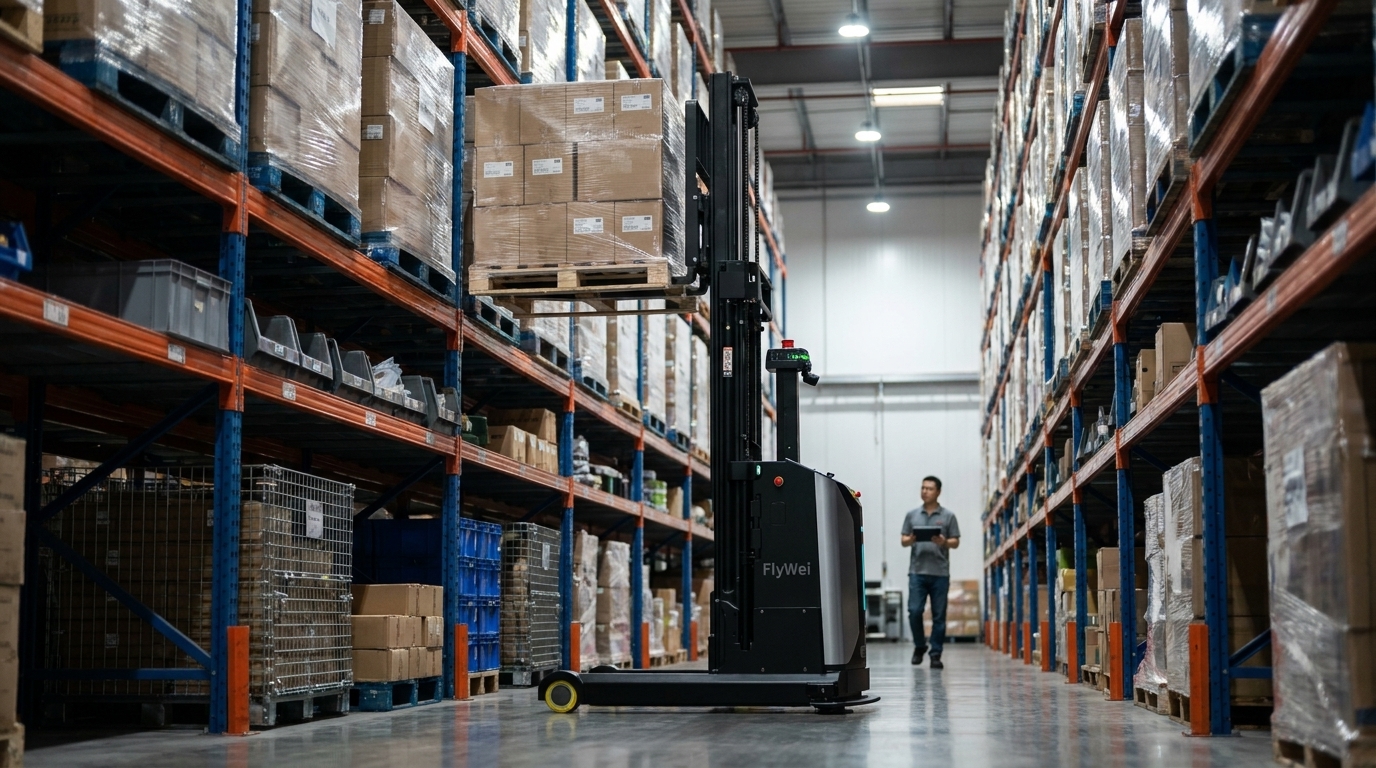
The hardest job in a UK cold store is not the one at the dock. It is the one nobody wants: eight hours of high-bay put-away and replenishment at −25 °C, in an aisle narrow enough that the operator works by rack light, with cold-exposure breaks written into the shift plan and a chronic shortage of people willing to hold the ticket. This illustrative case study looks at how an independent integrator typically automates the work inside the chamber — the deep-freeze aisles themselves — rather than the traffic in and out of them.
Illustrative scenario. The operator described below is a representative UK cold storage business, not a real or named client. FlyWei does not publish confidential client names. Every figure here is an indicative capability range drawn from equipment we integrate, not a measured result from a particular project.
Operation profile
- Operator: a regional UK frozen and chilled storage provider, holding stock for food manufacturers and grocery customers.
- Site: a single-chamber deep-freeze high bay held in the region of −18 °C to −25 °C, with a small chilled anteroom and an ambient dock.
- Scale band: mid-sized — roughly 10,000 to 25,000 pallet positions, racked six to twelve metres high.
- Shift pattern: two production shifts plus an under-crewed night replenishment window.
- Throughput band: a few hundred to low thousands of pallet movements per day, heavily peaked around vehicle arrivals.
At-a-glance application snapshot
Indicative capability ranges for equipment of the class typically specified for this work — not project results:
- Payload: typically 1.4 to 3 tonnes per unit, covering standard and chep-style pallets and most frozen block loads.
- Lift height: commonly 6 to 10 metres for reach and very narrow aisle classes; lower-bay stacker work usually sits under 6 metres.
- Aisle width: very narrow aisle configurations generally operate in the region of 1.6 to 2.0 metres; reach-truck aisles are typically wider.
- Travel speed: usually in the region of 1.0 to 1.8 m/s laden, deliberately de-rated in frost-affected zones.
- Runtime: lithium-iron-phosphate packs in sub-zero service typically deliver noticeably less usable capacity than at ambient, so opportunity charging between tasks is the normal design.
- Operating temperature: cold-rated builds are generally specified for continuous duty down to around −25 °C, with heated enclosures and condensation management.
The challenge
Labour that is genuinely hard to hold
Cold-store truck operation is a skilled, licensed, uncomfortable job. Sites commonly lose people to ambient warehouses paying similarly, and the night replenishment window is usually the first to go short. Health surveillance, layered clothing and warming breaks all reduce the productive fraction of a paid hour — entirely appropriately, but the arithmetic is unforgiving.
Cold, ice and condensation
Ambient trucks and sensors degrade quickly in a freezer. Optics fog, seals stiffen, hydraulic response changes, battery capacity falls, and every trip through a temperature boundary drives condensation that later freezes. Equipment not specified for the chamber tends to fail in ways that look random.
Accuracy in a dark, repetitive aisle
High-bay put-away at height, in poor light, with frost-obscured location labels, is precisely the pattern that produces mis-slots. A pallet in the wrong position in a large freezer is expensive to find and often only surfaces at pick.
Energy and door discipline
Every door cycle and every idling truck adds heat load. Manual operations rarely sequence aisle work to minimise boundary crossings, because the operator is optimising for their own trip, not the chamber's energy bill.
The solution: a vendor-neutral system design
FlyWei is an independent UK systems integrator. We do not manufacture trucks and we are not tied to one brand, so the specification below reflects what suits the chamber — drawn from several manufacturers where that is the better answer.
Matching machine class to the work
- Very narrow aisle automation for the dense high-bay core, where the aisle is too tight for counterbalance work and the value of each square metre is highest.
- Autonomous reach trucks where existing racking and aisle widths are fixed and the site needs automation without a re-rack — usually the least disruptive route in a live chamber.
- Autonomous stackers and pallet trucks for lower-bay replenishment, pick-face top-up and the chilled anteroom, where lift height is modest and cycle count high.
Cold specification is the part that decides whether a deployment survives its first winter: heated sensor windows, chamber-rated lubricants and seals, enclosure heating for control electronics, a charging strategy that accounts for reduced cold capacity, and a deliberate thermal-transition routine so machines that cross a boundary are not asked to work through a condensation cycle.
One fleet layer, several manufacturers
Mixed fleets are normal in cold storage, because no single manufacturer makes the best machine for every job in the building. A fleet management layer sits above the trucks, takes work from the site's existing warehouse or host system over a documented interface, and converts it into missions, routes and traffic rules. Open communication standards such as VDA 5050 allow vehicles from different suppliers to take orders from one controller without a bespoke integration for each. Completions and load confirmations are written back, so the existing system remains the record of stock — there is normally no need to replace a working WMS or ERP to automate the aisles.
How a deployment typically runs
- Free site survey. Our engineers usually start a cold storage project in the chamber itself: aisle and beam dimensions, floor condition and joints, frost and ice patterns, door positions, traffic conflicts, and where the label and location data is actually reliable.
- Data and simulation. Historic movement data is modelled before anything is ordered, to size the fleet and test whether the bottleneck is really the aisle rather than the dock.
- Phased rollout. Most sites begin with one aisle or one repetitive flow — often night replenishment — running alongside manual trucks under agreed traffic rules.
- Live operations. Exception handling and escalation paths matter more than peak cycle rate in the first weeks.
- Scale. Additional aisles, additional machine classes, and running hours extended into previously unstaffed windows.
Typical results
Ranged and qualitative only — what operations of this type generally report, not a measured project outcome:
- The coldest, most repetitive aisle hours become the automated hours; operators are typically redeployed to pick quality, goods-in checking and fleet supervision from a warm control point.
- Cold-exposure time per person generally falls, which tends to help both retention and health surveillance outcomes.
- Night and weekend replenishment running becomes feasible without crewing a full cold shift, so the morning pick face is more often ready.
- Put-away accuracy usually improves, because location confirmation is a scan-and-confirm event rather than a judgement made at height in poor light.
- Travel and door-crossing patterns generally become more disciplined once a controller sequences work across the whole chamber, and racking damage typically reduces as speed and approach are governed rather than discretionary.
What to consider for your site
- Are your location labels and stock balances trustworthy today? Automating on top of unreliable master data multiplies errors rather than removing them.
- Is your floor flat and jointed well enough for high-lift work in a freezer?
- Can your existing warehouse system expose open work and accept confirmations, or will middleware be needed?
- Where will charging sit — inside the chamber, or in the anteroom — and what does that do to your thermal design?
- Which flow is most repetitive and least judgement-dependent? Automate that one first.
- Are you being offered one manufacturer's catalogue, or the right machine for each job?
Cost is best discussed as drivers rather than headline figures: fleet size, how much cold specification is required, the depth of host-system integration, and whether you prefer to own the assets or spread them over a term. Our leasing options exist so a phased rollout need not become a single capex event.
Explore further
- Autonomous forklifts — reach, stacker and very narrow aisle classes.
- Lifting robots and AMRs — tote and roll-cage work in chilled areas.
- Controllers — the navigation and functional-safety layer.
- Solutions — how the parts come together for a sector.
- Leasing — commercial routes to a phased deployment.
If you run a chilled or frozen chamber and the aisle shift is the one you cannot reliably crew, the useful next step is a look at the actual building. FlyWei is an independent, vendor-neutral integrator: we specify across manufacturers, we are not a reseller for any of them, and we will tell you when automation is not yet the right answer. Book a free site survey and we will walk your chamber with you.