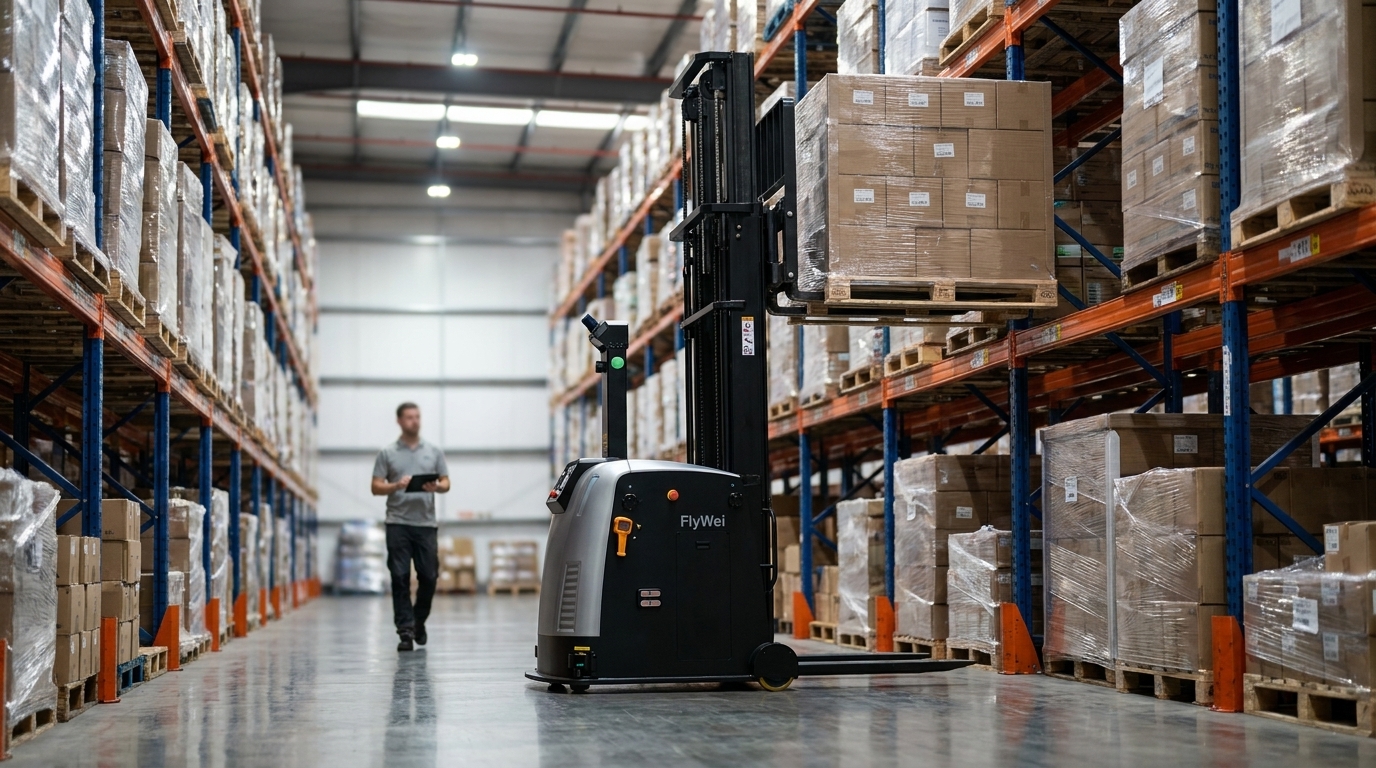
Peak decides an e-commerce fulfilment centre's year, and it is also when the building runs furthest from its design assumptions. Volumes climb, agency drivers arrive who have never seen the site, and the constraint quietly moves from picking to the pallet flow feeding it. This illustrative case study looks at how an independent integrator approaches that for a UK e-commerce operation: not by replacing the warehouse management system, but by automating the repetitive moves around it with autonomous forklifts and mobile robots drawn from several manufacturers.
Illustrative scenario. This is a representative application study, not a named-client reference. The operator described is a generic composite of UK e-commerce fulfilment sites, and all figures are indicative capability ranges, not measured project results.
Operation profile
- Operator: A mid-sized UK e-commerce fulfilment centre — illustrative and unnamed, serving direct-to-consumer and marketplace orders
- Building: Typically 15,000–40,000 m², selective and narrow-aisle racking over a ground-floor pick face, with packing benches and despatch lanes at one end
- Shift pattern: Commonly two shifts for most of the year, extending to double or triple shifts through peak
- Throughput band: Typically a few thousand to several tens of thousands of units a day, with peak multiples of roughly two to four times baseline for several weeks
- Load types: Mixed — full and part pallets, cages and roll containers, tote and carton replenishment
At-a-glance application snapshot
Typical capability ranges for the machine classes used here — what the equipment can generally do, not what any site achieved.
- Payload: autonomous pallet trucks typically 1,500–3,000 kg; jacking and tote-handling robots typically 150–1,000 kg
- Lift height: pallet movers at ground level; autonomous stackers typically to around 6 m; autonomous reach trucks to around 10 m for high-bay work
- Aisle width: narrow-aisle machines generally from roughly 1.6–2.0 m; counterbalance classes typically 3.0 m or more
- Travel speed: generally 1.0–2.0 m/s laden, automatically reduced in shared pedestrian zones
- Runtime: typically 6–10 hours per charge on 48 V lithium iron phosphate packs, with opportunity charging in breaks usually sustaining continuous running
- Navigation and safety: natural-feature navigation placing loads to commonly around ±10 mm, with certified safety laser scanners and functional-safety rated controllers, typically SIL 2 / PL d by class
The challenge
Fulfilment sites rarely struggle at peak because the pickers are slow. They struggle because the material flow behind the pick face cannot keep up — and because the extra hands hired to fix that arrive with the least site knowledge at the busiest moment.
Replenishment is the hidden constraint
Every unit picked has to be put there first. Through peak, let-down and replenishment grow in proportion to picking, but are served by a handful of shared trucks also covering goods-in, put-away and despatch. When those trucks saturate, pick faces run empty and productivity falls for reasons that have nothing to do with picking.
Seasonal labour is expensive in more ways than one
Counterbalance and reach-truck work needs a licensed, site-inducted operator — a hard resource to flex up for a couple of months and then release, with the induction burden landing on supervisors at the worst possible time. Sites in this position describe the same pattern: recruitment pressure, more near-misses in shared aisles, more damage in the weeks when damage costs most.
A system that must not be disturbed
Any fix carries a hard constraint: the warehouse management system is the record of stock and the source of order truth, and nobody sensibly replaces it in the run-up to peak. Automation has to take work from the existing system and hand results back to it.
The solution
The design principle is straightforward: automate the repeatable moves, leave judgement work with people, and choose each machine class on merit rather than on who supplies it. As an independent, vendor-neutral integrator, FlyWei is tied to no one product family — and in a mixed-flow building that matters, because no single manufacturer makes the best machine for every move on the list.
Matching the machine class to the move
- Goods-in to reserve racking: autonomous forklifts in the counterbalance or reach-truck class. Reach trucks are usually preferred where aisle width is already committed.
- Let-down and replenishment: autonomous stackers and narrow-aisle pallet trucks on scheduled and demand-triggered loops — typically the highest-value single flow to automate on a peak-constrained site.
- Totes, cages and roll containers: lifting robots and jacking mobile robots, which move sub-pallet loads far more efficiently than a forklift will, and fit where a truck should not go.
- Despatch marshalling: pallet-truck class robots running finished pallets from packing to loading lanes on a repeating circuit.
Integration without replacement
The robots do not talk to the warehouse system directly. A fleet management layer sits between them, taking work from the existing WMS or ERP over a documented interface — or, where none exists, a scheduled export handled by middleware — and translating each task into missions, routes and traffic rules. Completions and load confirmations are written back, so the existing system stays the record of stock, and the same layer handles PLC handshakes for doors and conveyors.
Because that layer speaks open standards such as VDA 5050, machines from different manufacturers can run under one traffic controller rather than needing a separate integration each — the difference between an operator who can add the right machine next year and one locked into whatever their original supplier now sells. Vehicle-side, safety and navigation behaviour comes from certified robot controllers, not bolt-on software.
How a deployment runs
- Free site survey. Engineers walk the building, measure aisles, floor condition and level changes, and record the real traffic pattern — including where pedestrians and manual trucks will keep working.
- Flow analysis and simulation. Movement data models which flows to automate first and how many vehicles each needs, tested against peak multiples rather than average days — so fleet size is decided before anything is ordered.
- Interface design. The WMS or ERP interface is scoped: which fields carry the task, what a completion looks like, how exceptions reach supervisors, and what happens if the link drops.
- Phased rollout. One flow goes live first — usually replenishment or despatch trunking — with a small fleet in a defined zone, alongside manual trucks. Teams are trained on exception handling, not just the robots.
- Live operations and scale. Vehicles and flows are added against measured behaviour, typically ahead of the next peak, on the same control layer.
Typical results
Outcomes are best described qualitatively: they depend on the building, the order profile and how much of the flow is automated. What operations of this type generally report:
- Replenishment becomes a scheduled, predictable flow rather than a queue behind shared trucks, so pick faces run empty less often.
- Long, repetitive travel legs move to robots, and travel time on them generally falls because routing is centrally optimised rather than left to judgement.
- Night-shift and shoulder-hour running becomes feasible without a fully crewed shift — often where peak capacity is actually recovered.
- Operators are typically redeployed to higher-value tasks — quality, exceptions, goods-in checking — rather than displaced.
- Damage and near-misses in automated lanes generally reduce, because robot travel is consistent, speed-limited and logged.
What to consider for your site
- Which flow is genuinely the constraint? If picking is not the bottleneck, automating it will not help; movement data answers this quickly.
- Are locations uniquely identified and stock balances trusted? Automating on top of unreliable master data multiplies errors rather than removing them.
- Can your existing system expose open work and accept confirmations? A documented interface is ideal; a scheduled export is often enough to start.
- What are your real aisle widths, floor tolerances and door constraints? These decide the machine class before anything else does.
- Buy or lease? Leasing suits operators who want the fleet to flex with contract length; purchase suits stable, long-horizon flows.
- Who owns the control layer? Ask any supplier whether you can add another manufacturer's vehicle later without a new integration.
Talk to an independent integrator
Every fulfilment building is different, and the honest answer to "would this work here?" starts with a walk round the site. FlyWei is an independent UK systems integrator: we specify autonomous forklifts and mobile robots from multiple manufacturers and integrate them with the systems you already run, with no incentive to favour one product family. If peak is exposing a material-flow constraint, book a free site survey and we will tell you which flows are worth automating — and which are not.