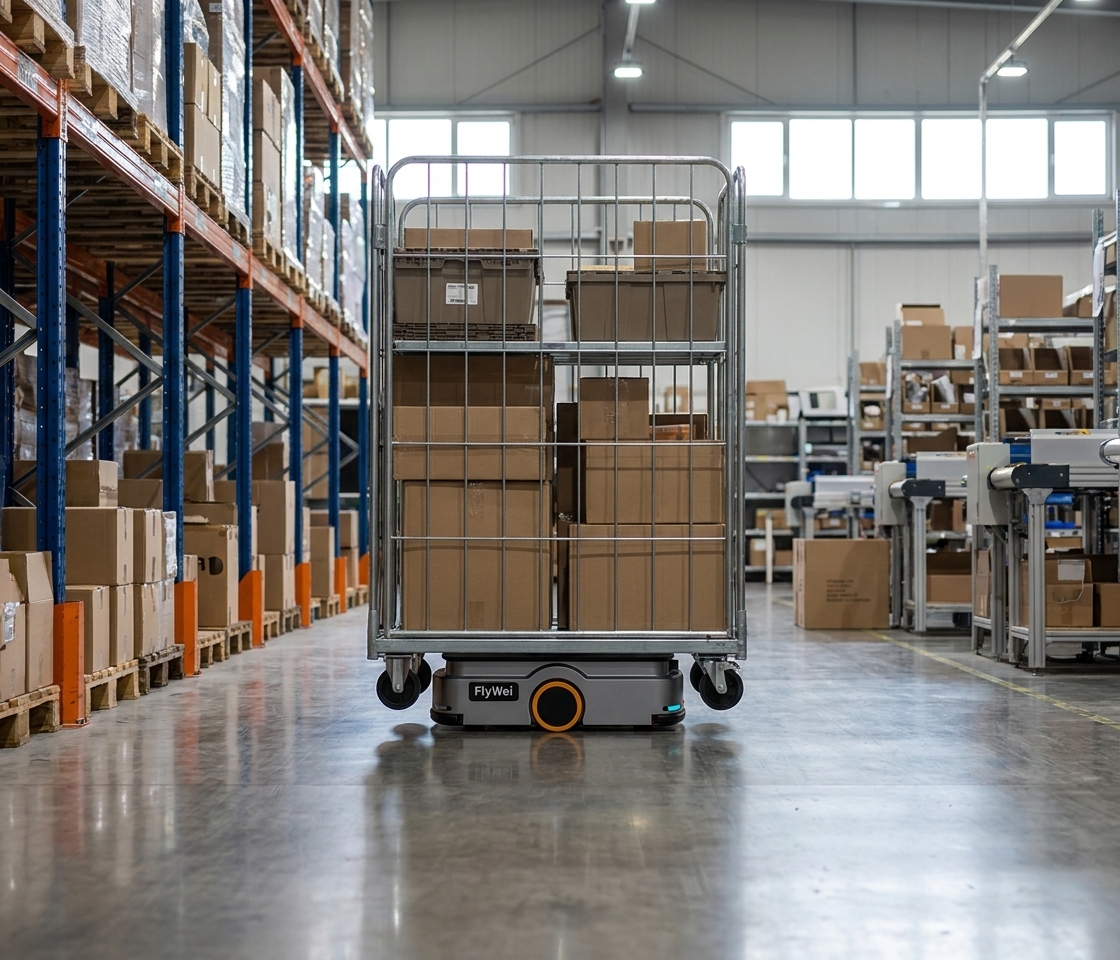
Illustrative case study — this scenario describes how a typical UK fashion & apparel operation can be automated with autonomous forklifts and mobile robots. It does not refer to a named client, and any figures cited are engineering capability ranges rather than measured results from a specific project.
Fashion & apparel is one of the most demanding intralogistics environments in the UK. A single mid-sized operation can carry fifteen to twenty-five thousand SKUs once every style, size and colour combination is counted, cycle through a seasonal reset four to six times a year, and see returns volumes climb sharply in the weeks after Christmas. The illustrative FlyWei engagement below shows how a vendor-neutral autonomous forklift and AMR programme is typically shaped to match that reality.
Operation profile
- Operator persona: a UK-based omnichannel fashion & apparel operator serving retail replenishment plus direct-to-consumer e-commerce.
- Site scale band: roughly 15,000–35,000 m² of storage and pick, plus a dedicated returns processing zone.
- Shift pattern: typically two shifts across the working week, expanding to three-shift running through Q4 peak.
- Throughput band: in the region of 20,000–40,000 units picked per day at peak, mixed pallet, carton and tote.
- Storage mix: block-stack for bulk inbound, adjustable pallet racking for reserves, shelving and totes for the pick face, and hanging-garment lanes for high-value ranges.
At-a-glance application snapshot
Indicative capability ranges — these are typical engineering envelopes for FlyWei-integrated fleets, not project outcomes.
- Autonomous pallet trucks in the 1.4–3 tonne class for inbound put-away, replenishment and cross-dock moves.
- Autonomous stackers and reach trucks lifting to around 6–10 m for reserve storage in high-bay racking.
- Latent-jacking and lifting AMRs handling 150–1,000 kg for tote consolidation and goods-to-person picking.
- Typical travel speeds in the region of 1.5–2.0 m/s loaded, with runtime around 8 hours between opportunity charges.
- Very-narrow-aisle configurations from around 1.6 m upwards where site geometry allows.
- WMS and ERP integration via VDA5050 or REST, so orders can flow from any established warehouse management system straight to the fleet.
The challenge
Every apparel operation has its own quirks, but a handful of pressures show up on almost every site survey:
- Walking dominates the pick hour. Small units and sprawling SKU counts mean operators typically spend a large share of the day travelling between locations rather than actually picking.
- Peaks you cannot hire your way around. Black Friday, Christmas and the January returns spike stack on top of an already-tight UK labour market, and agency turnover generally climbs at exactly the wrong moment.
- Safety around hanging garments and mixed loads. Manual pallet-truck routes weave between hanging rails, packing benches and returns tables, which raises incident risk on a busy night shift.
- Returns processing is a bottleneck. Returned items need inspecting, re-hanging or re-packing, then putting away — and it competes with outbound pick for the same operators.
- Frequent range resets. New season launches shift where SKUs live in the building four to six times a year, and static conveyor is expensive to reroute.
The solution: a vendor-neutral autonomous fleet
FlyWei is an independent UK systems integrator — we specify and deploy the best-fit robot from across multiple manufacturers, rather than being locked to a single OEM. That matters here because a fashion & apparel building rarely needs just one robot type. A typical illustrative design mixes:
- Autonomous pallet trucks (approximately 1.5–3 t class) moving inbound pallets from receiving into reserve, and taking bulk pallets out to replenishment drop points on the pick face.
- Autonomous counterbalance forklifts or reach trucks (also known as driverless forklifts) for high-bay put-away and let-down, freeing manual drivers for exception work only.
- Lifting AMRs and goods-to-person robots handling totes and small cartons so the pick operator stays at a fixed workstation while the robot walks.
- Latent-jacking AMRs shuttling roll-cages and dollies between pack, dispatch and the returns zone.
- A single fleet controller talking to the WMS via VDA5050, so tasks are dispatched by priority rather than by robot brand — the operator never has to think about which manufacturer built which robot.
Because the mix is modular, the same site can start with a pair of pallet trucks on inbound and add goods-to-person AMRs on the pick face later, without ripping anything out.
How a deployment typically runs
- Free site survey. Our engineers walk the floor, map aisles, measure lift heights and check floor tolerance.
- Simulation and scoping. We model throughput, congestion and charging strategy against the operator's actual order file, and size the fleet from there.
- Phased pilot. Usually a small subset of robots on one workflow — often inbound put-away — commissioned in around six to ten weeks.
- Ramp-up. Additional workflows join once the pilot is stable, typically returns handling and goods-to-person pick next.
- Live operations and continuous tuning. Traffic rules, dwell locations and charging windows are refined in the live building as volumes shift with the season.
Typical results
We publish outcome bands rather than fabricated headline numbers, because every site starts from a different baseline. In practice, a fashion & apparel operator following this pattern can usually expect:
- A meaningful drop in operator walking distance across the shift.
- Feasible unattended night-shift running for inbound put-away and dispatch staging.
- Returns processing capacity that flexes with volume rather than headcount.
- Operators typically redeployed to higher-value tasks — quality checks, value-add packing, personalisation and customer service.
- Fewer near-misses in high-traffic aisles once travel paths are formalised.
What to consider for your site
- Where does walking dominate the shift today — pick, put-away, or returns?
- Which SKUs are stable enough to automate first, and which move around each season?
- Are aisles wide enough for standard autonomous pallet trucks, or does the site call for very-narrow-aisle robots?
- What WMS is in place, and does it already speak VDA5050 or a REST API?
- Is the ambition capex purchase, or a fixed monthly lease against opex?
Explore further
- Autonomous forklifts — pallet trucks, stackers, reach trucks and counterbalance robots.
- Lifting robots and AMRs — goods-to-person, tote and roll-cage handling.
- Robot controllers — the safety-rated brains behind autonomous fleets.
- Sector solutions — how autonomous fleets shape up for fashion, FMCG, 3PL and more.
- Leasing and rental — fixed monthly opex options that scale with peak.
Talk to an independent integrator. Because FlyWei is vendor-neutral, we can benchmark autonomous forklifts and AMRs from across the market against your actual apparel workflows — no OEM bias, no reseller quota. Book a free UK site survey and we will map the fleet that fits your building, your season and your WMS.