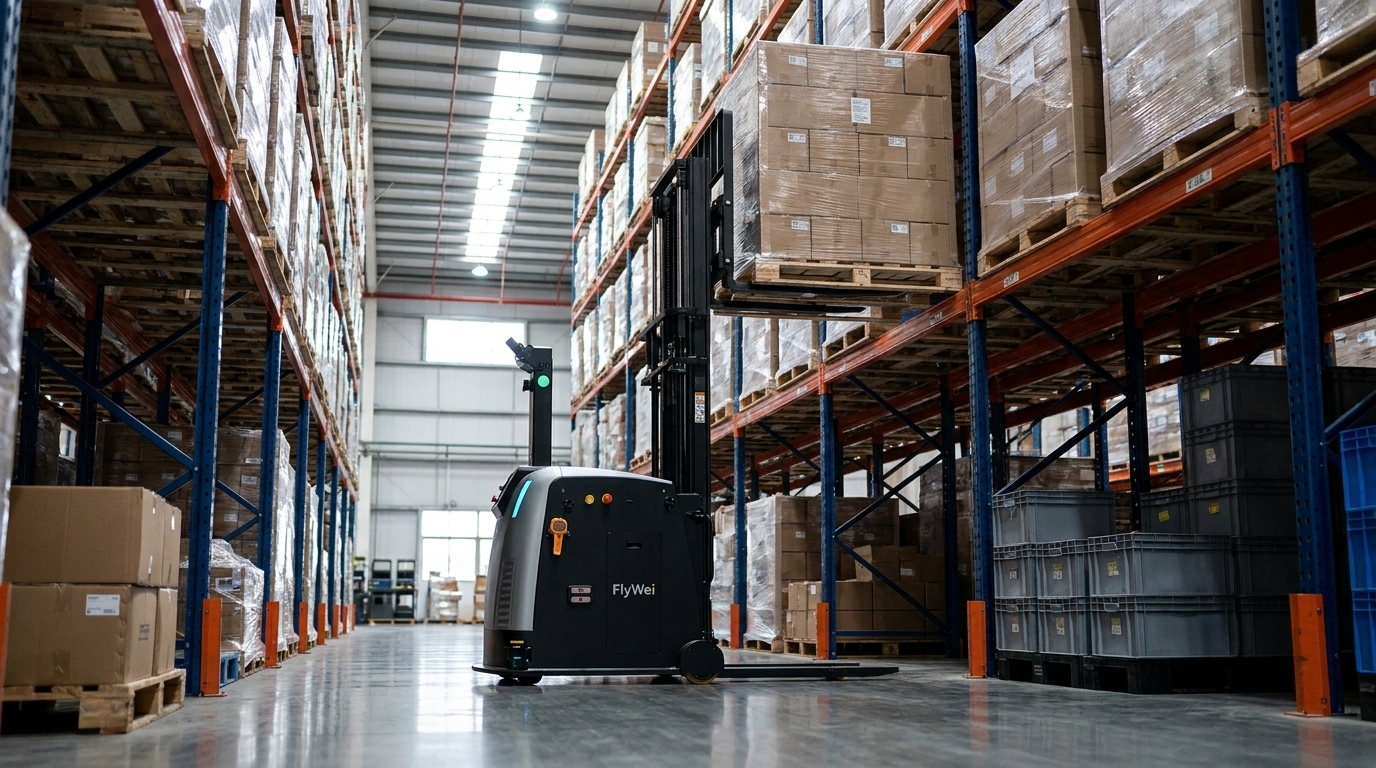
Illustrative scenario. This is a representative example of how autonomous forklift and AMR automation typically works in a UK automotive parts and aftermarket operation. It is not a named client reference — FlyWei does not publish confidential customer names — and every figure below is a typical engineering capability range rather than a result measured on a specific project.
An automotive aftermarket business is judged on breadth rather than raw volume. A regional parts distributor may carry tens of thousands of live part numbers at once: brake discs and clutch kits on pallets, exhaust sections and body panels in cantilever racking, filters and sensors in small-parts totes, and a long slow-moving tail that still has to be found within minutes when a garage calls. The intralogistics problem in this sector is rarely throughput alone. It is that one building has to handle three or four completely different load types simultaneously, keep the stock record honest across all of them, and do it while the same team is receiving deliveries, taking cores back from customers and loading vans at the trade counter.
Operation profile (illustrative)
- Operator: a UK regional distributor of automotive parts and aftermarket consumables, supplying independent garages, motor factors and a trade counter.
- Site scale band: a single distribution centre typically in the region of 8,000–20,000 m², combining pallet racking, cantilever racking for long loads and small-parts shelving.
- Stock profile: commonly tens of thousands of active part numbers, with a large proportion of lines moving only a few times a year.
- Shift pattern: typically two day shifts with a late despatch wave, plus seasonal peaks around winter service demand and MOT cycles.
- Systems: an established WMS or parts-trading ERP that the business has no appetite to replace.
At-a-glance application snapshot
Indicative capability ranges for the classes of machine that usually suit this sector. These are typical equipment envelopes, not project results.
- Pallet handling: autonomous pallet trucks and stackers typically in the 1.0–3.0 tonne payload band.
- Lift height: autonomous stackers commonly reach around 6 m; autonomous reach trucks extend into the 8–10 m class, depending on model and mast.
- Tote and small-parts movement: jacking and base AMRs typically in the 150–1,000 kg band for shelf, trolley and roll-cage transfer.
- Travel speed: generally in the region of 1–2 m/s, tuned down in shared pedestrian zones.
- Runtime: typically most of a shift on lithium iron phosphate packs, with opportunity charging between tasks rather than battery swaps.
- Aisles: narrow-aisle and very-narrow-aisle classes allow working aisles considerably tighter than manual counterbalance operation, which is often what makes retrofit viable.
The challenge
Four load types, one building
Few sectors mix formats as aggressively as automotive aftermarket. Pallets of consumables, awkward long loads, cartons for van routes and returned cores all share the same floor. Automation that only handles one of these formats tends to strand the others, so the honest question is which movements are worth automating first rather than whether the whole site can be automated at once.
Stock truth across a long tail
When most lines move rarely, errors hide. A pallet put away in the wrong location or a movement recorded at the end of a shift instead of when it happened can sit undetected for months, surfacing as a stock-out on a part the system says is in the building. Manual confirmation steps are where that accuracy is usually lost.
Licensed labour and seasonal peaks
Counterbalance and reach truck operation requires trained, licensed people, and demand is seasonal. Recruiting to peak and carrying that cost through quieter months is a recurring pressure across the sector.
Space and safety
Most aftermarket sites cannot easily extend the building, so growth has to come from the footprint they have. At the same time, trade counter traffic means pedestrians and vehicles frequently share space — a safety picture that rewards predictable, repeatable machine movement.
The solution: a vendor-neutral system, not a single product
FlyWei is an independent systems integrator rather than a manufacturer, so the design starts from the movements a site actually makes and then selects machines across multiple manufacturers to suit them. In a parts and aftermarket operation that usually resolves into three layers.
- Bulk pallet movement: autonomous forklifts — pallet trucks for goods-in and cross-floor runs, autonomous pallet stackers for putaway, and reach truck classes where racking runs high. Brownfield automation of an existing truck type is often preferable to replacing a fleet that still has life in it.
- Small-parts and tote flow: lifting robots and AMRs moving shelving, trolleys and roll cages to a picking station, so pickers stop walking the slow-moving tail.
- Control and safety: AMR and forklift controllers with safety laser scanners and functional-safety-rated architectures for machines working near people.
Where stock accuracy actually comes from
The accuracy gain is not a property of the robot; it is a property of the integration. Autonomous trucks do not connect to a business system directly. A fleet management layer sits between them, taking work from the existing WMS or ERP over a documented interface and translating it into missions. Each completed move sends back a confirmation naming the load, the location it left and the location it reached, which the existing system posts as a stock movement. Because the confirmation is generated by the machine that performed the move, the record updates as pallets move rather than at a shift-end reconciliation.
Crucially, this does not require replacing the system the business already runs. In most cases the existing WMS or ERP stays the source of truth, and integration is scoped as a separate, visible piece of work. Where a fleet speaks the VDA 5050 open standard, machines from different manufacturers can be commanded by one fleet manager — which is precisely what makes a genuinely mixed, best-of-breed fleet practical rather than theoretical.
How a deployment runs
- Free site survey. Our engineers usually start a parts and aftermarket project by walking the floor: aisle widths, floor condition, racking types, door heights, pedestrian crossings and where loads actually queue.
- Data review. Movement history is examined to find the repetitive, high-mileage journeys. Locations must be uniquely identified and stock balances trusted; where master data is unreliable, that is fixed before automating on top of it.
- Simulation. A model of the flows tests fleet size, traffic rules and charging strategy before any machine is ordered.
- Phased rollout. A first phase typically covers one well-understood loop — goods-in to bulk putaway is a common starting point — proving the interface and the exception handling on a small scale.
- Live operation and scale. Additional flows and machine classes are added once the first loop is stable, reusing the same control and integration layer.
Typical results
Outcomes in this sector are best described qualitatively, because they depend heavily on site layout and data quality.
- Repetitive long-distance travel is generally absorbed by machines, so operators are typically redeployed to picking, quality checks and trade counter service.
- Stock movements are usually confirmed at the moment they happen, which tends to reduce the discrepancies that surface as phantom stock on slow-moving lines.
- Running unattended into the evening for putaway and replenishment commonly becomes feasible, flattening the morning backlog.
- Narrower working aisles can release storage capacity within the existing footprint, which is often worth more than the labour saving.
- Machine movement is predictable and speed-limited in shared zones, which usually improves the safety picture around pedestrian traffic.
What to consider for your site
- Which movements repeat most often, and how far do they travel?
- Are your storage locations uniquely identified, and do you trust the balances against them?
- Can your WMS or ERP expose open work and accept movement confirmations — through an interface, or a scheduled export to begin with?
- What is the floor condition, and what are the true minimum aisle widths?
- Where do pedestrians and vehicles cross, especially near the trade counter?
- Would leasing rather than buying better match seasonal demand and capital constraints?
- Which supplier is willing to specify machines from more than one manufacturer, and price the integration as its own line?
FlyWei is an independent, vendor-neutral UK integrator: we are not tied to any single robot manufacturer, so the fleet we specify is the one your movements justify. If you would like to see how this maps to your own building, explore our sector solutions or book a free site survey and talk to an independent integrator before you commit to anything.