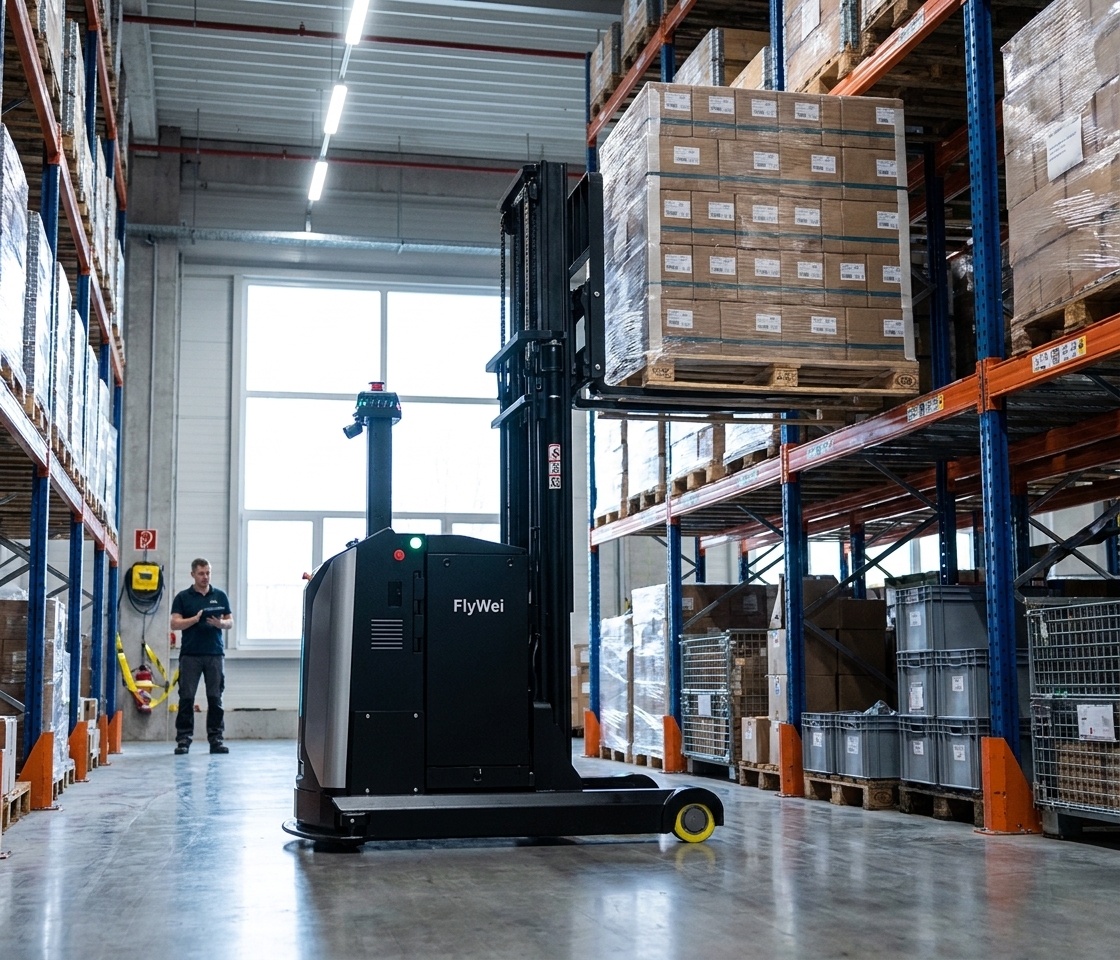
Electrical wholesalers and cable distributors sit at an awkward intersection of intralogistics: heavy reels, long conductor lengths, fast-moving trade counters and vans queued at the goods-out dock — all before a picker has cut a single metre. This illustrative case study looks at how autonomous forklift and AMR automation typically works for a mid-sized UK electrical wholesale and cable operation, drawing on how our engineers usually shape these projects.
Illustrative scenario: this case study describes a representative UK electrical wholesale and cable operation — not a named client. FlyWei Robotics does not publish confidential customer details. Figures and outcomes are typical engineering ranges, not project-specific results.
Operation profile (illustrative)
- Type: A regional UK electrical wholesaler and cable distributor with a central DC feeding branches, trade counters and next-day van deliveries.
- Site: Single-shift picking with an extended late shift during promotional peaks; typical footprint in the region of 8,000–15,000 m² under one roof.
- Throughput band: A few thousand order lines per day across cable cuts, boxed accessories, luminaires and switchgear.
- SKU spread: Tens of thousands of active SKUs — from small terminals to full-drum cable reels of several hundred kilograms.
At-a-glance application snapshot (typical ranges)
- Autonomous counterbalance forklifts — typically in the 2–3 tonne payload class, handling full pallets, cable drum cradles and pre-cut reels.
- Autonomous pallet trucks and stackers — typically 1.4–2 tonne, moving picked pallets between goods-in, pick faces and dispatch.
- Lifting AMRs / lifting robots — in the region of 150–1,000 kg payload for goods-to-person tote picking of small electrical accessories.
- Travel speeds: typically 1.2–1.8 m/s in main aisles, throttled around trade-counter and dispatch zones.
- Runtimes: commonly 8–12 hours on a single battery with opportunity charging at the wall.
- Aisle widths: from very narrow aisle at under ~1.8 m up to standard 2.5–3.5 m — retained on a brownfield rollout wherever possible.
The challenge
Electrical wholesale warehouses tend to accumulate a familiar set of pressures:
- Heavy, unstable loads. Full cable drums can be several hundred kilograms of copper on a metal reel — a serious manual-handling hazard and a slow forklift lift when a driver is doing it by hand.
- Long-length product. Cut-to-length cable, conduit and cable tray demand long racks and long travel distances between the pick face and the cutting bench.
- Trade counter and drivers on the floor. Many sites have collect-in-person customers and van drivers walking into the same warehouse where forklifts operate.
- Peaks and promotions. Contractor buying, framework tenders and quarter-end promotions cause sharp inbound and outbound peaks that a fixed manual fleet struggles to flex around.
- Safety and shrinkage. Copper is high-value; audit trails and traceable movements matter as much as speed.
The solution — a vendor-neutral system design
FlyWei is an independent UK systems integrator of autonomous forklifts and AMRs. We do not manufacture the hardware ourselves, and we are not tied to any single OEM. That matters here because an electrical wholesaler rarely has a "one robot fits all" flow — the right answer is usually a mixed fleet, drawn from the best autonomous forklifts and mobile robots across multiple manufacturers.
A typical FlyWei design for this sector might combine:
- An autonomous counterbalance forklift at the reel bay and heavy-goods dock, taking full drums off delivery trailers and placing them onto pick cradles or the cable cutting line.
- Autonomous pallet trucks and stackers for horizontal moves between goods-in, replenishment and dispatch — the routine repetitive travel that consumes a driver''s day.
- Lifting AMRs serving a goods-to-person area for small accessories (terminals, connectors, breakers, luminaire fittings), so pickers stay at a station instead of walking miles.
- Safety-rated fleet controllers coordinating mixed-manufacturer vehicles under one fleet manager, with defined slowdown and stop zones around the trade counter and dispatch bay.
- Integration with your existing WMS or ERP for order and stock, plus PLC handshakes with the cable cutting bench, drum racks and any high-bay racking already installed.
How a deployment runs
- Free site survey. Our engineers walk the DC, map aisle widths, floor flatness, dock behaviour and trade-counter footfall, and photograph every SKU class that will be handled autonomously.
- Simulation and business case. We model current flows and target flows, agreeing which movements are automated first — usually the highest-mileage, lowest-decision tasks: dock-to-stock, replenishment and drum-to-cutter.
- Phased rollout. Deployments typically start with two to four autonomous vehicles on the highest-value routes, with the rest of the fleet coming online in stages over several months as WMS integration is proven.
- Live operations. A fleet controller monitors, dispatches and re-routes vehicles around trade-counter surges; branch orders and drum handling become predictable rather than driver-dependent.
- Scale. Once the first flow is stable, additional AMRs and forklifts are added — often on a lease, so operations can flex with promotional peaks without a capex event.
Typical results (ranged and qualitative)
- Operators are typically redeployed away from repetitive drum shuttling and horizontal pallet moves onto higher-value work — cable cutting, quality checks, van loading and trade-counter service.
- Travel time on the highest-mileage routes generally falls once autonomous vehicles take over the "same trip, all day" tasks that dominate a driver''s shift.
- Late-shift and unattended operation becomes feasible for defined flows, particularly overnight replenishment ahead of a morning peak.
- Manual-handling incidents around heavy drums and long-length product tend to reduce, because the human element is designed out of the lift itself.
- Movement traceability improves — every autonomous move is logged, which supports high-value stock accountability without additional counting cycles.
What to consider for your site
- Do you know the top ten most-repeated movements in your DC by daily count, and which of them would you happily automate first?
- Are your aisle widths and floor flatness fit for autonomous MHE today, or would a brownfield project retain your existing racking?
- Where does your WMS or ERP currently draw the line between stock in racking and stock at the cutting bench? Automation lives on that boundary.
- How does trade-counter footfall interact with your forklift routes, and would you accept a defined slowdown zone?
- Would a lease structure fit your commercial model better than a capex purchase, particularly as you scale across branches?
Talk to an independent integrator
Because FlyWei is independent and vendor-neutral, we can size the right mix of autonomous forklifts and AMRs for an electrical wholesale and cable operation without pushing a single OEM catalogue at you. Every project begins with a free site survey and a phased business case — and where a flexible commercial structure helps, we can put the fleet on a long-term lease so your automation grows with your branch network. See our sector solutions or explore the autonomous forklift range to discuss your DC.