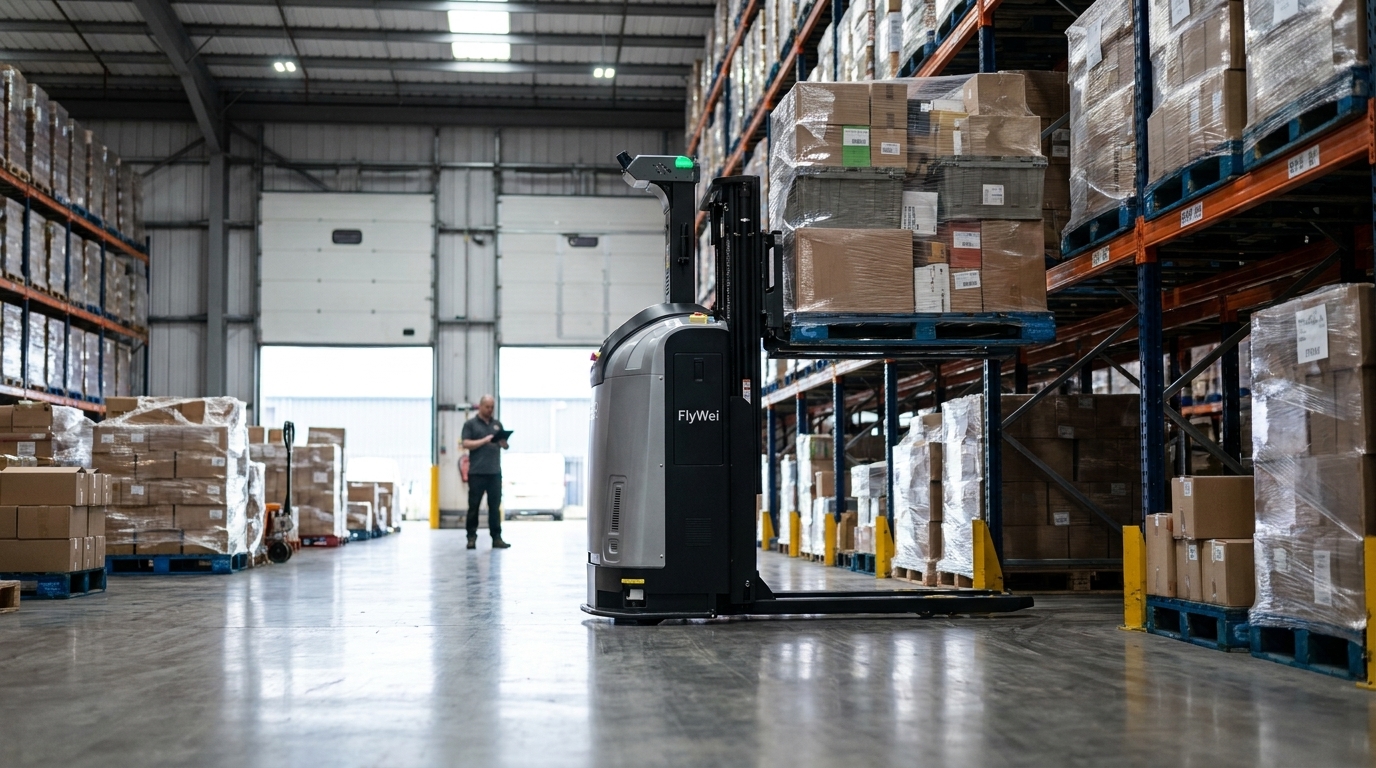
Illustrative scenario: this case study is a representative example of how FlyWei typically approaches an autonomous forklift and AMR deployment in a UK electronics and electrical-components operation. It does not describe a named client, and any figures are engineering ranges rather than measured project results.
Electronics and electrical-components distribution sits at an awkward point in the warehouse automation debate. The units are small and light, but the SKU count is vast, the tolerances are unforgiving, and the cost of a mishandled tray of PCBs, connectors or cable assemblies is out of all proportion to its weight. This is a scenario walkthrough of how a UK electronics distributor typically approaches autonomous forklift and lifting AMR automation with a vendor-neutral integrator — and how the design decisions differ from a straight FMCG or e-commerce build.
Operation profile (illustrative)
- Operator: a mid-sized UK electronics and electrical-components distributor supplying industrial OEMs, panel-builders, contract manufacturers and MRO customers.
- Site: a single distribution centre in the Midlands or North West, in the region of 12,000–20,000 m² of usable floor.
- Shift pattern: two shifts, five to six days per week, with a light overnight window used for replenishment and cycle counts.
- Throughput band: typically in the region of a few thousand order lines per day, weighted heavily toward small totes, connectors, cable coils and light cartons, with a smaller flow of full-pallet moves.
- Storage mix: narrow-aisle pallet racking for bulk stock, shelving and carton flow for pick faces, and a small ESD-controlled area for sensitive semiconductor and PCB stock.
At-a-glance application snapshot
The figures below are indicative FlyWei capability ranges, not project results. They give a sense of what a typical electronics deployment can look like on paper.
- Autonomous pallet trucks and stackers: payload typically 1.0–3.0 tonnes; lift height in the region of 1.6–6.0 m depending on model.
- Lifting AMRs and jacking robots: payloads typically from around 150 kg up to 1,000 kg for shelf, roll-cage and tote movement.
- Travel speeds: generally in the region of 1.2–2.0 m/s in open aisles, throttled automatically in busy or mixed-traffic zones.
- Aisle widths: vehicles are available for reach truck aisles down to roughly 1.6 m, with very-narrow-aisle variants for tighter layouts.
- Runtime: typically eight-plus hours between opportunity charges on 48 V LiFePO4 packs, with automated docking for continuous running.
The challenge
Electronics distribution has a specific pain profile. Components are small, but SKU counts frequently run into the tens of thousands, and each order line is often picked in low quantities. Peaks are driven by project releases, new-product introductions and end-of-quarter OEM pulls rather than by a smooth demand curve, so the difference between a quiet Tuesday and a peak Thursday can be substantial. Manual travel time tends to dominate the working day — pickers walk long distances between deep racking and the pick face, and forklift drivers spend a disproportionate share of the shift moving a small number of pallets across a large footprint.
Layered on top of the flow problem are the sector's discipline requirements: electrostatic-discharge (ESD) control in sensitive zones, careful handling of reel-fed and cable-drum stock, batch and lot traceability for components going into regulated end markets, and the need to protect fragile packaging. Any automation has to fit around those constraints rather than fight them.
The solution — a vendor-neutral system design
FlyWei is an independent UK integrator, not an original equipment manufacturer. That means the specification starts with the task, not with a preferred brand of robot. For a typical electronics and electrical-components operation, the fleet mix usually looks something like this:
- Autonomous pallet trucks for horizontal moves — inbound goods-in to reserve, and reserve-to-forward replenishment. These are the workhorses that free driven forklifts from long, low-value cross-site runs.
- Autonomous stackers or reach trucks where put-away needs to reach higher racking without a manned truck, particularly for the bulk end of the SKU catalogue.
- Lifting AMRs and jacking robots to move shelving, roll-cages and totes for goods-to-person picking of small components — often the highest-impact change in an electronics DC because it eliminates the long walk between pick faces.
- Fleet controllers and safety-rated hardware that meet functional-safety expectations for mixed traffic with people, existing manned trucks and third-party equipment.
Because FlyWei integrates across multiple manufacturers rather than selling a single brand, the fleet can be tuned to the site: a lower-profile jacking AMR for ESD-adjacent zones, a higher-lift autonomous stacker for narrow-aisle bulk, an autonomous counterbalance for outbound staging where full pallets go to the yard. The integration layer talks to the operator's existing WMS or ERP over standard interfaces, so orders, replenishment triggers and traceability data flow into and out of the fleet without a rip-and-replace on the software side. That last point matters in electronics distribution, where the WMS is usually well tuned and any large software change carries its own project risk.
How a deployment typically runs
- Free site survey. Engineers walk the site with the operations team to map flows, floor conditions, aisle widths, charging positions and ESD zones.
- Simulation and business case. Movements are modelled against real historical order data to size the fleet honestly — no oversell, and no undersell that leaves peak uncovered.
- Phased rollout. A first phase typically automates the highest-value, lowest-risk moves — commonly inbound-to-reserve pallet moves and one goods-to-person picking loop.
- Live operations with operator training. Warehouse staff are trained as fleet supervisors, not displaced; roles shift toward exception handling, quality and higher-value tasks.
- Scale. Additional vehicles, more picking loops and eventual night-shift running are added once the operating rhythm is proven and the business case is validated by real data.
Typical results (ranged and qualitative)
Results vary widely with layout and product mix, so we describe them as ranges and directions of travel rather than as fixed promises:
- Manual travel time for pickers and forklift drivers generally falls, sometimes materially, once goods-to-person loops and autonomous replenishment are live.
- Operators are typically redeployed from repetitive transport to higher-value work: quality inspection, kitting, ESD handling and exception management.
- Night-shift running becomes feasible for replenishment and cycle counting, smoothing the day-shift peak and giving stock accuracy a lift.
- Damage and mispicks tend to reduce as sensor-guided moves replace ad-hoc manual runs, though the size of that improvement depends heavily on the baseline discipline of the site.
- Peak throughput is easier to absorb: the fleet does not tire, does not need overtime, and can be scaled by adding vehicles rather than by rehiring, which suits the project-driven demand pattern of electronics distribution.
What to consider for your electronics site
A short checklist for operations directors weighing up a first phase:
- Where does manual travel time actually go — reserve pallets, replenishment, or the pick walk?
- Which zones need ESD-controlled equipment and procedures, and which do not?
- What are the narrowest aisles the fleet must operate in, and is very-narrow-aisle work required?
- What is the current WMS or ERP, and what integration interfaces are already available?
- Which peak is the automation actually there to absorb — daily, weekly, or project-driven?
- What does the site want to keep manual for good operational reasons, and why?
Explore FlyWei's autonomous forklifts, lifting robots and safety-rated controllers, or read the wider solutions overview. If the commercial framing matters more than the engineering right now, our leasing options are worth reviewing alongside outright purchase.
Talk to an independent integrator. FlyWei is a UK-based, vendor-neutral integrator of autonomous forklifts and AMRs. If you would like a no-obligation view of what could realistically be automated in your electronics or electrical-components operation — and, just as importantly, what should stay manual — book a free site survey with our engineering team.