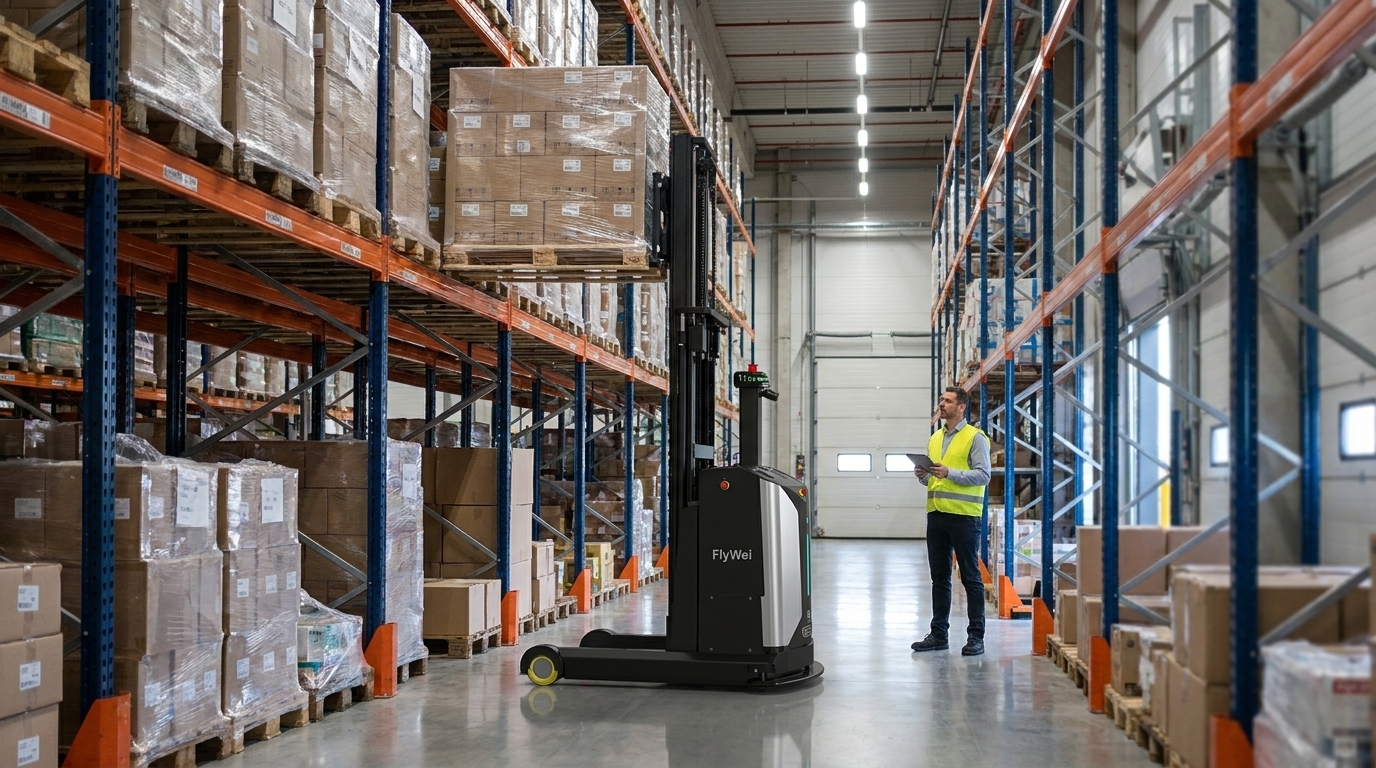
A UK automotive component plant is rarely a blank sheet. The presses and moulding cells were laid out years ago, the works order system is the one the quality team trusts, and every stillage movement has to leave a record that will stand up in a customer audit. So the question a plant manager actually asks is not whether a driverless forklift can move a stillage — it plainly can — but whether it can do so without ripping out the systems that already run the plant. This illustrative case study sets out how FlyWei, as an independent, vendor-neutral integrator of autonomous forklifts and AMRs, typically approaches a brownfield retrofit for a UK automotive component manufacturer.
Illustrative example. The operator described below is a composite persona, not a named FlyWei client. Every figure quoted is a typical capability range for this class of equipment, not a measured project result.
Operation profile (illustrative)
- Operator: a UK Tier-1 or Tier-2 component manufacturer — pressings, mouldings or sub-assemblies — supplying vehicle assembly plants and aftermarket customers.
- Site: a single brownfield plant in the region of 15,000–40,000 m², spanning goods-in, raw-material buffer, production cells, WIP buffer and dispatch.
- Shift pattern: typically two or three shifts across five to six days, with weekend running during launches or model changeovers.
- Load types: returnable metal stillages, euro and industrial pallets, resin octabins, roll cages and dollies of mixed weight and footprint.
- Systems in place: an ERP holding orders and stock, a plant MES that owns traceability, scanning at key gates, and a mixed fleet of manual counterbalance and reach trucks.
- Movement profile: commonly a few hundred to a couple of thousand internal moves per day, spiking around changeovers and dispatch cut-offs.
At-a-glance application snapshot
Typical equipment capability bands for a plant of this shape — indicative, not project outcomes.
- Autonomous counterbalance forklifts: typically 1.4–3.0 tonne payload, for goods-in and heavy stillage work.
- Autonomous pallet trucks and stackers: typically 1.0–2.0 tonne payload, lift heights generally in the region of 1.6–6 m.
- Autonomous reach trucks: typically around 1.4 tonne payload, lift heights up to roughly 10 m where racked storage is involved.
- Lifting AMRs and jacking robots: typically 150–1,000 kg for totes, dollies and roll cages between cells.
- Travel speeds: generally in the region of 1.0–2.0 m/s, tuned down automatically in shared pedestrian zones.
- Aisle requirements: counterbalance work typically wants around 3.0–3.5 m; stacker and very-narrow-aisle classes work considerably tighter.
- Runtime: typically 6–10 hours per charge, with opportunity charging in idle windows so a fleet runs across shifts.
- Navigation and safety: natural-feature SLAM with reflector assistance where needed, safety laser scanners and safety-rated controllers suited to mixed traffic.
The challenge
The traceability record cannot break
An automotive customer expects to know which batch went into which build. If a robot moves a stillage and nothing is written back, the plant has swapped a manual scan for a blind spot. Automation here has to strengthen the audit trail, not thin it out.
The plant systems are not up for replacement
The MES has been validated by quality, the ERP is shared with group finance, and neither is on the table. Any proposal that opens with a system replacement tends to stall at the first review.
Brownfield geometry and mixed traffic
Aisles sized for manual trucks have since collected stillages and tote racks. Cross-traffic between goods-in and the cells is heavy, and pedestrians share routes with trucks exactly when the plant is busiest.
Labour volatility, volume swings and supplier lock-in
Licensed truck drivers are hard to recruit and harder to retain on nights, while volumes move with customer call-offs. Meanwhile a single-manufacturer fleet is easy to buy and awkward to live with: the truck that suits a 3-tonne stillage is rarely the platform that suits a jacking robot under a dolly, so one badge means compromising on one job or the other.
The solution: a vendor-neutral system design
FlyWei does not manufacture robots, so the design starts with the movement, not a catalogue. In a plant of this shape the work usually separates into four families, each matched to the platform that genuinely fits it: autonomous counterbalance forklifts for goods-in and heavy stillage transport; stackers or reach trucks for buffer put-away and retrieval, chosen on lift height and aisle width rather than raw capacity; lifting AMRs and jacking robots for frequent cell-to-cell moves under dollies and trolleys; and pallet trucks running repeatable finished-goods loops into dispatch staging.
Mixing platforms is only sustainable if one layer commands them all. That layer sits above the robots and below the plant systems: it takes work from the MES or ERP over a documented interface, decides which vehicle takes which task, arbitrates traffic across the whole fleet regardless of who built each truck, manages charging, and writes completions back. Where vehicles support the open VDA 5050 standard, one fleet manager can command trucks from different manufacturers in the same message format — which is what makes a mixed fleet practical rather than theoretical.
Integration stays deliberately conservative. The MES remains the record of traceability: each completed move returns a confirmation naming the load, the location it left and the location it reached, and the plant system posts that as it would a scanned movement. Read access is broad, write access narrow and logged. Where a cell, conveyor or shutter must hand over physically, the interface is a PLC handshake rather than someone waving a truck through. And where a plant system has no live interface, a scheduled export of open work with an import of confirmations is usually enough to start.
How a deployment typically runs
- Free site survey. Our engineers usually start by walking the real routes at the busy hour — aisles, floor condition, door thresholds, navigation features, and where pedestrians actually cross.
- Data and simulation. Move logs and call-off patterns are modelled to size the fleet against the changeover peak, not the daily average.
- Interface definition. Fields, exception paths, ownership of each side, and what happens to work in progress if the network drops — agreed in writing before any truck is ordered.
- Phased rollout. One route family goes live first, often finished goods to dispatch, running alongside manual trucks while operators build confidence.
- Live operations. Safety validation, operator training, and a handover that includes the plant maintenance team.
- Scale. Further routes and platforms join the same orchestration layer, so growth is not a second integration project.
Typical results
- Internal transport becomes consistent rather than variable — the same move takes broadly the same time at 03:00 as at 10:00, which makes buffer sizing and dispatch planning easier.
- Breaks, handovers and night shifts stop creating gaps in material flow, so lightly-crewed night running generally becomes feasible.
- Licensed truck operators are typically redeployed to higher-value work such as quality checks and changeover support.
- Stock and traceability records generally improve, because a confirmed move posts automatically instead of relying on a scan someone may forget under pressure.
- Damage to racking, doors and stillages tends to fall, and capacity becomes easier to flex later.
What to consider for your site
- Are locations uniquely identified and stock balances trusted today? Automating on unreliable master data multiplies errors rather than removing them.
- Can your MES or ERP expose open work and accept movement confirmations — through an interface, or at minimum a scheduled export?
- Which moves are genuinely repeatable, and which need a human decision? The first group is the automation case; the second is not.
- What is the real aisle width at the tightest point, and how much pedestrian traffic shares those routes?
- Where does the peak come from — changeovers, dispatch cut-offs or call-off spikes — and what does the fleet need to absorb it?
- Does your supplier commit to an open standard, or does adding a second platform later mean a second integration?
Where to read more
Specifications are set out on our autonomous forklifts and lifting robots pages, the navigation and safety hardware behind them on controllers, comparable sector applications under solutions, and funding routes including lease-versus-buy on leasing.
Talk to an independent integrator
Because FlyWei is vendor-neutral, the recommendation for your plant is not decided before we arrive: we integrate the platforms that fit the moves you actually make, around the systems you already run. Book a free site survey and we will walk your routes, model your peak, and tell you plainly which moves are worth automating first — and which are not.