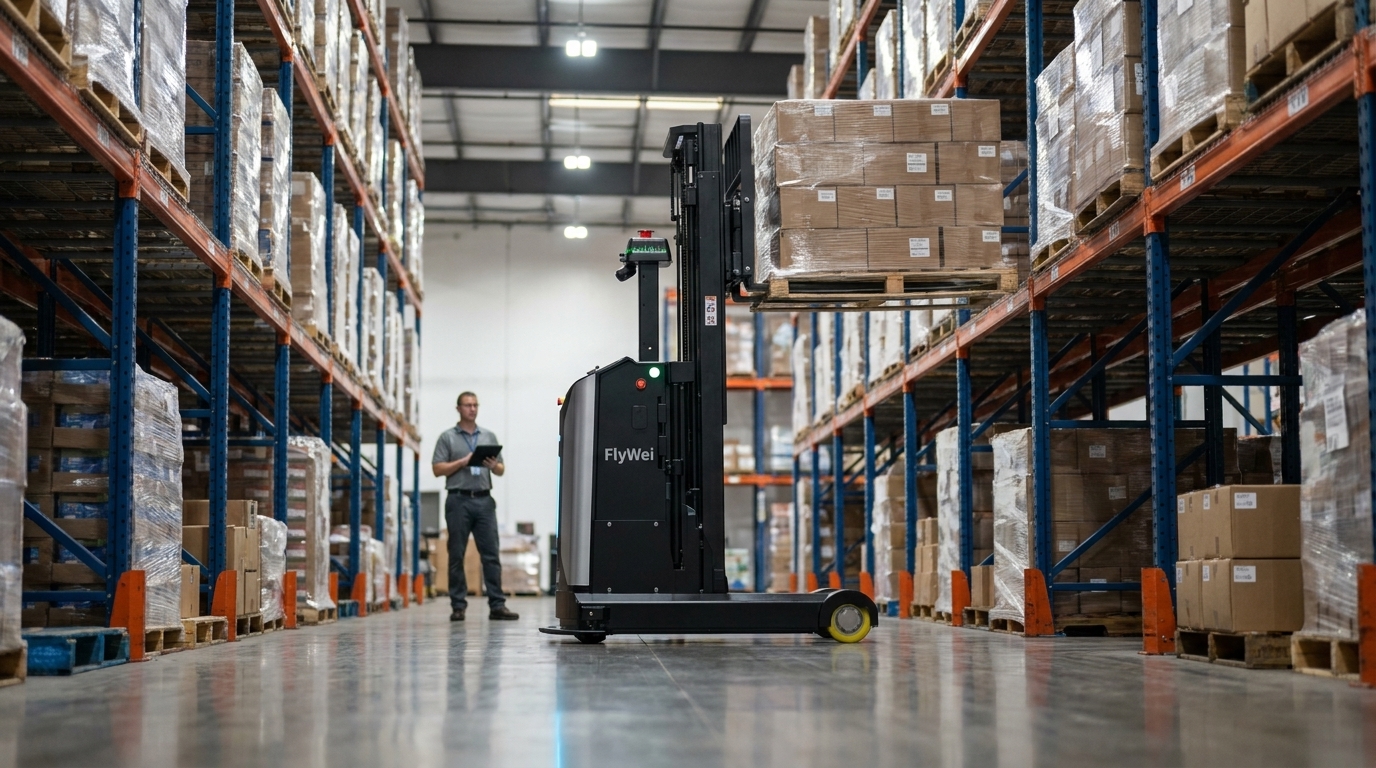
Metals is a sector where a single mis-loaded coil can close a bay for hours and where every intralogistics decision carries weight — literally. In UK metals and steel operations — coil service centres, plate stockholders, structural fabrication shops, non-ferrous distributors and re-rollers — the internal-transport task list looks similar wherever you go: heavy, off-centre unit loads; long straight runs between goods-in, saw lines, shot-blast, paint and dispatch; a shrinking pool of counterbalance-licensed drivers; and a strong safety case for taking the human out of the pallet-versus-pedestrian crossover. This piece walks through how an independent, vendor-neutral integrator like FlyWei typically approaches an autonomous-forklift rollout in a representative UK metals warehouse — the operation profile, the design choices across manufacturers, and the outcome ranges an operations director should realistically expect.
This case study is illustrative — not a named client reference. FlyWei does not publish confidential customer names, addresses or postcodes. The operator profile, capability figures and outcomes below are generic engineering ranges typical of UK metals-sector deployments, not results from a single project.
Operation profile (illustrative)
- Sector: a UK mid-sized metals and steel service centre — coil, plate and long-product stock, with in-house cut-to-length
- Site: single-site, approximately 8,000–18,000 m² under one roof, with an outdoor bunded yard for inbound wagons
- Shift pattern: two shifts weekdays, occasional Saturday overtime, with a growing appetite for lights-out running on the most repetitive internal moves
- Throughput band: in the region of 200–500 pallet-equivalent moves per shift, plus 40–120 heavier coil or plate handoffs to processing lines
- Fleet today: a mixed manual counterbalance and reach-truck fleet, mostly diesel and LPG legacy trucks nearing end-of-lease
At-a-glance application snapshot
The figures below are indicative, typical FlyWei-class capability ranges — not a single project’s promise. Real numbers are always sized from the site survey.
- Autonomous counterbalance forklifts, typically rated in the region of 1.4–3.0 tonnes for coil and pallet work
- Autonomous pallet trucks in the region of 1.5–3.0 tonnes for goods-in and dispatch
- Autonomous reach trucks lifting typically to around 10 m for narrow-aisle racked plate or bar
- Supported aisle widths generally around 1.6–2.8 m depending on truck class
- Payload centre offsets, cradle and clamp attachments engineered to the load — coils, sheet packs, tundishes, billets
- Full 24/7 duty cycle achievable with charge scheduling; opportunity-charging typical between shifts
The challenge
Metals sites carry a heavy safety burden. Coils shift under acceleration, plate packs get out of centre if the fork spread is wrong, and pedestrian yard movements sit uncomfortably close to loaded reversing trucks. Add in the well-documented shortage of counterbalance-licensed operators in the UK, an ageing manual fleet that costs more to service every year, and a customer base that expects same-day cut-to-length, and the pressure on the intralogistics layer is unmistakable. Manual reach-truck operators typically spend a large fraction of their shift on repetitive shuttle runs from stock to saw — work that is boring, tiring, and in a coil environment genuinely dangerous when concentration lapses.
The solution — vendor-neutral by design
FlyWei is an independent UK systems integrator; we do not manufacture the trucks and we are not a single-brand reseller. That matters in metals more than in most sectors, because a single manufacturer rarely has both the right heavy counterbalance and the right narrow-aisle reach truck and the right pallet mover for a service centre in one catalogue. A typical FlyWei design for a UK metals site mixes and matches:
- Autonomous counterbalance forklifts, typically in the 2–3 tonne class, for coil-to-line and yard-to-bay heavy moves — see autonomous forklifts
- Autonomous reach trucks for high-bay plate and long-bar storage
- Autonomous pallet trucks for goods-in receiving and dispatch consolidation
- Lifting AMRs where sub-assembly totes or tooling need to move between cells — see lifting robots
- A safety-rated fleet controller layer speaking WMS or ERP over standard integrations — see controllers
Because the fleet is heterogeneous by manufacturer, load handling is engineered per unit load — coil cradles, C-hooks on lifting AMRs, plate clamps, and vision-assisted docking for critical drop points. Integration with the operation’s existing WMS, ERP or MES is handled through the fleet controller; we do not force a rip-and-replace of the software the operations team already trusts.
How a typical deployment runs
- Free site survey. A FlyWei engineer walks the aisles, measures floors, notes ramps, gradients, expansion joints, dock levellers and pedestrian crossings, and captures a typical week of internal moves.
- Simulation and truck-mix design. The team models the flow at unit-load level and proposes a vendor-neutral mix — counterbalance, reach, pallet — with capacity headroom for peaks.
- Phased rollout. The first wave typically automates the highest-repetition, lowest-variability legs — for example coil-to-slitter shuttles — before extending to more variable dispatch flows.
- Live operations. Chargers, traffic-management zones, MEWP interlocks and marshalling points are commissioned; drivers move to higher-value cover roles.
- Scale. As the base fleet proves out, additional trucks and additional flows are added without re-architecting the controller.
Typical results — ranges only
Every deployment differs, so we deliberately quote engineering ranges and qualitative outcomes rather than pretending to reproduce a single project’s figures:
- Repetitive, in-plant coil and plate shuttle runs are usually the first to become predictable — travel time on those legs generally falls, and unit-load damage on the automated legs typically drops
- Manual counterbalance and reach-truck operators are typically redeployed to higher-value roles — customer-order picking, cut-to-length setup, saw operation, dispatch supervision
- Night-shift and weekend running on the automated legs becomes feasible without adding headcount
- Manual handling near loaded trucks is reduced on the automated crossings, generally improving pedestrian safety on internal roads
- Fleet OpEx becomes more predictable, particularly when combined with a leasing structure — see leasing
What to consider for your site
- Are your heaviest, most repetitive moves clearly identifiable and steady week to week?
- Are aisle widths, floor flatness and dock heights within tolerance for a counterbalance or reach-class AMR?
- What does your unit load actually look like — coil, slit-coil, plate, blank, billet, tundish, cage, pallet? Attachments matter.
- What WMS, ERP or MES does the automation need to speak to, and are stock movements already booked to a barcode or RFID?
- Where will chargers live, and is there electrical headroom for opportunity charging near the busiest bays?
- Do you want to own the fleet, or lease it to smooth cashflow through a phased rollout?
“On a metals site our engineers usually start with a free survey and a truck-mix study across manufacturers — not with a single-brand pitch,” is the FlyWei opening line. Vendor-neutral means the design is chosen for the load, not for a stock list.
Talk to an independent integrator
If you run a UK metals or steel operation and you are weighing autonomous forklifts, autonomous reach trucks or lifting AMRs against another year of manual overtime, book a free site survey. As an independent, vendor-neutral integrator, FlyWei will scope a fleet across multiple manufacturers to fit your loads, your aisles and your WMS — and give you an honest engineering view of what automation can and cannot do for a metals warehouse. Visit our solutions or autonomous forklifts pages to start the conversation.