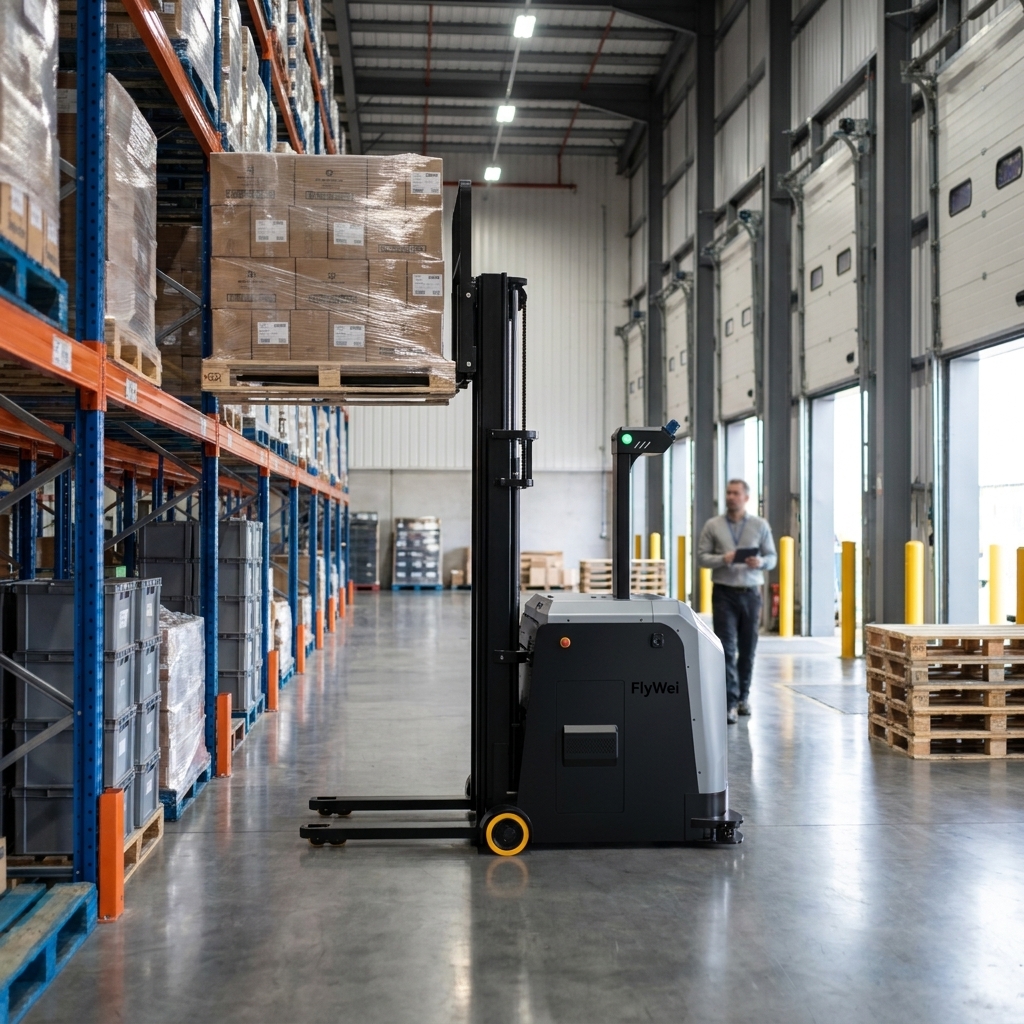
For a UK third-party logistics (3PL) operator, the number that decides whether a contract earns its margin is rarely the pick rate — it is how many weeks pass between signing a new client and running their volume at full rate. Every contract arrives with its own warehouse management system, its own load types and its own service-level promises, and the ramp-up window is where margin quietly leaks away. This illustrative case study looks at how autonomous forklift and AMR automation typically shortens that ramp-up — and what has to be true about your data before it can.
Illustrative note: this is a representative UK third-party logistics scenario, written to show how the technology is normally applied. It is not a named client reference, and every figure below is a typical engineering capability range rather than a measured project result.
Operation profile (illustrative)
- Operator: a UK third-party logistics provider running a shared-user contract logistics site on the Midlands motorway corridor.
- Scale band: in the region of 20,000–50,000 m² under one roof, with three to six client contracts sharing the building.
- Shift pattern: two staffed shifts, a lighter twilight shift, and standing pressure to open a night window at peak.
- Throughput band: typically 6,000–15,000 pallet movements a week across all contracts, plus roll-cage and tote work.
- Contract profile: agreements commonly running three to five years, with volumes that can change inside a quarter.
At-a-glance application snapshot (indicative ranges)
- Pallet transport: autonomous pallet trucks typically rated in the region of 1.5–3.0 tonnes for horizontal moves, marshalling and cross-dock work.
- Put-away to height: autonomous stackers typically working to around 6 m, and autonomous reach trucks in the region of 10 m for high-bay racking.
- Dense storage: very narrow aisle variants typically handling around 1.5 tonnes in aisles far tighter than a counterbalance truck can work.
- Non-pallet loads: lifting and jacking AMRs typically rated from around 150 kg up to 1,000 kg for roll cages, dollies, totes and goods-to-person work.
- Travel speed and runtime: usually in the region of 1–2 m/s, with site traffic rules rather than the vehicle setting the working limit; opportunity charging between task batches typically covers a full shift.
- Navigation: laser SLAM referenced to existing racking and building structure, so most brownfield sites need no floor magnets or reflector arrays.
The challenge: every new client is a new integration
A 3PL warehouse is not one operation. It is several operations sharing a roof, each with its own inventory system, labelling convention, put-away logic and reporting pack. That is why automation in this sector succeeds or fails on the integration seam rather than on the robots.
- A different system every time. One client mandates their own warehouse management system, another expects yours to hold the stock record, a third sends a nightly file and nothing else. The automation must sit under all three.
- Labour that arrives late. Counterbalance and reach-truck licences take time to recruit for, and agency cover is hardest to secure exactly when a new contract goes live.
- Mixed load types under one roof. Pallets for ambient grocery, roll cages for retail replenishment, totes for e-commerce — one vehicle class rarely covers all of it.
- Space that is already spoken for. Ramp-up usually means denser storage in the footprint you have, not a new building — and shared aisles carrying manual trucks, pedestrians and automation at once.
- Assets that outlive the contract. A five-year truck against a three-year agreement is a commercial problem long before it is an engineering one.
The solution: one control layer, several manufacturers
FlyWei is an independent, vendor-neutral systems integrator, not a manufacturer — so the design question is which vehicle from which maker suits each task, rather than how to stretch one product range across a building. On a multi-client 3PL site that matters: pallet moves, high-bay put-away and roll-cage runs are different problems, and the best machine for each rarely comes from one factory.
Matching the vehicle class to the work
- Autonomous pallet trucks for the high-volume horizontal legs — inbound bay to staging, staging to despatch, cross-dock transfers — usually the most repetitive share of the movement profile.
- Autonomous stackers and reach trucks for put-away and replenishment into racking, including the night window manual operations often cannot staff.
- Very narrow aisle vehicles where ramp-up depends on storing more pallets in the same footprint.
- Lifting and jacking AMRs for roll cages, dollies, totes and goods-to-person picking, where a forklift is the wrong tool entirely.
The integration seam
Autonomous vehicles do not connect to a warehouse management system directly. A fleet management layer sits between them: it takes work from your system — or a client's — over a documented interface, turns each task into routes, traffic rules and vehicle assignments, and writes completions and load confirmations back. The existing system stays the record of stock, which is what keeps the arrangement auditable for a client's compliance team.
Because that layer can speak the VDA 5050 open standard, vehicles from different manufacturers can take orders from one place rather than each needing a bespoke interface. For a 3PL that is the point of the exercise: onboarding client four does not mean rebuilding the control stack clients one to three already run on. Where a client's system exposes no interface at all, a scheduled export of open work and an import of confirmations is generally enough to start, with middleware handling translation, retries and duplicate suppression.
How a deployment usually runs
- 1. Site survey. Our engineers normally start a 3PL project by walking the building: aisle widths, floor condition, racking type, level-change transitions, pedestrian routes and the real traffic pattern at shift change rather than the one on the drawing.
- 2. Data and interface review. Locations uniquely identified, stock balances trusted, and a clear answer on how each client's system hands over work. Data readiness, not vehicle commissioning, usually sets the timeline.
- 3. Simulation. The movement profile is modelled against vehicle classes and fleet sizes before anything is ordered, including peak-week behaviour and exception paths.
- 4. Phased rollout. One flow — usually the most repetitive horizontal leg — goes live first alongside the manual fleet, while the traffic rules settle.
- 5. Live operations and scale. Once the first flow is stable, further vehicle classes and further client contracts join the same control layer.
Typical results
What follows is qualitative and typical, not a headline figure attributed to a project.
- Travel time on repetitive horizontal legs generally falls, because vehicles take the same route the same way regardless of shift or workload.
- Operators are typically redeployed to higher-value tasks — exception handling, quality checks, client reporting and value-added services — rather than driving pallets from A to B.
- Running an unstaffed replenishment or marshalling window overnight generally becomes feasible, taking pressure off the morning shift.
- Onboarding the next client is normally faster than the first: the control layer, traffic rules and site map already exist, and only the interface work is new.
- Rack and product damage tends to reduce, and peak becomes a fleet-sizing conversation rather than a recruitment one.
What to consider for your site
- Can each client's system expose open work and accept confirmations — through an interface, or at minimum a scheduled file?
- Are your locations uniquely identified and your stock balances trustworthy today? Automating on top of unreliable master data multiplies errors rather than removing them.
- Which single flow is repetitive enough to automate first, and measurable enough to prove it?
- What are your narrowest working aisle, your highest beam level and your heaviest routine pallet?
- How do contract length, expected volume changes and asset life line up — and does leasing fit that shape better than buying?
- Who owns the control layer if you later add vehicles from another manufacturer, and how will mixed manual and automated traffic be risk-assessed?
Where to read more
- Autonomous forklifts — pallet trucks, stackers, reach trucks, very narrow aisle vehicles.
- Lifting robots and AMRs — jacking and goods-to-person platforms.
- Controllers — the navigation and safety layer under a mixed fleet.
- Solutions and leasing — scoping an application, and funding shape against contract length.
If a new contract is about to land and the ramp-up plan already looks tight, the useful first step is a survey of the building as it actually runs. FlyWei is an independent integrator: we specify the vehicle that suits each flow across multiple manufacturers, and we will say plainly where automation is not yet the right answer. Book a free site survey and talk it through with a vendor-neutral engineer.