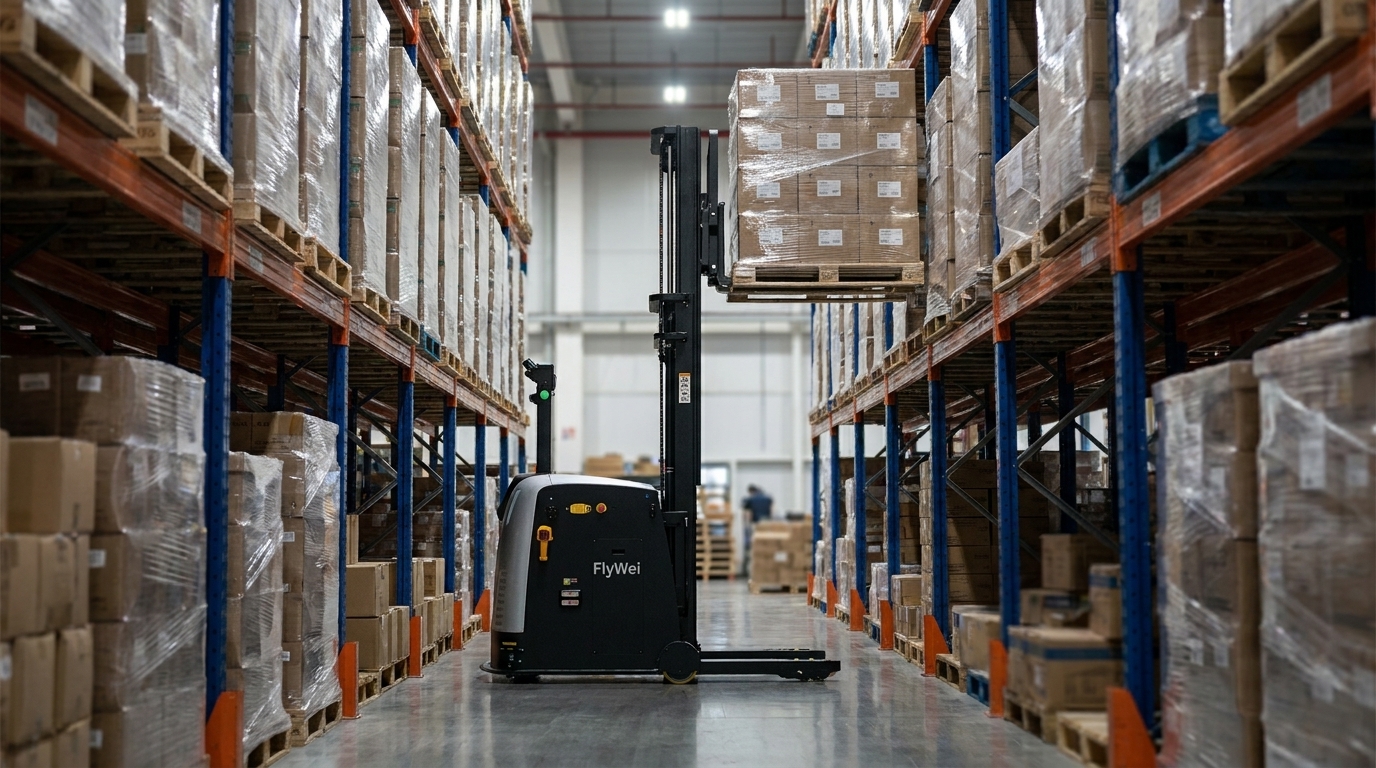
A plastics and polymer processing plant is one of the few warehouse environments where pallets get harder to handle as they get lighter. Mouldings, films, closures and thin-wall containers leave the machines as high-cube, low-density loads that consume rack space far faster than they consume payload capacity — and they arrive without pause, because extrusion and moulding lines do not stop at the end of a shift. On most UK sites the limiting question is not whether a robot can lift the pallet. It is whether the handling fleet can hold a 24-hour production rhythm, and whether it knows what the plant’s own systems already know.
Illustrative scenario. This case study describes how autonomous handling typically works for a representative UK plastics and polymer processing operation. It is not a named client reference. The operator is generic, and every figure below is an engineering capability range or a qualitative observation — never a result claimed for a specific project.
Operation profile
- Operator: An independent UK polymer processor running extrusion and injection moulding under one roof, supplying packaging and technical components.
- Scale band: Roughly 12,000–35,000 m² of combined production and warehouse floor.
- Shift pattern: Production continuous across seven days; warehouse and dispatch typically staffed over two shifts, with a thin or unstaffed night window.
- Throughput band: In the region of 300–900 pallet movements per day, rising during campaign runs and after tool changes.
- Storage profile: High-cube finished goods, commonly in the region of 300–900 kg per pallet against racking rated well above that — space-constrained, not weight-constrained.
- Systems in place: An established ERP with a warehouse module, plus machine-level production counts from an MES or line PLCs.
At-a-glance application snapshot
Indicative capability ranges for the equipment classes that typically suit this environment. These are typical engineering figures, not measured project outcomes:
- Payload: typically 1,000–3,000 kg depending on truck class — comfortably above what most polymer pallets weigh.
- Lift height: in the region of 1.6–6 m for autonomous stacker classes, and up to around 10 m for autonomous reach-truck classes serving high bay.
- Aisle width: narrow-aisle and very-narrow-aisle classes typically work in aisles materially tighter than a conventional counterbalance truck needs — usually the single largest storage-density gain available on a cube-constrained site.
- Travel speed: generally in the region of 1–1.5 m/s laden, deliberately conservative near people and machine aisles.
- Runtime: typically a full shift between opportunity charges on modern lithium iron phosphate packs, topping up in idle windows rather than to a fixed timetable.
- Navigation and safety: natural-feature SLAM with safety laser scanners and certified functional-safety controllers. Floor magnets and wire guidance are rarely needed in a brownfield polymer hall.
The challenge: cube, continuity and the data gap
Three pressures recur on polymer sites, and they interact.
Cube, not tonnage. A blow-moulding or thin-wall line fills pallets with air. Racking is rarely loaded anywhere near its weight rating, so the only route to more storage on the same footprint is tighter aisles and greater height — which pushes operators towards narrow-aisle and reach-truck work that is slow, precise and tiring to do manually all day.
Continuity. Machines run through the night whether or not anyone is available to clear their output. Pallets build up at line ends, operators leave the machine to move them, and a handling delay becomes a production delay. Tool changes and campaign runs then produce bursts that the same fixed crew has to absorb.
The data gap. Most plants already know exactly what has been produced, at which machine, against which works order. That knowledge usually lives in the MES or ERP and never reaches the handling fleet, so drivers are dispatched by radio, line of sight and habit. Stock is reconciled at a shift-end count rather than as pallets actually move. Automating the trucks without closing this gap simply produces a faster version of the same guesswork.
The solution: a vendor-neutral system, not a single-supplier fleet
FlyWei is an independent UK systems integrator, not a manufacturer or a reseller, so a polymer plant is designed around the moves rather than around one supplier’s catalogue. In practice no single robot manufacturer builds the best machine for every move on a plastics site, and a design that pretends otherwise ends up compromising somewhere.
Matching truck class to the move
- Line-end clearance: low-level autonomous pallet trucks and stackers shuttle finished pallets from machine-side buffers to a marshalling lane — short, repetitive, high-frequency moves.
- Putaway into high bay: autonomous reach-truck and very-narrow-aisle classes handle the tall, precise placements that make cube-constrained storage work.
- Totes, regrind and small components: lifting robots and jacking AMRs move roll-cages, totes and octabins of regrind without tying up a fork truck.
- Goods-in and yard: counterbalance classes take trailer and hardstanding work where surfaces and ramps rule out narrow-aisle equipment.
Brownfield retrofit matters here. Much of this fleet can be built on standard production truck chassis fitted with autonomous navigation and functional-safety controllers, which keeps the plant on familiar service parts and lets manual override continue where it is genuinely useful.
Closing the integration seam
The part of the design that decides whether the project succeeds is the interface, not the robot. A fleet management layer sits between the plant’s existing systems and the vehicles: it takes work from the ERP, MES or warehouse module over a documented interface, converts each task into routes, traffic rules and vehicle assignments, and writes completions and load confirmations back. The existing system stays the record of stock — replacing it is almost never necessary.
Because the fleet layer speaks the VDA 5050 open standard, vehicles from different manufacturers can take orders from one controller without a bespoke integration per supplier. That is what makes a genuinely mixed fleet practical, and it is the main reason an independent integrator can specify the right machine for each move rather than the one machine a single vendor happens to sell.
How a deployment runs
- Free site survey. Engineers walk the floor, measure aisles, floor flatness, door and ramp transitions, and record where pallets actually queue — which is rarely where the layout drawing says they should.
- Data review. What can the ERP or MES expose, in what format, and is there a test environment? On most projects this, not the vehicles, is the long pole.
- Simulation. Move profiles are modelled to size the fleet, place charging points and test the awkward cases: tool-change bursts, a blocked aisle, a dispatch surge.
- Phased rollout. One flow is automated first — usually line-end clearance, because it is repetitive and the benefit is visible within days.
- Live operation. Mixed running with manual trucks is the norm, not a transition stage.
- Scale. Further flows and truck classes join the same fleet controller as the case is proven.
Typical results
Deliberately qualitative and ranged — the honest answer is that outcomes depend on the site:
- Travel time between machine and store generally falls, because routing is dispatched centrally rather than by radio and line of sight.
- Night-shift and weekend running of the handling function becomes feasible without a full warehouse crew on site.
- Storage density typically improves where narrow-aisle classes replace counterbalance trucks, since aisles can be designed to the robot rather than to a worst-case manual manoeuvre.
- Stock accuracy tends to improve as movements post on completion rather than at a shift-end count.
- Operators are typically redeployed to quality checks, tool changes and dispatch work rather than spending shifts driving.
What to consider for your site
- Are your locations uniquely identified, and are your stock balances trusted? Automating on top of unreliable master data multiplies errors rather than removing them.
- Can your ERP, MES or warehouse module expose open work and accept confirmations — and if not, would a scheduled export be enough to begin?
- Is your constraint cube or tonnage? The answer changes the truck class entirely.
- Which flow is repetitive enough to automate first, and who owns each side of the interface?
- Would leasing rather than capital purchase better match the equipment to a production contract term?
FlyWei is an independent, vendor-neutral UK integrator: we specify and integrate the best autonomous trucks and robots across multiple manufacturers, then connect them to the systems you already run. If you would like a view of what is practical in your own plant, explore our sector solutions or book a free site survey and talk to an integrator with no manufacturer to defend.