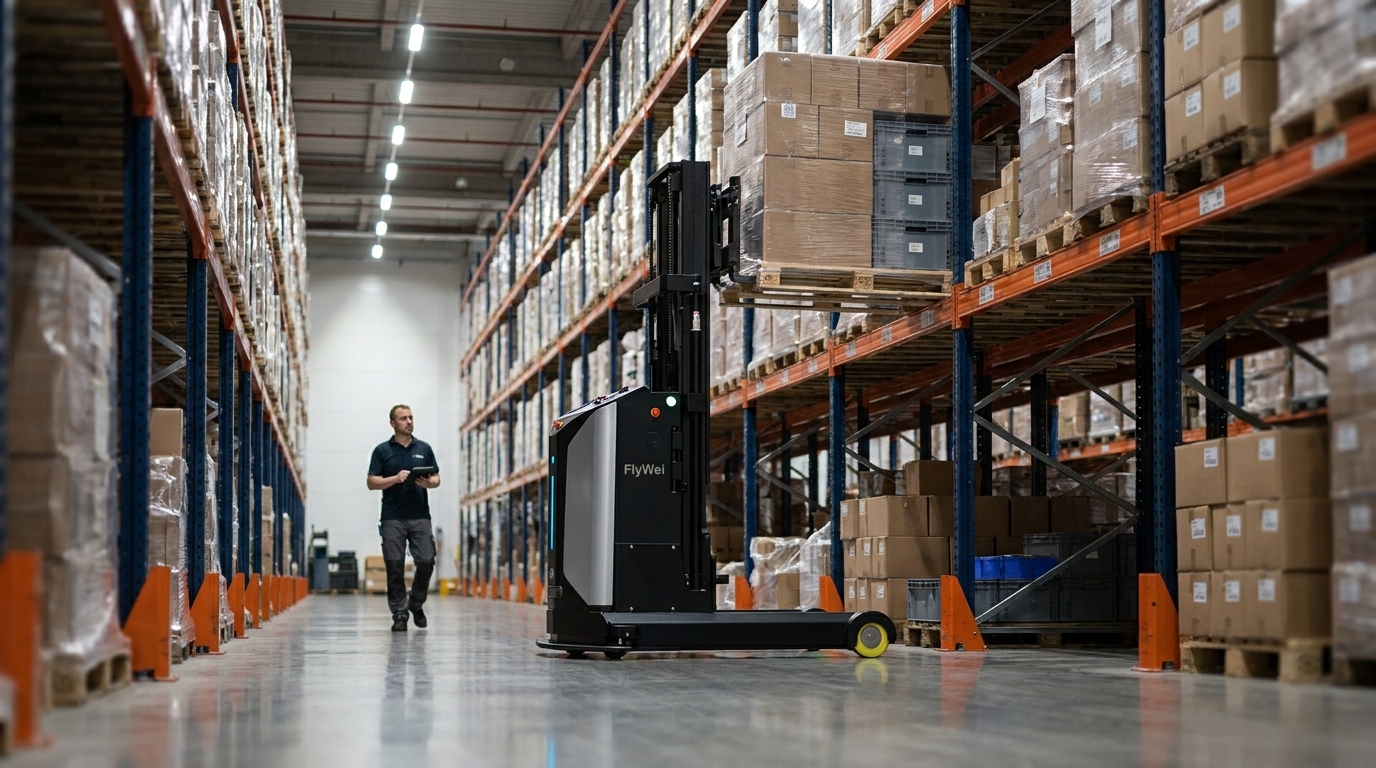
Illustrative scenario. This shows how autonomous forklift and AMR automation typically works for a UK chemicals and lubricants operation. It is a representative engineering example drawn from FlyWei's capability, not a named client reference: no customer is identified, and every figure below is an indicative capability range, not a measured project result.
In a UK blending and lubricants business, the hard part of intralogistics is rarely the weight of the pallet — it is the paperwork attached to it. A pallet of finished engine oil, a part-filled IBC of additive, a stillage of returned empties: each carries a batch number, a hazard classification and a location that some system of record has to believe in. When those facts are captured at the end of a shift rather than as the load moves, stock accuracy drifts, batch genealogy is reconstructed after the event, and despatch spends its morning chasing pallets rather than loading them. Automation earns its place here when it closes that gap — when the robot that moves the pallet is also what confirms where the batch went.
Operation profile
- Sector: Chemicals & lubricants — blended base oils, additive packages, coolants and pack-sized finished goods.
- Operator type: An illustrative UK blender and contract filler with its own distribution warehouse. No real operator is described.
- Site footprint: Typically 8,000–25,000 m²: blending and filling hall, ambient racked warehouse, bunded hazardous store and marshalling area.
- Shift pattern: Two manned shifts with a lightly-staffed overnight replenishment window.
- Load mix: Typically 1,000 L IBCs, 205 L drums, kegs, shrink-wrapped part-pallets and returned empties.
- Throughput band: Broadly in the region of 400–1,200 pallet-equivalent moves per 24 hours.
- Systems in place: An established ERP holding batch and stock records, a warehouse module of varying maturity, and filling-line PLCs signalling pallet completion.
At-a-glance application snapshot
Indicative planning bands, not a specification for any particular site.
- Equipment classes: Autonomous pallet trucks (low-lift driverless forklifts) for high-cycle horizontal lanes; autonomous stackers and reach trucks — automated guided forklifts (AGFs) — for racked put-away; counterbalance units for heavier drum work; lifting AMRs for part-pallets, kegs and totes.
- Typical payload band: Roughly 1.0–3.0 tonnes per truck; lifting AMR classes typically cover 150 kg to around 1,000 kg.
- Typical lift height band: In the region of 3–10 m across ambient racking, with low-lift classes on the horizontal traceability lane.
- Aisle width: Usually configured to the existing layout — reach classes generally suit aisles of about 2.7–3.0 m, with very-narrow-aisle variants down to roughly 1.7 m.
- Runtime and charging: Lithium-iron-phosphate packs typically give in the region of 8–12 hours of active duty; opportunity charging during changeovers is normally enough to sustain round-the-clock running.
- Integration surface: A vendor-neutral fleet layer between the ERP and the trucks, using the open VDA 5050 standard to command vehicles from more than one manufacturer.
The challenge: the batch record lags the pallet
Chemicals and lubricants sites tend to run a perfectly capable system of record — an ERP already holding batch numbers, hazard data and stock balances — alongside a floor process that updates it late. A filled pallet leaves the line, sits in a staging lane, is moved by whoever is free, and is confirmed into a location some time afterwards. Between those moments the pallet exists physically but not accurately in the record.
That lag is expensive here because the consequences are regulatory as well as operational. Segregation rules depend on knowing what is actually stored where; recall exposure depends on genealogy that is complete rather than reconstructed; hazardous despatch documentation depends on the pallet in the bay matching the pallet on the note. Operations teams usually know where the weak link is — they have no spare labour to close it by adding another confirmation step to a driver's cycle, and with a mixed profile of IBCs, drum pallets and returned empties, scanning discipline is applied unevenly in any case.
The solution: automate the lane, keep your system of record
FlyWei is an independent, UK-based systems integrator. We do not manufacture trucks or resell a single range, so a chemicals fleet is specified zone by zone rather than badge by badge — and we never ask an operator to replace the ERP that already holds their batch data.
Where the traceable lane usually starts
The highest-value first lane is normally the release-to-warehouse move: filling line or blending hall, through a defined handover point, into racked or bunded storage. It is high-cycle, predictable — and exactly where the record goes stale. Automating it typically means a small group of autonomous pallet trucks on a fixed route, with stackers or reach trucks taking the put-away leg.
How the systems actually connect
Autonomous forklifts do not talk to an ERP directly. A fleet management layer sits between them: it takes work from the ERP over a documented interface, turns each task into routes, traffic rules and vehicle assignments, and writes completions back. Each completed move returns a confirmation naming the load, the location it left and the location it reached — so the stock movement posts as the pallet moves, not at a shift-end count. Where no suitable interface exists, a scheduled export of open work and an import of confirmations is often enough to begin. The ERP stays the record of stock and batch throughout.
Mixed manufacturers, one fleet
No single manufacturer builds the best truck for every zone of a chemicals site. Because the fleet layer speaks VDA 5050 — an open standard for commanding mobile robots — vehicles from different manufacturers run under one control layer without a bespoke integration per supplier. So the truck that suits the bunded store is chosen on its merits, without compromising the choice made for the high-bay aisles.
What happens when the link drops
A well-designed integration degrades rather than stops: trucks finish the task already issued and then hold safely, while the fleet layer queues completions and replays them on reconnection with duplicate protection. Ask any integrator this directly — it matters more in a hazardous-goods environment than almost anywhere else.
How a deployment runs
- Free site survey. Our engineers start on the floor: aisle widths, floor tolerance, racking pitch, classified and bunded zones, marshalling lanes — and what the ERP can expose and accept.
- Data readiness check. Locations must be uniquely identified and balances trusted first; automating on unreliable master data multiplies errors rather than removing them.
- Simulation. The real mix of IBC, drum, keg and packaged-pallet moves is modelled against peak profiles to size the fleet — often smaller than expected, because autonomous cycles vary less than manual ones.
- Phased rollout. Phase one is normally the single release-to-warehouse lane, alongside manual trucks under managed rules of the road.
- Live operations. Shared running first, then defined overnight replenishment once the team is comfortable.
- Scale. Despatch, put-away and narrow-aisle zones join the same orchestration layer, without disturbing what works.
Typical results
We do not attach single-point statistics to an illustrative scenario. Broadly, well-scoped programmes in this sector tend to show:
- Stock and batch records updating as loads move rather than at a shift-end reconciliation.
- Operators typically redeployed from repetitive truck duty to blending-hall supervision and despatch quality.
- Travel time and cycle variance generally falling as consistent robot missions replace manual variability.
- Overnight running usually becoming feasible for defined replenishment tasks, freeing daytime capacity.
- Fewer segregation and documentation exceptions, because the record reflects the floor in near real time.
- Damage to IBCs, drum pallets and rack uprights typically reducing, as cycles are engineered for a controlled set-down.
Your own outcome depends on load mix, layout, system maturity and the current baseline.
What to consider for your site
- Where does your batch record go stale — at line release, put-away or despatch?
- Can your ERP expose open work and accept movement confirmations, or would a light orchestration layer be needed on top?
- Are locations uniquely identified and balances trusted today? If not, that is the first piece of work.
- Which zones are classified or bunded? That shapes equipment selection at survey stage, not at rollout.
- Is there one high-cycle lane that would make an obvious phase one?
- Would full-service leasing suit the operating profile better than capital purchase?
Further reading: autonomous forklifts, lifting robots, controllers, solutions, leasing.
Book a free UK site survey
FlyWei is an independent, vendor-neutral integrator of autonomous forklifts and AMRs, specifying across manufacturers and connecting robots to the systems you already run. If you operate a UK chemicals or lubricants site and want a straight answer on whether a traceable automated lane is worth doing, book a free site survey and talk to an engineer.