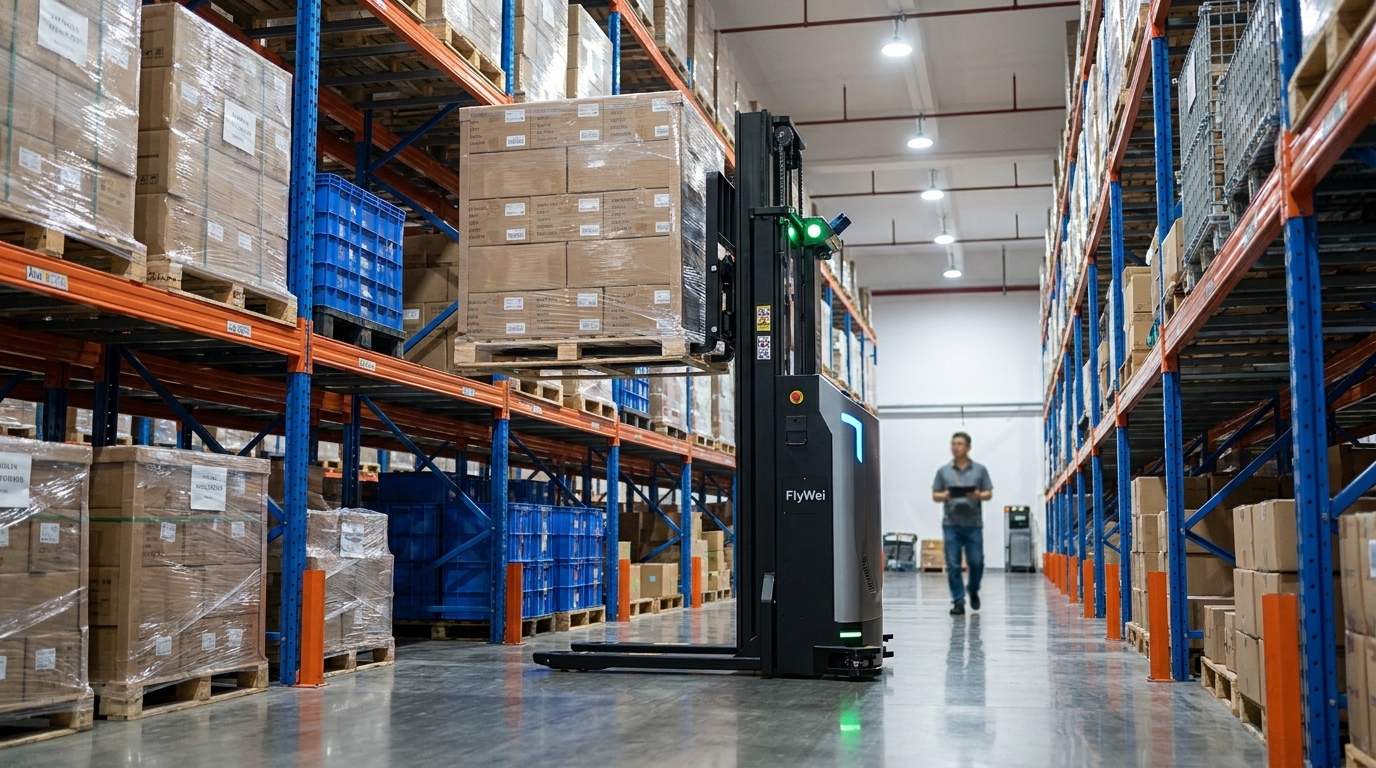
Illustrative scenario. FlyWei does not publish confidential client names. The operator described below is a representative composite of UK grocery and supermarket distribution operations, and every figure is a typical engineering capability range — not a measured result from a single named project.
Ask a grocery distribution manager what stops a robot project and the answer is rarely the robot. It is the data. A supermarket distribution centre moves the same pallet through ambient, chilled and frozen space, against date codes, store allocations and a despatch window that will not move — and every move must be visible in the warehouse management system the moment it happens. Automation that shifts pallets beautifully but reports them late simply relocates the problem. This illustrative study looks at how a vendor-neutral fleet of autonomous forklifts and mobile robots is typically designed around a UK grocery operation's existing WMS, so that traceability improves as the trucks come online rather than waiting on an integration phase two.
Operation profile
- Operator: a UK regional grocery & supermarket distribution centre serving a cluster of stores and a small online picking operation (illustrative composite — not a real named business).
- Scale band: typically in the region of 15,000–35,000 m² under one roof, with mixed ambient, chilled and a modest frozen chamber.
- Shift pattern: usually a six- or seven-day operation, goods-in weighted to daytime, store despatch weighted to late and overnight.
- Throughput band: commonly a few thousand pallet movements per week in and out, rising materially across promotional and seasonal peaks.
- Systems: an established WMS of record, an ERP above it, and a transport system owning the loading sequence.
At-a-glance application snapshot
Indicative capability ranges for the vehicle classes that typically fit this kind of site — engineering envelopes, not project results.
- Payload: typically 1,000–3,000 kg per vehicle across pallet truck, stacker, reach and counterbalance classes.
- Lift height: in the region of 1.6 m for low-level pallet moves, up to roughly 6 m for autonomous stackers and around 10 m for autonomous reach truck classes.
- Travel speed: generally around 1.0–1.7 m/s laden, tuned down in pedestrian-shared and chilled areas.
- Runtime: usually a shift-length duty cycle with opportunity charging in natural dwell periods, not scheduled battery changes.
- Aisle width: commonly from about 1.6 m for very-narrow-aisle classes, which is what makes retrofitting existing racking feasible.
- Placement accuracy: typically within about ±10 mm at pick and drop, which is what allows a confirmation to be trusted as a stock movement.
- Temperature: ambient and chilled duty is standard; sub-zero and chamber-to-dock transitions need condensation-managed builds specified deliberately.
The challenge
Grocery distribution punishes vagueness. Four pressures recur on UK sites:
Stock truth degrades between counts
Where moves are confirmed on a terminal at the end of a run, or by a chalk mark and a later reconciliation, the WMS is accurate at shift end and approximate in between. Short-life lines make that expensive: a mis-recorded location on a date-sensitive pallet is a write-off waiting to be discovered.
Date-code and rotation discipline
FIFO is the stated rule; FEFO is the real one. Enforcing rotation manually depends on the person on the truck knowing the line, and that knowledge walks out of the door with agency turnover.
Three temperature regimes, one pallet flow
The same pallet may cross ambient, chilled and frozen boundaries. Each zone has different traction, condensation, visibility and dwell-time constraints — and a vehicle specified for one is often wrong for another.
Repetitive long-haul moves consume skilled drivers
Trunking pallets from goods-in to reserve, and from reserve down to a pick face, is high-mileage, low-judgement work — and where experienced drivers spend hours they could give to loading, exceptions and yard work.
The solution
As an independent integrator, FlyWei starts from the moves and the data, not from a catalogue. Two design principles usually drive a grocery brief.
Right vehicle class per move, across manufacturers
A single proprietary platform asked to cover every zone of a grocery DC is compromised somewhere. Because FlyWei is vendor-neutral and integrates robots from multiple manufacturers, a typical design mixes classes: autonomous forklifts — pallet trucks for horizontal trunking, autonomous pallet stackers for reserve put-away, reach classes where height is the constraint, counterbalance for dock and yard-facing work — alongside lifting robots and AMRs where totes, roll cages or goods-to-person sequences are involved. Chilled and frozen duty is specified explicitly rather than assumed.
The WMS stays the record of stock
The robots do not talk to the WMS directly and should not. A fleet management layer sits between them: it takes work from the WMS or ERP over a documented interface, converts each task into routes, traffic rules and vehicle assignments, and writes completions and load confirmations back. Because that layer can command vehicles from different suppliers through an open standard, mixed fleets do not mean a separate integration per manufacturer. Where a legacy system exposes no live interface, a scheduled export of open work and an import of confirmations is usually enough to start. On-vehicle safety and navigation controllers handle the real-time layer — obstacle detection, speed zoning, safe stops — independently of the business systems above.
The practical effect is that each completed move posts as a stock movement naming the load, the location it left and the location it reached. Failed or abandoned moves raise an exception rather than posting silently. Rotation rules live where they belong — in the WMS — and the fleet executes them without relying on tribal knowledge.
How a deployment runs
- Site survey. Our engineers normally start a grocery project on site: aisle and door dimensions, floor condition, temperature boundaries, pedestrian and manual-truck interaction, and — critically — how the WMS currently exposes work and accepts confirmations.
- Simulation. Modelling the real move mix, including peak weeks, before any vehicle is quoted. Fleet size, charging strategy and traffic rules are settled here — where a poor idea is cheap to discard.
- Integration and data readiness. Locations uniquely identified, stock balances trusted, exception handling agreed. Automating on top of unreliable master data multiplies errors rather than removing them, so this runs before go-live, not after.
- Phased rollout. Typically one well-bounded flow first — often ambient goods-in to reserve — proven in live conditions alongside manual trucks.
- Live operations. Mixed manual and autonomous running, with operators trained to handle exceptions rather than to drive.
- Scale. Additional flows and zones added against measured behaviour, with vehicle class chosen per flow rather than inherited from phase one.
Typical results
Ranged and qualitative only — a comparable site should expect directional outcomes of this kind, not a guaranteed figure:
- Stock records generally move from shift-end accuracy toward move-by-move accuracy, because confirmations post as pallets land.
- Rotation compliance typically becomes systematic rather than person-dependent.
- Travel time on repetitive trunking routes usually falls, and it becomes predictable, which matters more than the saving itself when planning a despatch window.
- Operators are typically redeployed to loading, exception handling and yard work rather than displaced.
- Extended and overnight running generally becomes feasible without proportional labour increases.
- Risk exposure in mixed-traffic aisles tends to reduce, as the highest-mileage moves become consistently speed-zoned and sensor-governed.
- Manual handling and cold-exposure time in chilled and frozen space is generally reduced.
What to consider for your site
- Can your WMS expose open work and accept move confirmations, and is there a test environment?
- Are all storage locations uniquely identified, and are current stock balances trusted?
- Which moves are genuinely repetitive and high-mileage — and which need human judgement?
- Where are your temperature boundaries, and what happens to a vehicle crossing them repeatedly?
- What is the narrowest aisle a vehicle must work in, and the highest beam it must reach?
- How are exceptions surfaced to your team today, and who owns them at 03:00?
- Is capital or an operating-lease structure the better route for your finance team? Our leasing options exist precisely because that answer differs by operator.
- Would you rather be advised by an integrator with a single platform to defend, or one that can specify across manufacturers?
FlyWei is an independent, vendor-neutral UK systems integrator: we specify and integrate the best-fitting autonomous forklifts and AMRs across multiple manufacturers, and connect them to the systems you already run. To test this scenario against your own aisles, temperature zones and WMS, explore our sector solutions or book a free site survey — an independent assessment, with no obligation to buy from anyone.