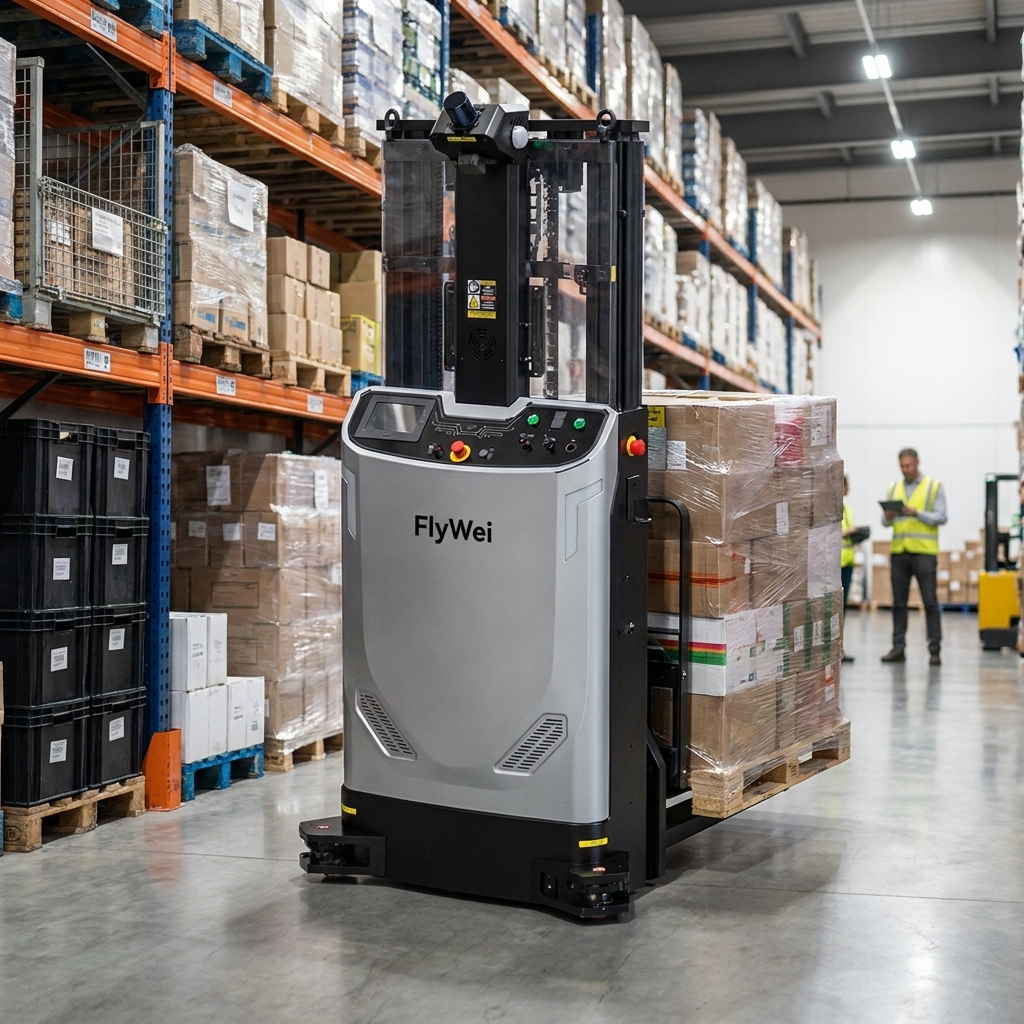
A food and beverage plant runs to two clocks at once. The line clock will not wait: once a filler or a depositor is running, everything downstream has to keep up. The hygiene clock decides when the line may run at all, and stops for wash-downs, allergen changeovers and quality holds whether or not the warehouse is ready. Pallet movement sits between the two — line end to wrapper, wrapper to chill or ambient store, store to despatch — and usually absorbs every delay the other two create.
An illustrative scenario. FlyWei does not publish client names or confidential site data. What follows is a representative account of how autonomous forklift and AMR automation typically works for a UK food and beverage production operation, built from the equipment classes and deployment methods our engineers use on real sites. Every figure is a capability range, not a result claimed for any project.
Operation profile
- Operator: a mid-sized UK food and beverage producer, own-label and branded lines, supplying grocery and foodservice customers.
- Site: a single building in the region of 10,000–25,000 m², combining a wet production hall, a chilled buffer and an ambient finished-goods store.
- Shifts: typically two production shifts with a wash-down window overnight, moving to near-continuous running during promotional and seasonal peaks.
- Throughput: indicatively a few hundred to low thousands of pallets a week across several finished-goods lines, plus inbound ingredient and packaging pallets.
- Constraints: allergen segregation, date-code discipline, wet and chilled floors, and racking laid out long before anyone considered automating it.
At-a-glance application snapshot
Indicative capability bands for the equipment classes that typically suit this kind of site — design envelopes to check against your own building, not a quotation.
- Payload: autonomous pallet trucks and stackers typically in the 1.0–3.0 tonne range, which covers most full pallets of packed food and filled drinks.
- Lift height: commonly up to around 6 m for autonomous stacker classes, with reach-truck classes generally reaching roughly 10 m where the racking demands it.
- Aisle width: very-narrow-aisle classes typically operate in aisles in the region of 1.6–2.0 m; counterbalance classes usually need something closer to 3.5–4.0 m of working aisle.
- Travel speed: generally in the region of 1.2–2.0 m/s in open runs, reduced automatically in shared and pedestrian zones.
- Runtime and charging: lithium iron phosphate packs typically give most of a shift between charges, with opportunity charging at natural dwell points, so no battery-change routine is needed.
- Temperature: ambient and chilled duty is routine for standard builds; sustained sub-zero and high-humidity duty calls for a cold-rated specification and condensation management.
The challenge
The recurring pain in food and beverage production is rarely a shortage of trucks. It is that pallet movement is interrupt-driven and hard to staff.
Changeovers create bursts, not flow
An allergen or recipe changeover empties the line end of one product and fills it with another in a short window. The handling demand is spiky: clear everything, stage the new packaging, and do it without leaving a pallet of the previous product where it could reach the next run.
Hygiene zoning cuts the building into pieces
Wet and dry areas, high-care and low-care boundaries and wash-down schedules mean a truck cannot simply take the shortest route. Routes must respect the zoning, and equipment crossing a boundary has to be cleanable, and cleaned.
Date codes punish improvisation
Short-shelf-life stock makes first-expired-first-out a commercial requirement, not a preference. When a pallet is put down somewhere convenient instead of its recorded location, the cost surfaces later as write-off, a picking error or a failed customer audit.
Labour is the hardest part to hold
Reach-truck work on a chilled or wet floor, at night, is among the hardest material handling work to recruit for and retain. Overtime and agency cover often mask a structural shortage rather than solving it.
The solution: a vendor-neutral system design
FlyWei is an independent UK systems integrator, not a manufacturer or a reseller of one range. That matters on a site like this, because a wet production hall, a chilled buffer and a high-bay ambient store do not want the same machine. A single-range answer forces at least one area to accept a compromise.
A typical design mixes classes rather than standardising on one:
- End of line to wrap and buffer: autonomous pallet trucks and stacker classes handle the short, high-frequency moves away from the palletiser. These runs are predictable, and are usually where automation earns its place first — see autonomous forklifts.
- Buffer to store: where racking is high or aisles narrow, reach and very-narrow-aisle classes take the put-away, keeping the location record accurate at the moment the pallet lands.
- Totes, trays and roll-cages: lighter internal moves — packaging feed, QA and sample runs, returnable trays — suit lifting robots and AMRs rather than a forklift class.
- Navigation and safety: LiDAR natural-feature navigation avoids cutting the floor for wire guidance, and certified safety scanners with functional-safety robot controllers govern speed and stopping in shared zones.
Integration is where these projects are won or lost. Robots do not talk to your ERP directly: a fleet management layer takes work from your WMS, ERP or line PLCs over a documented interface, translates it into missions, and writes completions and load confirmations back, so your existing system stays the record of stock. Where a fleet spans more than one manufacturer, the VDA 5050 open standard lets one fleet manager command vehicles from different suppliers without a bespoke interface for each — which is what makes a mixed, best-fit fleet practical rather than theoretical. More on our sector approach sits on the solutions pages.
How a deployment runs
- Site survey. Our engineers usually start a food and beverage project on the floor: aisle widths, floor condition, door and zone boundaries, wash-down regime, racking geometry, and where pedestrians actually walk rather than where the markings say they do.
- Data and simulation. Move profiles are taken from your own records and simulated before anything is ordered, so fleet size, charging positions and traffic rules are tested against your real peak, not an average week.
- Phased rollout. A first phase generally takes one well-understood, repetitive flow — most often line end to buffer — running alongside manned trucks, not instead of them.
- Live operations. Exception handling is agreed before go-live: what happens to a mission if the WMS link drops, how a blocked location is escalated, who clears a stranded pallet at two in the morning.
- Scale. Further flows are added once the first is stable, reusing the same fleet layer and integration rather than starting again.
Typical results
Honest reporting matters more here than a headline percentage. These are the outcomes operations teams generally report, not numbers attributed to any project:
- Travel time on repetitive line-end runs typically falls: a robot takes the same route at the same speed regardless of the hour.
- Stock accuracy generally improves, since each completed move posts a confirmation naming the load and the location it reached, instead of relying on a shift-end reconciliation.
- Night-shift and wash-down-window running becomes feasible without a full manned crew on the floor.
- Operators are typically redeployed to higher-value work — quality checks, changeover preparation, despatch marshalling — instead of repeating the same loaded trip.
- Rack, product and door damage tends to reduce, because speed and approach are governed rather than judged.
What to consider for your site
- Are your storage locations uniquely identified, and do you trust your stock balances? Automating on unreliable master data multiplies errors rather than removing them.
- Can your WMS or ERP expose open work and accept confirmations — through an interface, or at minimum a scheduled export?
- Which flows are genuinely repetitive, and which are judgement calls better left manned for now?
- Where do hygiene zones cross traffic routes, and what is the cleaning regime for equipment that crosses them?
- Does any part of the duty cycle need a cold-rated or wash-down-rated specification?
- Is capital or an operating lease the better route for your business? Our leasing page covers the options without pretending one suits everyone.
Talk to an independent integrator
The most useful thing FlyWei can do is look at the actual building before recommending anything. Because we are vendor-neutral, the answer might be a mixed fleet, a single class, or — occasionally — that a flow is not yet worth automating. Book a free site survey and we will tell you which of those it is.