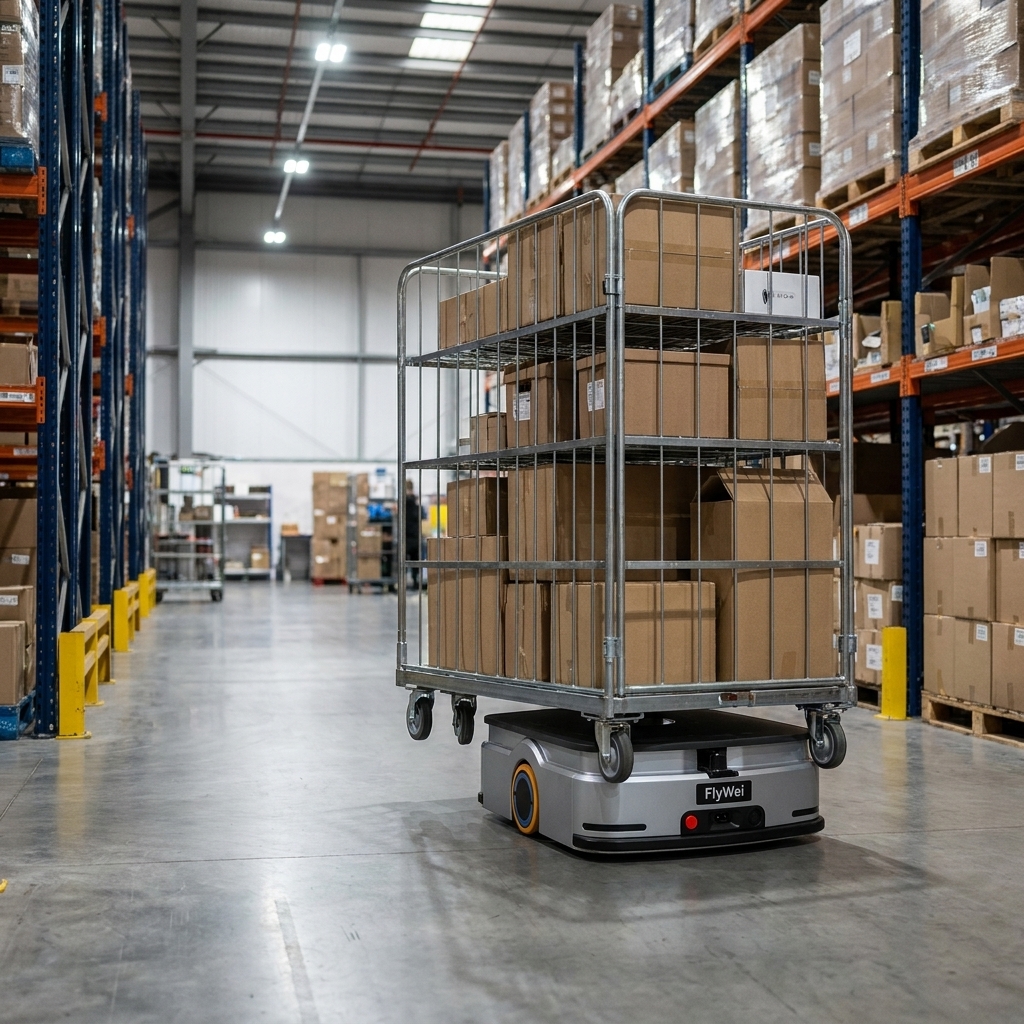
Illustrative case study — this article describes a representative UK aerospace & defence operation, not an identifiable named client. Figures shown are typical engineering ranges, not project-specific claims.
A spares and MRO operation in aerospace and defence is asked to do two contradictory things at once: hold a very long tail of slow-moving stock, and release any single line of it within hours when an aircraft is on the ground. For a UK aerospace and defence operation, autonomous forklifts and lifting AMRs are less about replacing a picker than about keeping a store surge-ready without staffing for the worst day of the month — inside an existing building, without tearing out the racking or replacing the system of record.
Operation profile
A representative UK aerospace and defence spares and MRO operation — not a specific client, and no real site or customer.
- Type: the spares and MRO support arm of a UK aerospace and defence group — rotables, consumables and repair kits supporting airframe, rotorcraft and land-systems fleets.
- Footprint: typically in the region of 8,000–18,000 m²: goods-in and inspection, a narrow-aisle small-parts store, bulk and long-item racking, a bonded and export-controlled cage, and a kitting and despatch hall.
- Shift pattern: commonly a single weekday day shift with an on-call rota for aircraft-on-ground demand, usually under pressure to extend towards round-the-clock cover.
- Throughput band: high-mix, low-volume — commonly tens of thousands of active part numbers, with order lines dominated by singles and small kits rather than full pallets.
- Regulatory context: AS9120 distribution quality, serial and batch traceability, export-control obligations, and customer clauses covering foreign object debris, security and stock segregation.
At-a-glance application snapshot
Indicative capability ranges — typical engineering envelopes for these vehicle classes, not measured project results.
- Vehicle classes: autonomous reach and very narrow aisle trucks for height; autonomous pallet trucks and stackers for goods-in and despatch; jacking and roller-top lifting AMRs for totes and kit trolleys.
- Payload envelope: typically in the region of 150–1,000 kg for lifting AMRs, and 1.0–3.0 tonnes for forklift-class vehicles.
- Lift height: typically a few hundred millimetres for jacking AMRs, in the region of 6 m for autonomous stackers, and up to roughly 10 m for reach and very narrow aisle trucks.
- Availability: typically 6–10 hours of running between charges, with opportunity charging in natural gaps making extended and unattended shifts feasible.
- Interfaces: work taken from the warehouse or ERP system already in place; robot command and state over the open VDA 5050 standard where the vehicles support it.
The challenge
Spares and MRO stores in this sector share a recurring set of pressures, and few are solved by buying a faster truck.
- Demand arrives in spikes. A grounded aircraft turns a routine day into a same-hour retrieval, kit and despatch job. Staffing for that peak leaves capacity idle most of the week; staffing for the average means overtime and improvisation.
- Licensed operators are scarce. Very narrow aisle and high-reach work needs trained, certificated drivers, and that pool is generally shrinking across UK industry. A single absence can effectively close an aisle.
- The long tail is physically inconvenient. Slow movers occupy height and depth, so retrieving one line can mean a long travel and a high lift for a part weighing a few kilograms.
- Loads are mixed. Pallets, stillages, long items, sealed transit cases, totes and kit trolleys rarely suit one vehicle type.
- Segregation is not optional. Bonded, export-controlled, customer-owned and quarantined stock has to stay separated, and every movement has to be attributable afterwards.
- The building already exists. Most UK sites here are brownfield: existing racking, floor and security zoning, and a quality-approved system of record nobody wants to re-validate.
The solution
FlyWei is an independent integrator rather than a manufacturer, so the opening question is which vehicle suits each leg of the work — not which vehicle sits in one supplier's catalogue. In a spares store that usually points to a deliberately mixed fleet, because no single manufacturer's range is simultaneously the best answer to a 10 m retrieval in a narrow aisle and a low-profile robot that slides under a kit trolley.
Matching the vehicle class to the leg
- Goods-in and despatch: autonomous pallet trucks and stackers absorb the repetitive trunking between bays, inspection and despatch — the highest-mileage, lowest-judgement moves on site. See autonomous forklifts.
- Height and density: autonomous reach and very narrow aisle trucks reach the slow-moving tail without a certificated driver waiting on each retrieval.
- Kitting and goods-to-person: jacking and roller-top lifting robots bring trolleys and totes to a seated inspector or kitter, so high-value parts are handled at a bench rather than carried across a hall.
One fleet manager over a mixed fleet
A mixed fleet only works if one layer arbitrates it. A fleet management layer assigns tasks, sets traffic and priority rules, manages charging and holds the site map, so vehicles from different manufacturers share aisles under one set of rules instead of running as separate islands. Where vehicles speak the open VDA 5050 standard, that removes the need for a bespoke integration per manufacturer — the point at which multi-supplier projects most often come unstuck. Safety-rated controllers and laser scanners keep protective stopping a vehicle-level function, independent of the fleet layer above.
Integration without replacing the system of record
The existing warehouse or ERP system stays the source of truth. The robot layer takes work from it and returns acceptance, completion, exception and load-confirmation messages, so stock balances move as parts move rather than at a shift-end count. Segregation rules live in the same layer: which vehicles may enter the bonded or export-controlled zone, which routes avoid it, and what happens to a task interrupted part-way. Where a legacy system has no live interface, a scheduled export of open work and an import of confirmations is usually enough to begin.
How a deployment runs
Our engineers usually start an aerospace and defence project with a site survey rather than a vehicle recommendation, because the constraint is almost always the building and the data, not the robot.
- Site survey: floor condition, aisle and door widths, racking type, charging positions, pedestrian routes, security zoning, and where loads actually queue today.
- Data review: whether locations are uniquely identified, whether stock balances can be trusted, and how the existing system exposes open work and accepts confirmations.
- Simulation: modelling flows and peaks before committing to a fleet size, so surge behaviour is tested on a model rather than during a live aircraft-on-ground event.
- Phased rollout: automating one repeatable leg first — commonly the goods-in to store trunk — then adding retrieval and kitting.
Typical results
Qualitative and ranged outcomes for this class of application — not results attributed to a specific project.
- Long internal travel legs generally fall away from skilled staff, who are typically redeployed to inspection, kitting and quality work rather than driving between aisles.
- Peak response usually becomes less dependent on who is on shift, because retrieval capacity is available on demand rather than rostered.
- Running into evenings, nights or weekends normally becomes feasible without a matching jump in headcount.
- Stock accuracy tends to improve where each completed move posts a confirmation, and damage exposure generally reduces as repeatable machine handling replaces manual high-lift retrieval.
- Fleet composition can be revisited later — with a vendor-neutral fleet layer, adding a different manufacturer's vehicle is a configuration exercise, not a restart.
What to consider for your site
- Which single leg of movement consumes the most operator hours for the least judgement? That is normally the first candidate.
- Are your locations uniquely identified and your stock balances trustworthy? Automating on top of unreliable master data multiplies errors rather than removing them.
- Can your existing system expose open work and accept confirmations, or is a scheduled file exchange the sensible starting point?
- Does the proposed fleet layer speak an open standard natively, or through an adapter that ties you to one manufacturer? And would owning or leasing the vehicles suit your capital planning better?
Talk to an independent integrator
Every aerospace and defence store combines building, data and regulation differently, so the first step is a survey, not a quotation. FlyWei is vendor-neutral: we integrate the best-suited autonomous forklifts and AMRs across multiple manufacturers, connect them to the systems you already run, and stay accountable for the result as a whole. Explore our solutions, or book a free site survey to find out which leg of your operation is worth automating first.