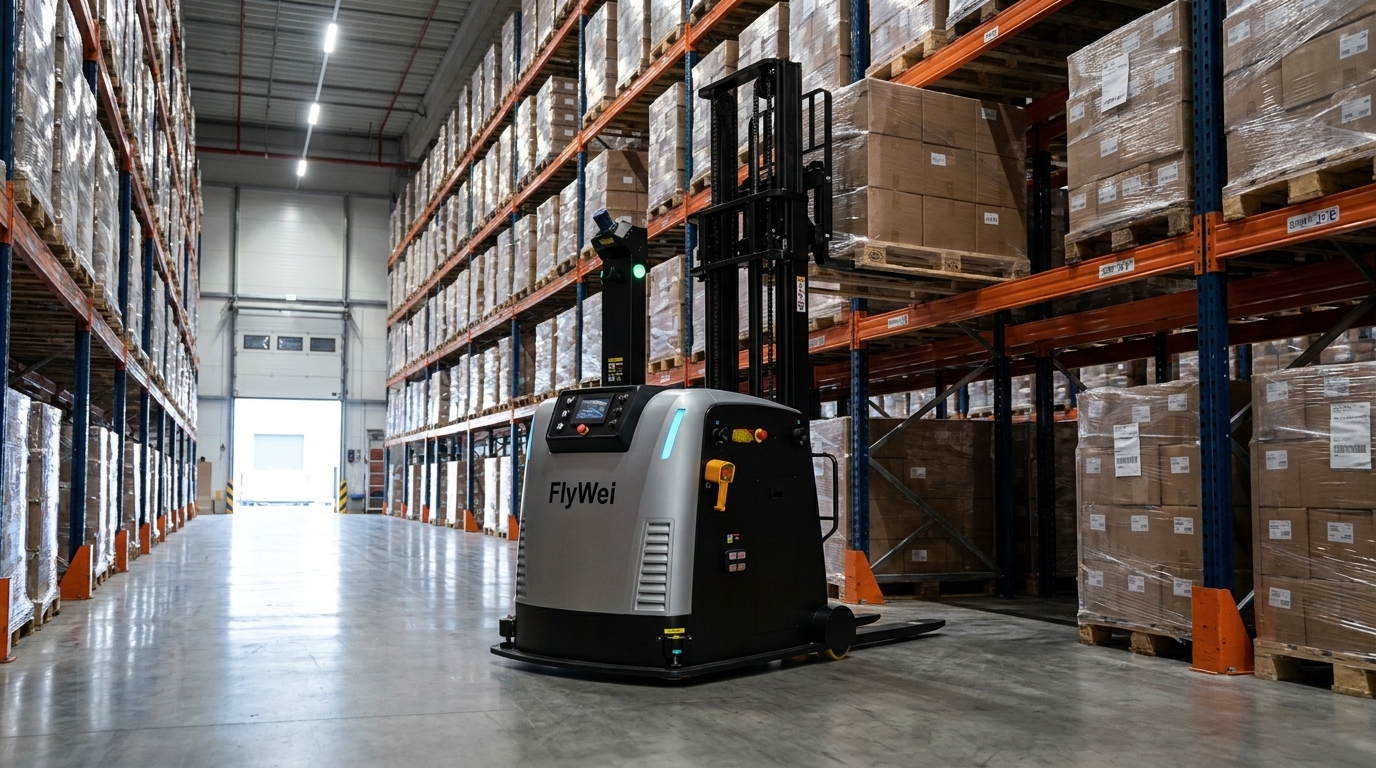
In pharmaceutical and healthcare distribution, the warehouse management system is not simply software. It is a validated part of the quality system, tied to change control, audit trails and Good Distribution Practice. That is where a great many UK automation projects stall before they begin — on the assumption that autonomous trucks mean ripping out the WMS and revalidating everything around it. They usually do not. This is what autonomous forklift and AMR automation typically looks like when it is designed to sit around a validated WMS rather than replace it.
Illustrative scenario. The operator described below is a representative UK pharmaceutical and healthcare distribution profile, not a specific named client. All figures are typical engineering ranges drawn from FlyWei project experience, not measured results from a single deployment.
Operation profile
- Sector: UK pharmaceutical and healthcare distribution — wholesale supply to hospital pharmacies, community pharmacy and primary care.
- Footprint: a regional distribution centre in the region of 12,000–30,000 m².
- Storage mix: ambient racking for the bulk of lines, a 2–8 °C chilled chamber, a secure controlled-drug cage, and a quarantine and returns area.
- SKU profile: typically 6,000–15,000 active lines, with a long tail and a pronounced fast-moving head.
- Shift pattern: two day shifts plus an overnight despatch wave for next-day delivery.
- Systems: a GxP-validated WMS as the system of record, an ERP above it for orders and finance, and batch-and-expiry traceability end to end.
- Regulatory posture: MHRA-licensed wholesale dealer operating to UK Good Distribution Practice, with formal change control over anything that touches stock records.
At-a-glance application snapshot
The following are indicative capability ranges for the classes of machine typically specified on a site of this shape. They describe what the equipment can do — they are not a promised project outcome.
- Fleet shape: typically three to eight autonomous trucks across pallet-truck, stacker, reach and counterbalance classes, frequently blended across more than one manufacturer, plus a small number of lifting AMRs for tote and roll-cage moves.
- Lift height: generally 5–8 m for reach-class machines in narrow-aisle racking; in the region of 1.5–3 m for stacker-class trucks working pick faces.
- Payload: usually 1,000–2,000 kg for pallet handling; typically 150–600 kg for tote and cage AMRs.
- Travel speed: normally capped in the region of 1.2–2 m/s in shared pedestrian areas, and higher on segregated runs.
- Aisle width: reach and very-narrow-aisle classes typically operate from roughly 1.6–2.9 m, depending on truck class and pallet handling.
- Runtime: commonly a full shift on opportunity charging, with machines docking automatically between tasks rather than at fixed breaks.
- Navigation: natural-feature and reflector-assisted SLAM, generally without floor magnets or wire guidance — which matters where a sealed resin floor cannot be cut.
The challenge
A pharmaceutical depot rarely has a throughput problem in the abstract. It has a compliance-shaped throughput problem.
The WMS cannot simply be swapped
The system of record has been validated and its interfaces are documented in the site quality file. A supplier who proposes to replace it, or to become the new master of stock, is proposing a validation exercise that will outlast the robot deployment several times over. Most operations quite reasonably refuse — and then assume automation is closed to them.
Every move has to be evidenced
A pallet that moves without an attributable record is a deviation. Automation must therefore write back what it did — load, source location, destination, time — in a form the WMS accepts, and must raise an exception rather than post silently when a move fails.
Mixed handling on one floor
Ambient pallets, chilled totes, secure lines drawn under supervision and a steady trickle of returns share the same aisles and the same people. The peak is driven by the despatch wave, not spread across the day.
Labour that is hard to hold
Counterbalance and reach licences plus GDP training make an experienced operator expensive to replace, and night-shift cover is the hardest of all to recruit consistently.
The solution
The design principle is straightforward: the WMS stays the system of record, and a fleet management layer sits between it and the robots. The WMS says what needs to move. The fleet layer decides which machine goes where, in what order and under what traffic rules. The robots report position, load and task state back, and the fleet layer returns clean confirmations to the WMS.
Class before brand
As an independent integrator, FlyWei specifies the truck class against the task before anyone discusses a badge:
- Autonomous pallet trucks for horizontal moves — goods-in to staging, staging to despatch lanes, the long repetitive runs that consume most operator hours. See autonomous forklifts.
- Autonomous stackers and reach trucks for put-away and replenishment into narrow-aisle racking, where lift height and residual capacity at height decide the specification.
- Counterbalance-class machines where trailer loading and yard-adjacent moves need the reach and stability.
- Lifting AMRs for tote, tray and roll-cage flows, including goods-to-person presentation at a pick station — see lifting robots.
Because FlyWei is tied to no single manufacturer, a mixed fleet is a normal outcome rather than a compromise: the best machine for a chilled chamber and the best machine for a narrow aisle need not come from the same factory. What makes that practical is a common command layer. Open interoperability standards such as VDA 5050 let one fleet manager issue orders to vehicles from different suppliers in a single message format, and the robot controllers underneath are chosen for the safety rating the application actually demands rather than the one that happens to ship.
Where the integration seam sits
In a validated environment, the seam is the whole design question. Typical practice:
- The WMS exposes open work over a documented interface — or, where none exists, through a scheduled export and import handled by middleware. The core system is not modified.
- The integration account is scoped tightly: broad read access, narrow write access.
- Every completed move returns a confirmation the WMS posts as a stock movement, so balances update as pallets move rather than at a shift-end count.
- Failed, abandoned or ambiguous moves raise an exception to a named person. Nothing posts silently.
- If the link drops, the fleet layer finishes the task in hand, holds safely, queues completions, and replays them without duplication when the link returns.
- The robot network is segmented from the business network, with supplier remote access controlled and logged — IEC 62443 zones and conduits being the usual reference.
Scoped this way, the change-control conversation is about an interface, not about a new system of record. That is the difference between a project the quality team can assess and one it has to refuse.
How a deployment runs
- Free site survey. Our engineers walk the flows with the operations and quality teams: floor condition, aisle widths, door and airlock interfaces, dock layout, where pedestrians and trucks genuinely conflict, and which moves are repetitive enough to automate first.
- Data and interface review. Are locations uniquely identified? Are stock balances trusted? Can the WMS expose open work and accept confirmations? Where master data is unreliable, automating on top of it multiplies errors rather than removing them, so that is fixed first.
- Simulation. Flows are modelled to size the fleet and test traffic rules before anything is ordered. This is also where a proposed fleet size gets challenged honestly downwards.
- Phased rollout. One flow — usually the dullest and most repetitive — goes live first, with people alongside. Confirmations are reconciled against the WMS record before the flow is trusted unattended.
- Qualification support. FlyWei supplies the documentation the quality team needs for its own change-control file: interface specification, exception handling, safety assessment and test evidence.
- Live operations and scale. Further flows are added on the same fleet layer. Because that layer is manufacturer-neutral, the next ten machines are not decided by the first one bought.
Typical results
Honest reporting matters more in this sector than a headline figure, so what follows is deliberately qualitative and ranged.
- Repetitive long-haul moves — goods-in to staging, staging to despatch — are typically the first taken off people, and travel time generally falls as a share of the shift.
- Operators are usually redeployed to work that needs judgement: exception handling, quality checks, controlled-drug picks, goods-in verification.
- Pre-wave and night-shift running generally becomes feasible without a full crew, because machines will work the replenishment queue unattended.
- Stock records tend to become more current, since movements post as they happen rather than at a count.
- Rack and product damage typically falls, because approach speeds and lift profiles are consistent rather than driver-dependent.
- The audit trail becomes easier to evidence: every automated move carries a machine identity, a timestamp, and a confirmed source and destination.
What does not happen is a step change on day one. Benefit accrues flow by flow, as the fleet takes on more of the routine and the operation learns to trust it.
What to consider for your site
- Which of your moves are genuinely repetitive, and how many operator hours do they consume across a week?
- Does your WMS expose open work through a documented interface, or would a scheduled export be the honest starting point?
- Is a test environment available, and who owns each side of the interface?
- Are your locations uniquely identified and your stock balances trusted today?
- How wide are your aisles at their tightest, and what is the floor condition through the chilled chamber and its door interfaces?
- Where do pedestrians and trucks currently conflict — and would automation remove that conflict or simply move it?
- What must your quality team see before a flow is allowed to run unattended?
- Does outright purchase or a lease better suit the way capital is approved on your site? See leasing and funding options.
- Is the control layer you are being offered manufacturer-neutral, or does the first machine decide the next ten?
Talk to an independent integrator
FlyWei is a vendor-neutral UK systems integrator of autonomous forklifts and AMRs. We have no manufacturing arm and no exclusive dealership, so we have no reason to recommend a truck that does not fit your aisle or a control layer that locks your next decision. Our engineers start every pharmaceutical and healthcare project with a free site survey and a frank view of which flows are worth automating and which are not. Browse our wider sector solutions, then book a survey — we will tell you plainly what your operation stands to gain, and what it does not.