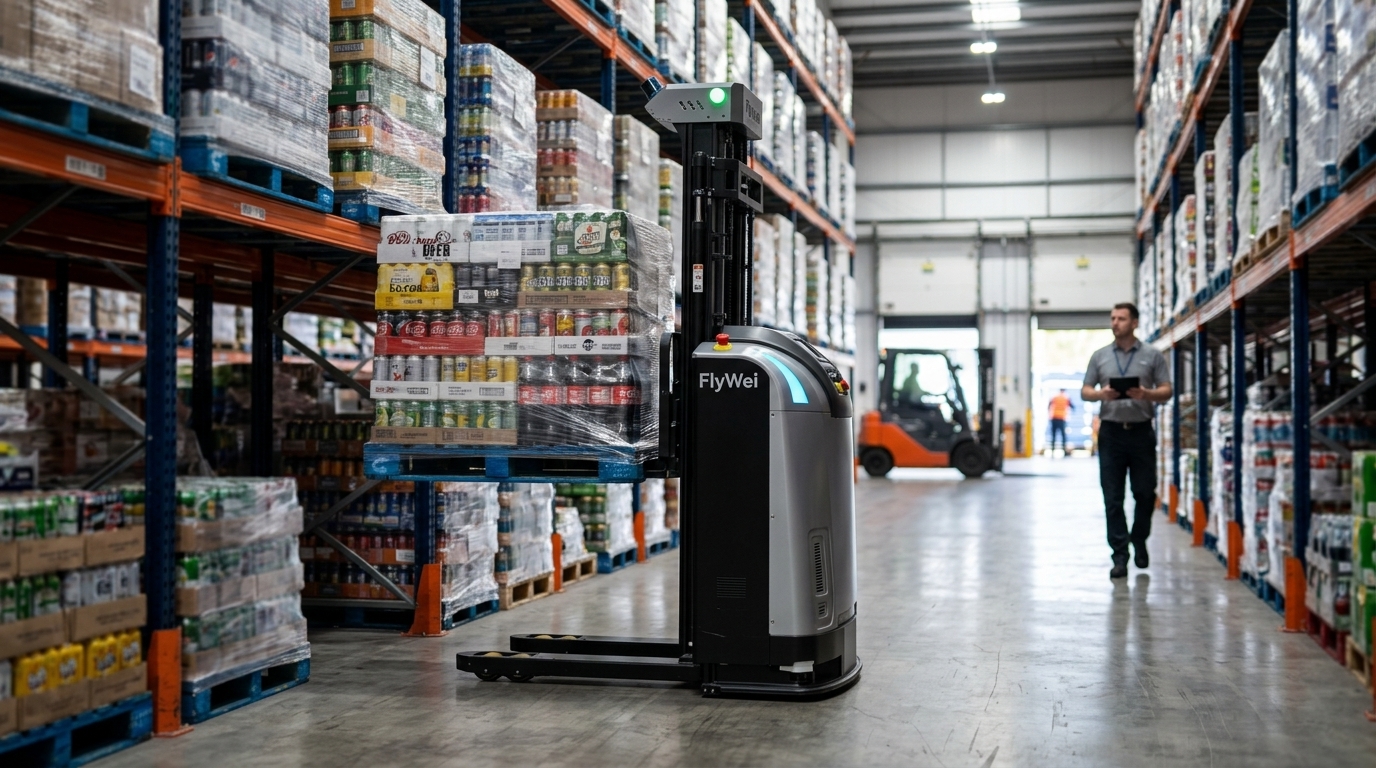
AGV forklift cost in a UK drinks distribution centre is best understood as a five-year total cost of ownership figure rather than a sticker price, because hire, leasing, full-service maintenance, energy, fleet-management software and the avoided cost of agency forklift drivers all sit inside the same procurement decision. The headline number every drinks procurement committee asks for is the per-machine monthly outlay — and it lands meaningfully below a traditional manned forklift once the labour line is added back in. UK workplace-transport injuries are still running at around 1,300 RIDDOR-reported incidents a year, with lift-trucks the largest single contributor — and the Health and Safety Executive lists forklift-related events as the highest-impact workplace-transport category. For Procurement Directors at UK drinks DCs in Burton-on-Trent, Daventry and Magna Park, that pain is doubly acute: peak season demands more forklifts, off-season needs fewer, and a five-year capex commitment fits neither half of the calendar.
Why drinks procurement keeps stalling on AGV forklift cost
Drinks logistics in the UK runs on a brutal calendar: a Q4 spike around Christmas, a Q2 spike around summer, sport-driven peaks, and a broad off-peak trough. A traditional manned forklift fleet is sized for the peak — meaning 30 to 40 per cent of the asset base sits idle for six months of the year, while peak still needs agency drivers at premium rates. Procurement Directors see the resulting forklift line every quarter and rightly ask whether automation changes the maths.
The hesitation is rarely the technology. It is that the procurement committee is being asked to compare a fully loaded autonomous forklift price (chassis, sensors, charging, software, integration, service contract) against a stripped manned forklift price (just the truck) without the labour, agency premium, sickness cover, training and lift-truck incident exposure netted off. The Logistics UK Skills Report has tracked persistent forklift-operator shortages and rising hourly costs for three running years; when those are added back, the comparison flips.
The second blocker is residual value risk. A bought autonomous forklift is on the balance sheet for seven years; demand may not be. The shift to 3, 5 and 7-year leasing, alongside Robotics-as-a-Service per-machine monthly pricing, exists precisely to lift that risk off the operator and onto the supplier — the only commercial structure that survives a Procurement Director''s worst-case scenario test.
Lever 1 — Operational: fleet flex against the drinks calendar
Rather than sizing a single fleet for the peak, lease two tiers. A permanent core of four to six autonomous forklifts on a 5 or 7-year lease for steady-state flows (inbound from bottling, palletised picks for repeat retail orders), and a flex layer of two to four machines on a 12 to 24 month rental for Q4 and Q2. The core fleet absorbs steady-margin moves; the flex layer carries the seasonal risk. FlyWei''s M4 fleet manager allows machines to be added and removed without re-architecting the routing — every robot you onboard self-orients to the same map.
This is the single biggest cost lever in a drinks DC. A core of six leased autonomous forklifts at, conservatively, £2,200 to £2,800 per robot per month all-inclusive, plus a seasonal layer of four flex machines, will typically come in below the fully loaded cost of a manned counterbalance fleet of the same throughput, once the agency line is netted out. The labour saving compounds when the DC runs a third shift — a forklift driver costs the same at 02:00 as at 14:00; a driverless forklift does not.
Lever 2 — Commercial: 3-year vs 5-year vs 7-year lease vs RaaS
A 3-year lease keeps the lowest commitment but a higher monthly outlay; a 5-year lease is the sweet spot for the steady-state core; a 7-year lease gives the lowest monthly figure but is harder to flex with the business. Robotics-as-a-Service — per-robot per-month with no asset on the balance sheet — wins when the operator wants pure opex treatment for IFRS 16 reasons, or when the drinks brand is expanding into new SKUs and does not want to bet on a five-year volume forecast. The right answer is almost never one lever: a typical FlyWei drinks customer mixes a 5-year lease on the core plus RaaS on the flex.
The comparison below is the spine of every procurement paper. Use it as the first page of the Capex committee submission.
| Structure | Term | Capex commitment | Peak-season flex | Service and software | Best for |
|---|---|---|---|---|---|
| Outright purchase | 7 to 10 year asset life | Full upfront | None — own the resale risk | Separate contract | Stable volumes only |
| 3-year lease | 3 years | None | High at term end | Bundled | Uncertain demand, fast pivots |
| 5-year lease | 5 years | None | Mid | Bundled | Steady-state core fleet |
| 7-year lease | 7 years | None | Low | Bundled | Lowest monthly outlay |
| RaaS per-robot monthly | Rolling 12 to 36 months | None | Highest | Bundled plus uptime SLA | Seasonal flex layer |
Lever 3 — Technical: the right machine class for drinks flows
Drinks DCs are pallet-density operations. Most flows are full-pallet inbound from bottling, full-pallet putaway, full-pallet picks and outbound to the retail RDC. That favours counterbalanced and reach-truck autonomous forklifts rather than tote shuttles or cube storage. A FlyWei counterbalanced autonomous forklift handles 2-tonne stacked beverage cartons and shrink-wrapped kegs to standard pallet heights; a reach-truck variant handles narrow-aisle high-bay racking up to 8m. Both are governed by the M4 fleet manager and dispatched by RDS robot dispatch against the existing WMS without ripping it out. Energy cost per pallet move on a modern automated guided forklift sits well inside the operating envelope of a manned IC counterbalance once charging is opportunity-based at break points.
Lever 4 — Regulatory: PUWER, LOLER and ISO 3691-4 are spec, not extras
Any compliant autonomous forklift sold into a UK DC must meet PUWER 1998 for the work-equipment requirement, LOLER provisions for the lifting attachment, and the autonomous-industrial-truck-specific ISO 3691-4 for safety architecture. A drinks DC also needs to verify floor flatness against BS EN 15620 and TR34 — autonomous forklifts at speed amplify any floor defect. The right procurement question is not whether it complies but what evidence of compliance ships with the machine. A FlyWei machine ships with a PUWER inspection record, an ISO 3691-4 conformity declaration, and an ACOP L117-aligned operating envelope; a buyer who has to chase a paper trail later is a buyer paying twice. For DIRFT- and Magna Park-style multi-tenant 3PL sites where the drinks contract sits next to non-drinks freight, the compliance pack is also what unlocks the safety case with the site landlord.
A leased autonomous forklift in a UK drinks DC lands meaningfully below the fully loaded cost of a manned counterbalance fleet once the agency labour line, sickness cover and peak-season premium are added back in.
What FlyWei does in a UK drinks DC
FlyWei designs, supplies, integrates and services autonomous forklifts for UK drinks distribution centres on a single commercial framework. A typical engagement starts with a 30-minute site survey at the operator''s Burton-on-Trent, Daventry or Magna Park DC, leads into a fleet-sizing model that maps the drinks calendar onto a leased core plus a flexible RaaS layer, and ends with a deployment under M4 fleet manager and RDS orchestration. FlyWei autonomous forklifts cover counterbalanced 2-tonne handling, reach-truck high-bay storage, and pallet-truck dock-to-stock moves — every class governed by ISO 3691-4 safety.
Engineering, commissioning and on-call service are delivered by UK-based engineers, not subcontracted. Service is bundled into every leased machine and into the RaaS subscription, so the procurement committee sees one monthly figure that already includes uptime. For drinks DCs that want to validate fit before committing, FlyWei offers a 48-hour feasibility read on the operator''s highest-volume flow — a documented pallet-move trace, with cost-per-move and ROI estimate, against the existing fleet baseline.
FAQ
What does an AGV forklift cost in the UK in 2026?
Fully loaded monthly cost for a leased autonomous forklift in a UK drinks DC typically falls in a £1,800 to £3,400 per-robot per-month range, depending on payload class (1.5t pallet truck vs 2t counterbalance vs reach truck), lease term (3, 5 or 7 years), and whether full-service maintenance and M4 software are bundled. Volume pricing applies above three machines. RaaS deals are priced per-month with no upfront capex. Request a specific quote via FlyWei procurement.
Is leasing or buying an autonomous forklift better for a drinks DC?
For most UK drinks operators, leasing wins on three grounds. First, peak-versus-off-peak demand flex is impossible to do with owned assets. Second, leasing converts capex to opex which simplifies IFRS 16 treatment and protects the balance sheet. Third, leased machines come with bundled service, software updates and uptime SLAs, eliminating the parallel service contract a bought fleet otherwise needs.
How does AGV forklift cost compare to a manned counterbalance forklift?
On the sticker, an autonomous forklift is two to three times the capex of a manned IC counterbalance truck. Once labour, agency cover, multi-shift premiums, sickness, training, and lift-truck incident exposure are added to the manned figure, the per-pallet-move cost crosses over inside 24 to 30 months in a typical UK drinks DC running two or three shifts.
What is included in a FlyWei autonomous-forklift lease?
Every FlyWei lease bundles the autonomous forklift, charging infrastructure, M4 fleet-manager software, RDS robot dispatch, ongoing software updates, scheduled and reactive maintenance, spares for wear items, and a defined uptime SLA. The operator sees one monthly invoice per robot. Charging hardware is included; the operator provides the 3-phase electrical tail.
Can a drinks operator flex AGV forklift numbers across peak season?
Yes. The standard FlyWei approach is a permanent core leased on 5 or 7 years plus a flex layer on rolling RaaS — typically 12 to 36 month rental terms — that scales up for Q2 and Q4 and back down for Q1 and Q3. Because every machine is governed by the same M4 fleet map, scaling up is an onboarding step rather than a re-integration project.
Are FlyWei autonomous forklifts compliant with PUWER, LOLER and ISO 3691-4?
Yes. Each machine ships with a PUWER inspection record, a LOLER-aligned lifting-equipment declaration where forks are present, and an ISO 3691-4 conformity declaration for autonomous-industrial-truck safety. ACOP L117 operating envelopes are documented for the safety case file. A FlyWei deployment engineer signs the compliance handover with the operator''s HSE lead.
How quickly does an AGV forklift pay back in a UK drinks DC?
Payback in a UK drinks DC typically lands at 24 to 36 months on a 5-year lease, driven by the labour line and the avoided peak-season agency premium. Operators running a third shift see faster payback, since the labour saving compounds across three shift cycles per day rather than two.
If AGV forklift cost is sitting on your Q3 capex review and the drinks calendar is making the maths ugly, FlyWei can model the rental-versus-lease-versus-RaaS shape against your actual pallet-move data, not a generic spreadsheet.
Request a fleet-sizing and ROI estimate for your DC — or browse FlyWei autonomous-forklift leasing terms (3, 5 and 7 years) to see the commercial structures available before the call.
UK-based engineers · no obligation · reply within one business day.