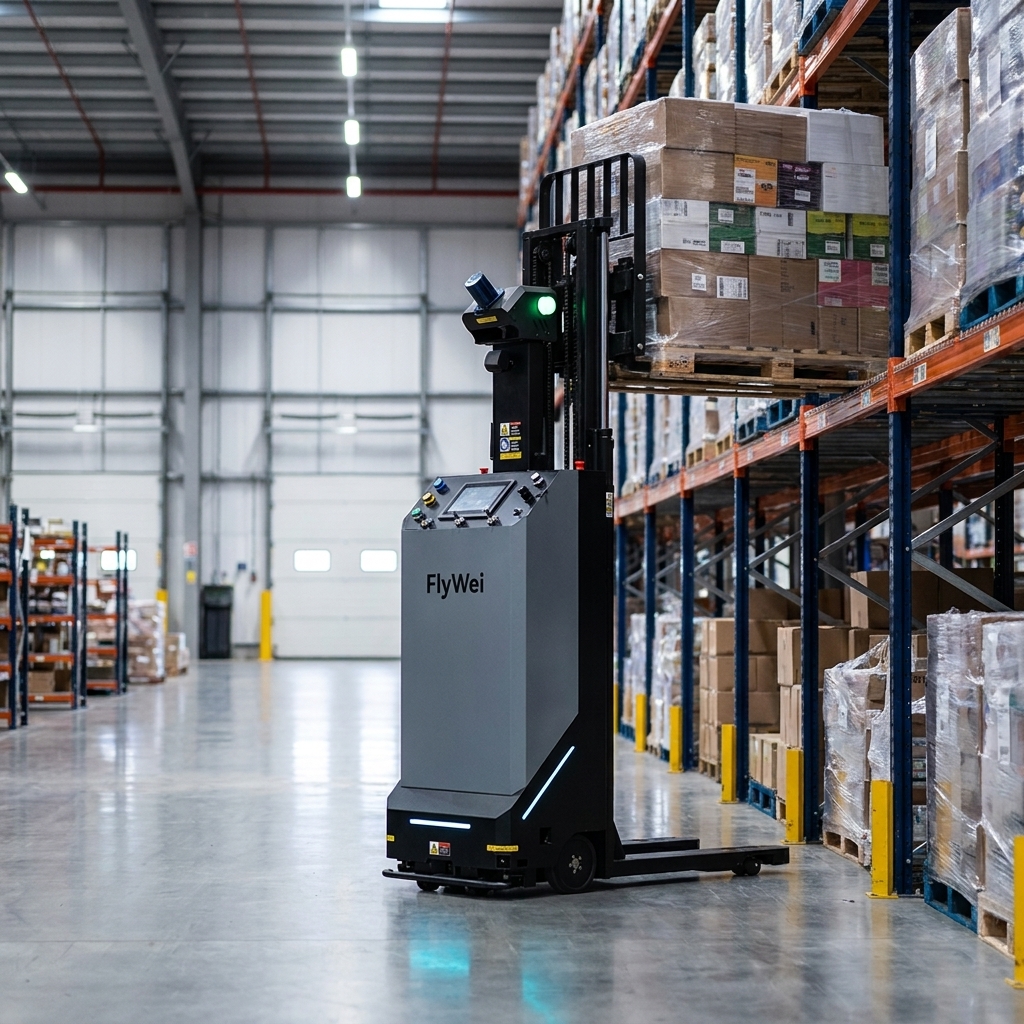
An AGV forklift is a driverless, sensor-guided lift truck that moves pallets between goods-in, racking, and dispatch without an operator on board — the term now covers autonomous counterbalance, reach, stacker, and pallet-truck variants used across UK third-party logistics (3PL) contract sites. Operations directors running multi-tenant 3PLs across Magna Park, DIRFT and SEGRO East Midlands Gateway inherit a familiar problem: the HSE reports over 5,000 workplace transport injuries every year in Great Britain, and forklift incidents remain the single largest slice — a compliance risk that stacks on top of driver churn topping 30% at peak. This quarter the AGV forklift shortlist has moved from a capex debate to an uptime debate: contract renewal cycles are 24 months, throughput commitments are three-shift, and the operations director signing the SLA has to answer for availability, safety and service response before the CFO signs the cheque.
Why 3PL contract sites keep tripping over the same AGV forklift problems
The average UK 3PL contract site was built to move pallets, not to host robots. Concrete floors were poured to old flatness tolerances, WMS integrations were welded to a single client''s ERP, and the peak-season shift plan was written around agency drivers who cannot be found in Q4 2026 at any price Logistics UK is reporting. When an operations director inherits that site — through TUPE or a bolt-on acquisition — the AGV forklift business case has to survive three audits: safety, integration, and service.
Safety is the loudest. The Provision and Use of Work Equipment Regulations 1998 (PUWER) require any lift truck — driverless or not — to be suitable, safe, and maintained. LOLER 1998 sits on top for the lifting portion. On a mixed fleet where an autonomous counterbalance forklift shares an aisle with a manual reach truck, the risk assessment has to account for both. That is a documentation load most 3PLs never had to carry when the fleet was 100% manned.
Integration is quieter but more expensive. A 3PL usually does not own its client''s WMS. When the AGV forklift fleet manager needs a task from the enterprise WMS, that call has to cross an OT/IT boundary the 3PL cannot rewrite — every change window is a client change window. Any AGV platform that cannot speak VDA 5050 or expose a REST bridge to the operator''s existing ERP and WMS ends up as a walled garden the site cannot orchestrate at peak.
Service is the slow-burn killer. A ten-year manual forklift service contract from a tier-one MHE channel partner is a known quantity. An AGV forklift, by contrast, is a mechanical + electrical + software product, and the response-time clause has to cover all three. Sites that lock in a 4-hour on-site response with a UK-based engineering team ride out incidents; sites that do not end up hand-jacking pallets on Boxing Day.
Lever 1 (operational) — Size the fleet against pallet-moves, not headcount
The temptation is to convert driver headcount into AGV forklift count one-for-one. That trips a contract site twice: under-sized at peak (drivers do overtime, robots do not) and over-sized at trough. The better model is to instrument two weeks of pallet-move data at a typical site — inbound receipts, put-away, aisle replenishment, pick-face top-up, dispatch loading — and size the AGV fleet to the 90th-percentile hour, not the average. On a 250,000 sqft ambient 3PL site handling 3,500 pallet-moves per 12-hour shift, that usually lands between 8 and 12 counterbalanced AGV forklifts plus two autonomous pallet trucks for goods-in staging and two autonomous stackers for the mid-height racking runs. Trough hours are where a leasing model earns its keep: idle robots on Sunday cost the operator nothing, whereas idle drivers still cost holiday pay.
Lever 2 (technical) — Pick an AGV platform that can be orchestrated, not just installed
An AGV forklift alone is a machine. A fleet under a live fleet manager is a system, and the gap between the two separates a 96%-availability site from a 78%-availability one. The 3PL sites that get to 96%+ at peak all share three technical building blocks: a VDA 5050-compliant robot bus so the AGV forklifts speak a single traffic language, a fleet manager that can hold every AGV in one traffic model with deadlock-free intersection logic, and a robot dispatch layer that maps operator WMS tasks to physical pallet-moves. Without those three, an operations director ends up watching two robots idle in an aisle while a third waits at a chute. FlyWei''s M4 fleet manager and RDS robot dispatch handle exactly this: M4 holds the traffic model and mission queue; RDS translates operator tasks into pallet-move jobs across the mixed fleet.
Lever 3 (regulatory) — Treat PUWER, LOLER and ISO 3691-4 as one checklist
The regulatory picture for AGV forklifts in UK 3PL sites is not new — it is fragmented. PUWER covers work-equipment safety. LOLER covers the lifting portion. BS EN ISO 3691-4:2023 (published by BSI) covers the driverless-truck behaviour. Approved Code of Practice (ACOP) guidance from the HSE sits above them. Treat those four documents as a single install checklist. In practice, that means: safety-rated LiDAR with dual-channel obstacle avoidance to Category 3 PL d minimum, an emergency-stop chain any site operative can hit from an aisle-end or dock, a documented thorough examination schedule under LOLER at intervals no greater than 12 months, and a maintenance log a competent person can produce for HSE inspection on demand. Sign that lot off with the site H&S lead before commissioning and the safety audit becomes routine.
Lever 4 (commercial) — Match AGV amortisation to contract length
UK 3PL contracts run 24–60 months. AGV forklifts have a useful economic life of 8–10 years. That mismatch has historically killed AGV business cases at contract sites: no ops director wants to sign for capex that outlives the client, no procurement director wants a stranded asset at re-tender. Full-service FlyWei leasing on 3, 5, or 7-year terms neutralises the mismatch: the AGV fleet size, spec, and site liability all sit inside a monthly service line that ends when the contract ends. When the site re-tenders, the fleet re-tenders with it. The operations director right-sizes at each renewal without an asset-disposal headache — a different conversation with the CFO than a traditional MHE capex round.
Cost, payback and risk — the decision-grade view
| Lever | Effort | Cost profile | Payback | Residual risk if skipped |
|---|---|---|---|---|
| Data-driven fleet sizing | 2-week pallet-move audit | Sub-£5k consultancy | Immediate (avoids over-buy) | 10–20% over-sized fleet, dead lease cost |
| Orchestrated M4 + RDS platform | 4–8 week rollout | Included in service line | Under 9 months on uptime alone | Fleet stalls at peak, driver overtime returns |
| PUWER + LOLER + ISO 3691-4 checklist | Pre-commissioning workshop | Internal H&S time | First HSE inspection cycle | Enforcement action; contract client walks |
| Full-service leasing on 3/5/7-year term | Term sheet + credit check | Fixed monthly OpEx | Cash-flow neutral from month one | Capex trapped in a fleet longer than the client contract |
AGV forklift fleets sustained above 96% availability across three-shift UK 3PL contract sites in 2026, converting peak-season overtime spend into a fixed monthly service line.
What FlyWei does at UK 3PL contract sites
FlyWei designs, supplies and integrates autonomous forklift fleets across UK third-party logistics contract sites — from cross-dock lanes at DIRFT and Magna Park to ambient DCs at SEGRO East Midlands Gateway, Daventry and Burton-on-Trent. Our range covers counterbalanced, reach, stacker and pallet-truck variants, all VDA 5050-ready and driven by our own M4 fleet manager and RDS robot dispatch. On a typical 3PL engagement, our UK engineering team runs the two-week pallet-move audit, sets the 90th-percentile fleet size, integrates M4 with the operator''s existing ERP and WMS via the VDA 5050 bus, and commissions inside a single client change window. Sites under our 3, 5 or 7-year full-service leasing terms get robots, software, and mechanical + electrical + software SLA in one monthly line — matched to contract length, not machine life. When the contract re-tenders, the fleet flexes with it. Every site is looked after by UK-based engineers with a 4-hour on-site response; nobody flies spares in from overseas at 2 a.m. on Boxing Day.
Frequently asked questions
Can an AGV forklift work in a shared aisle with a manual reach truck?
Yes, under a documented mixed-fleet risk assessment that satisfies PUWER 1998 and BS EN ISO 3691-4:2023. Dual-channel safety-rated LiDAR, a maximum shared-aisle speed, a floor-taped keep-out convention, and a first-shift briefing for every manual driver all form part of the assessment.
What availability should a UK 3PL operations director expect from an AGV forklift fleet?
Above 96% across three shifts is now table-stakes for UK 3PL SLAs, provided the fleet is under a live orchestration platform (M4 + RDS class), on a full-service maintenance contract, and installed against a floor flatness survey. Below 92% is a symptom that one of those three ingredients is missing.
Do AGV forklifts need TR34 or BS EN 15620 floor flatness?
The AGV forklift does not mandate a specific flatness class, but sustained accuracy at ≥6 metre lift heights needs a defined tolerance. TR34 (Concrete Society) or BS EN 15620 free-movement classes are the usual UK 3PL benchmarks; a pre-install laser survey is faster and cheaper than remediation after commissioning.
How does an AGV forklift fleet integrate with the client''s WMS if the 3PL does not own it?
Through a VDA 5050 robot bus and a REST bridge from the fleet manager into the operator''s existing ERP and WMS. The client WMS stays unchanged; the fleet manager subscribes to task events and writes confirmations back through the same bridge.
What is the LOLER position on driverless lifting trucks?
The Lifting Operations and Lifting Equipment Regulations 1998 still apply. A thorough examination is required at intervals no greater than every 12 months, or 6 months where the truck lifts persons. A competent person carries out and records the examination — driverless status does not remove the duty.
What service-response clause should I write into a 3PL AGV forklift SLA?
A 4-hour on-site response from a UK-based engineering team, 24/7 across peak season, with fleet manager and dispatch layer under the same SLA as the physical trucks. Anything longer, and a single stalled aisle at peak costs more in agency drivers than the year''s SLA premium.
Is a 3-year or a 7-year AGV forklift lease better for a 3PL contract site?
Match the lease to the customer contract length plus one option year. A 3-year lease suits an inbound 24-month rolling contract with a break clause. A 7-year lease is the right call for long-tenure anchor clients where the site is not going anywhere. FlyWei leasing terms cover both cases and let the operator hand back tender-cycle risk.
If AGV forklift uptime across your inherited 3PL contract sites is on your Q3 risk register, we can help. Book a free 30-minute site survey with our UK engineering team and we will map your pallet-move profile against a right-sized autonomous forklift fleet — or explore our 3, 5 and 7-year full-service leasing terms so you can match fleet amortisation to your contract length.
UK-based engineers · no obligation · reply within one business day.