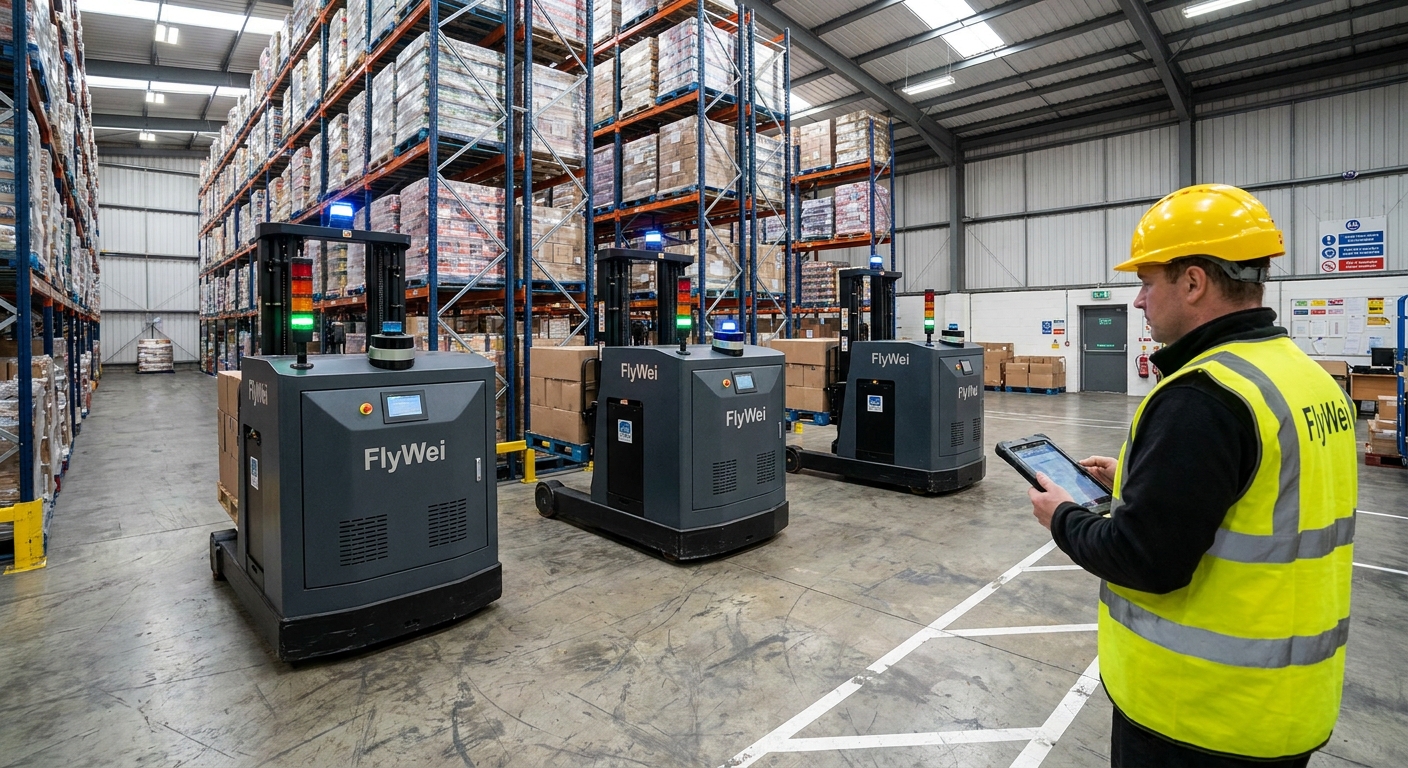
AMR fleet intelligence is the software layer that plans, dispatches and continuously re-routes a fleet of autonomous mobile robots across a UK warehouse, and for 3PL operators it is now the single biggest determinant of whether automation flexes with demand or fights it. The Health and Safety Executive warns that workplace transport, lift trucks and vehicles moving in and around buildings, is involved in roughly 25% of UK workplace fatalities each year (HSE workplace transport guidance), which is why any robot navigating shared aisles must be predictable. For a Supply Chain Director running multi-client contract logistics, the concrete pain this quarter is rigidity: every time a client re-slots stock, adds a mezzanine or flexes for a seasonal peak, a fixed-path robot fleet needs its navigation map re-surveyed, freezing throughput for hours. Fleet intelligence promises a different model: robots that adapt to the building, rather than a building frozen around the robots.
Why fixed-path navigation quietly erodes 3PL throughput
Fixed-path navigation became the warehouse default for a simple reason: it was predictable. Early automated guided vehicles followed magnetic tape, induction wire or reflective laser targets, and that determinism made them straightforward to certify and easy to trust on a busy floor. The trade-off only becomes visible later. A fixed-path fleet does not understand its environment; it follows a surveyed route. When a UK 3PL wins a new client, re-slots a fast-moving SKU or installs a mezzanine, that surveyed route is no longer valid, and the robots must be re-commissioned before they can move safely again.
For contract logistics, where layouts change with every contract cycle, this is not an edge case: it is the operating model. Logistics UK consistently identifies labour availability and cost pressure as the sector's defining challenges, and automation is the obvious response. But automation that freezes for hours each time the building changes simply moves the bottleneck rather than removing it. There is a safety dimension too. The Health and Safety Executive stresses that workplace transport risk is highest where vehicles, pedestrians and changing layouts mix. A fixed-path robot running an out-of-date map in a reconfigured aisle is precisely the hazard regulators warn against. The root cause is architectural: fixed-path systems treat the warehouse as a static object. Modern 3PL operations are anything but static, and the mismatch shows up as downtime, re-survey invoices and a creeping dependence on the original integrator.
Every time a UK 3PL re-slots stock or flexes for a seasonal peak, a fixed-path robot fleet needs its navigation map re-surveyed, freezing throughput for hours: whereas AMR fleet intelligence lets robots re-plan routes in real time.
Lever one: cost every reconfiguration before you sign
The most useful figure in any AMR business case rarely appears on the vendor's quote: the cost of change. Before committing capital, a Supply Chain Director should model how often the operation genuinely changes (new client onboarding, SKU re-slotting, racking moves, mezzanine installs and the inevitable peak ramp) then ask each vendor, in writing, what every one of those events costs. The honest answer covers re-survey time, chargeable engineering days and, most expensive of all, lost throughput while the fleet stands idle. A contract-logistics site at Magna Park or DIRFT that re-slots monthly will pay that bill far more often than a static manufacturer. Treat it as a recurring operating cost, not a one-off, and the comparison between fixed-path and fleet intelligence changes sharply. This is an operational lever because it requires no new technology: only disciplined questioning before the purchase order is raised. The cost of change, once quantified, usually becomes the deciding number in the business case.
Lever two: insist on real-time path replanning and open orchestration
This is the technical core of fleet intelligence. Instead of following a fixed route, an intelligent fleet maintains a live model of the building and re-plans paths continuously: routing around a dropped pallet, a parked cage or a busy pick face without human intervention. FlyWei M4, our fleet management platform, performs dynamic path replanning and multi-robot orchestration so that dozens of machines share aisles safely and productively. Equally important is how the platform talks to the rest of the operation. Look for native VDA 5050 messaging, the open interface standard for AMR communication, and clean REST APIs into the operator's existing ERP and WMS, not bespoke middleware that only the original integrator can maintain. Open orchestration is what lets a 3PL run a mixed fleet, add robots from more than one generation and avoid single-vendor lock-in. FlyWei fleet dispatch software turns warehouse instructions into safe robot tasks on that same open layer, so the fleet adapts to the warehouse rather than the warehouse to the fleet.
Lever three: make EN ISO 3691-4:2023 and PUWER non-negotiable
Flexibility must never cost safety. Any autonomous truck operating in a UK warehouse should be certified to ISO 3691-4, the international safety standard for driverless industrial trucks, and the operation as a whole must satisfy the Provision and Use of Work Equipment Regulations 1998 (PUWER). PUWER places a clear duty on the operator to ensure equipment is suitable, properly maintained and used only by adequately trained people: duties that do not disappear because the truck drives itself. Fleet intelligence helps here: a platform that re-plans routes in real time can also enforce speed zones, pedestrian-priority areas and exclusion zones consistently, and log every movement for audit. BSI guidance and the HSE's workplace transport principles both stress segregation and predictable vehicle behaviour. Make EN ISO 3691-4:2023 conformity, UKCA or CE marking and a documented PUWER assessment explicit contractual requirements rather than assumptions; this regulatory lever protects both your people and your operating licence.
Lever four: design for mixed fleets and seasonal flex
UK contract logistics lives and dies by peak. A fleet sized only for an average week will choke in November; a fleet sized for peak sits idle in February. Fleet intelligence makes the fourth lever, elastic capacity, practical. Because intelligent robots share one orchestration layer, a 3PL can add hired or redeployed units for a seasonal surge and remove them afterwards without re-surveying the building. The same layer lets autonomous forklifts, pallet movers and latent-jacking AMRs cooperate on one floor, each doing the task it suits best. Operators across the East Midlands golden triangle (Daventry, Burton-on-Trent and the SEGRO East Midlands Gateway) increasingly plan capacity this way. The result is an operation that scales with contracts won, rather than one re-engineered every time the workload moves.
| Factor | Fixed-path navigation | AMR fleet intelligence |
|---|---|---|
| Response to layout change | Re-survey and re-commission; hours of downtime | Real-time re-planning; no survey required |
| Seasonal flex | Difficult: routes are fixed | Add or remove robots on one orchestration layer |
| Integration | Often bespoke middleware | VDA 5050 and REST APIs into WMS and ERP |
| Vendor dependence | High: single-vendor lock-in | Lower: open, mixed-fleet architecture |
| Safety baseline | EN ISO 3691-4:2023 and PUWER | EN ISO 3691-4:2023 and PUWER, plus dynamic zone enforcement |
What FlyWei does here
FlyWei supplies and integrates autonomous forklifts and AMRs built for exactly this kind of changeable 3PL environment. Our autonomous forklifts (counterbalanced, reach, stacker and pallet-truck variants) navigate by on-board LiDAR and perception rather than floor tape or reflective targets, so they handle a re-slotted aisle without a re-survey. The fleet is coordinated by FlyWei M4, which performs the dynamic path replanning, traffic management and multi-robot orchestration described above, and by fleet dispatch software, our robot dispatch layer that converts WMS instructions into safe robot tasks. Because M4 speaks VDA 5050 and integrates through documented REST APIs, FlyWei deployments connect to the operator's existing ERP and WMS without locking the customer into bespoke middleware. For a Supply Chain Director, the practical promise is straightforward: throughput that stays live when a client changes its mind. FlyWei scopes, delivers and commissions these systems for UK 3PLs, and our solutions team assesses each site against its real reconfiguration rate, not an idealised static layout. Further guidance is published in the FlyWei news hub.
Frequently asked questions
What is AMR fleet management software?
AMR fleet management software is the platform that dispatches, routes and coordinates a fleet of autonomous mobile robots. Intelligent versions, often called fleet intelligence, re-plan paths in real time and orchestrate multiple robots sharing the same aisles, rather than running each robot on a fixed pre-surveyed route.
How do autonomous forklifts integrate with existing WMS?
Modern autonomous forklifts integrate through documented REST APIs and standards such as VDA 5050. The fleet platform receives tasks from the warehouse management system, translates them into robot moves and reports status back, so the WMS remains the single source of truth without bespoke middleware.
What EN ISO certification do UK warehouse robots need?
Driverless industrial trucks in the UK should conform to EN ISO 3691-4:2023, the safety standard for driverless trucks and their systems. Operators must also meet PUWER 1998 duties and apply UKCA or CE marking. Together these cover machine design, maintenance and safe use.
What is the difference between fixed-path navigation and fleet intelligence?
Fixed-path navigation follows a pre-surveyed route using tape, wire or laser targets and must be re-commissioned when the layout changes. Fleet intelligence builds a live map and re-plans routes continuously, so robots adapt to a reconfigured warehouse without downtime.
Can autonomous forklifts and AMRs run in the same fleet?
Yes. An open orchestration platform such as FlyWei M4 coordinates mixed fleets, counterbalanced and reach autonomous forklifts alongside latent-jacking AMRs, on one traffic layer, allowing each machine type to handle the tasks it suits best.
How quickly can a 3PL scale an AMR fleet for peak?
Because intelligent robots share a single orchestration layer, a 3PL can add units for a seasonal surge and remove them afterwards without re-surveying the building. This makes elastic, peak-driven capacity planning practical for UK contract logistics.
Ready to compare fixed-path and fleet-intelligent automation for your operation? Talk to FlyWei for a fleet assessment that scopes your site against its real reconfiguration rate.