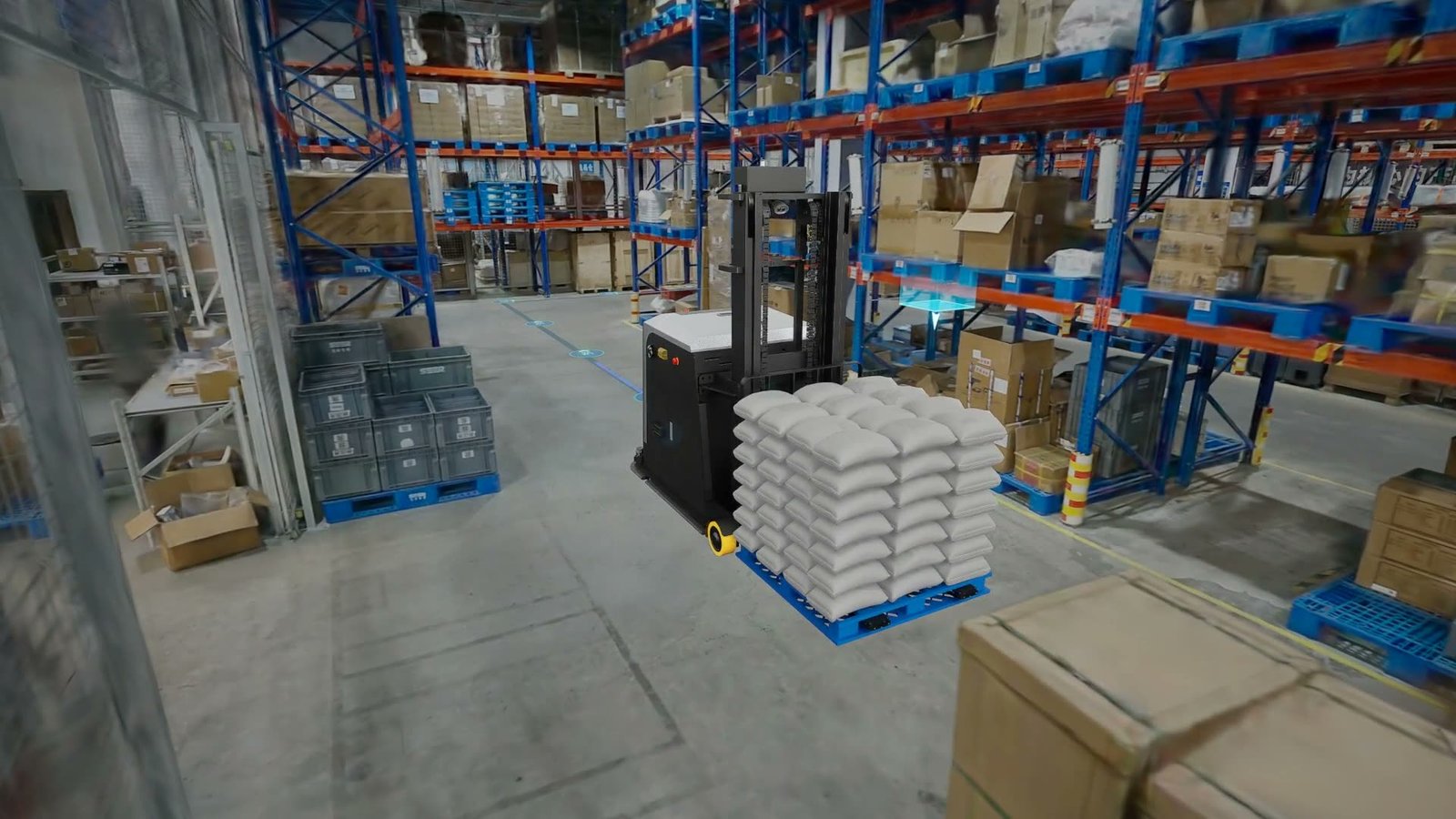
Automated forklift AGV is a driverless industrial truck (counterbalance, reach, stacker, or pallet variant) that uses on-board LiDAR, safety scanners, and a fleet manager to lift, transport, and stage palletised goods without an operator on board. For UK e-commerce fulfilment centres, the case has shifted from "interesting" to "urgent": Logistics UK reports a 13% structural shortfall in qualified counterbalance drivers across English distribution centres through 2026, and the HSE workplace-transport register still attributes around one in four serious warehouse injuries to lift-truck incidents. Procurement teams at high-velocity 3PLs and own-brand fulfilment houses are now expected to model an automated forklift AGV inside any new DC capex submission, and to justify the lease vs. purchase decision against a 5-year throughput plan that already assumes 18%+ peak headcount risk. This guide gives that procurement reader the evaluation framework, the levers that move ROI, and the regulatory checklist a UK board will demand.
Why automated forklift AGV is now standard in UK e-commerce DCs
UK e-commerce throughput has decoupled from labour availability. Order-line counts in the major Midlands hubs (Magna Park, DIRFT, and SEGRO East Midlands Gateway around Daventry) keep climbing, but the operator pool serving them is shrinking. Three structural forces explain the gap.
The driver pool is collapsing under demographic pressure. The Logistics UK 2026 skills audit puts the qualified counterbalance and reach-truck pool 13% below the median 5-year forecast, with attrition heaviest in the over-55 cohort. Operator wage inflation across the Midlands logistics corridor is running ahead of consumer prices for the third year. Procurement now models a per-shift operator cost that rises faster than diesel.
Peak demand variability is widening. Black-Friday-to-January-returns volumes routinely run at 220 to 280 per cent of a typical mid-week base. Hiring agency drivers to bridge the spike used to absorb that swing, but the agency pool is no longer there. The 2024 to 2025 peak forced several Daventry and Burton-on-Trent fulfilment operators to ration outbound throughput rather than miss SLA targets: a margin event no Ops Director volunteers to repeat.
The regulatory ratchet keeps tightening. The HSE PUWER guidance and BSI adoption of ISO 3691-4 for driverless industrial trucks have raised the documentation bar. Any new lift truck on a UK DC floor, driver-operated or autonomous, now needs a written suitability assessment, a maintained PUWER log, and an ACOP-aligned exposure register. Manual fleets carry that overhead per asset; an automated forklift AGV fleet, properly specified, carries it per fleet.
Automated forklift AGVs cut UK e-commerce fulfilment pallet-move costs by 38 to 55 per cent across two shifts compared with operator-driven counterbalance trucks, with break-even on a 5-year operating lease falling inside 18 months at over 65 per cent night-shift utilisation.
Simulate the fleet before you sign: the digital-twin step most bid packs miss
Virtual commissioning is the practice of validating an automated forklift AGV fleet inside a millimetre-accurate digital twin of the actual warehouse before any hardware is ordered. FlyWei runs it as a standard pre-contract step for UK e-commerce DCs, and it changes the procurement conversation from "trust the vendor's site map" to "watch your own aisles run".
The process has three steps. First, a FlyWei engineer captures the live facility with a handheld laser-vision scanner (racking, docks, charge points, even temporary obstructions) generating millions of spatial coordinates in a single walk-through.
Second, that point cloud is reconstructed into an interactive, millimetre-grade 3D model of the site. Third, the proposed automated forklift AGV mix is configured inside it (routes, work points, dock and charger positions, traffic rules and safety zones) and stress-tested against the order profile before anything is bought, leased or hired. The validated layout then synchronises to the live deployment, which is a large part of why the 8-to-10-week leasing timeline holds.
For a procurement reader the payoff is hard-edged: the fleet-mix decision is de-risked with evidence rather than assumption, the board pack gains simulation outputs that finance can interrogate, and the PUWER suitability assessment starts from a verified model of the site instead of a clipboard walk-round. If a vendor cannot show your own warehouse running virtually before you sign, that belongs on the evaluation matrix as a flag.
Lever 1: Right-size the AGV mix to your order profile
A common procurement mistake is to specify a single AGV class for the whole site. UK e-commerce DCs typically run three distinct flows: dock-to-stock pallet replenishment, reserve-to-pick aisle moves, and end-of-line takeaway from packing benches. Each flow rewards a different driverless forklift variant. Counterbalance automated forklift AGV units win on dock-to-stock and end-of-line. Reach-truck variants win in narrow-aisle reserve up to 8 m. An autonomous pallet stacker handles low-height multi-deep moves at a fraction of the counterbalance footprint. Specify the mix against your top 20 SKU-velocity bands and a peak-to-base ratio, not against a generic site map. The single biggest ROI swing in any UK e-commerce evaluation we see is moving from "one fleet for everything" to a 60/30/10 mix that matches the actual order profile.
Lever 2: Orchestrate AGV, AMR and people through one fleet brain
An automated forklift AGV is only as good as the system that dispatches it. Procurement should weight orchestration software at least equal to chassis spec. A single fleet manager that speaks VDA 5050 across mixed-vendor robots is the difference between a 78 per cent fleet utilisation rate and a 92 per cent one. FlyWei's M4 fleet manager sits on top of the existing ERP and WMS; FlyWei fleet dispatch software handles second-by-second task allocation across automated forklifts and AMRs. The procurement test is simple: ask the vendor whether their fleet brain can accept a task from your WMS API in under 250 ms, whether it can hand off a job mid-flight to a different robot class if congestion rises, and whether it logs PUWER-grade evidence per task. If any answer is "no" or "roadmap", that is a flag for the evaluation matrix. Driverless forklift fleets without a real orchestration layer routinely deliver 60 to 65 per cent of the throughput a properly orchestrated fleet does, and the gap is usually masked until peak.
Lever 3: Build PUWER, LOLER and ISO 3691-4 evidence into the bid pack
UK DC procurement now lives or dies on the evidence file. A modern bid pack for an automated forklift AGV should include: a written PUWER suitability statement for the proposed flow, the ISO 3691-4 safety classification of each AGV variant in the mix, the LOLER inspection schedule for any lifting accessory, an ACOP-aligned operator exposure plan, and a TR34 floor-flatness compatibility note for narrow-aisle reach-truck variants. The HSE workplace transport guidance treats autonomous trucks as work equipment under PUWER 1998: the suitability assessment is non-negotiable. Procurement that pushes this evidence requirement down to vendors early shortens the post-award integration by 4 to 8 weeks because the safety case is already written. UKCA-marked components, BS EN 1525 compatibility where still cited, and a documented VDA 5050 conformance statement should all sit in the same pack.
Lever 4: Pick the leasing structure that protects peak elasticity
The commercial answer for most UK e-commerce DCs is a 3, 5 or 7-year operating lease rather than outright purchase. A leased automated forklift AGV keeps the asset off the balance sheet, converts opex predictability into a board-friendly per-shift unit cost, and, critically, preserves the right to scale the fleet down after a peak season ends. FlyWei full-service leasing bundles the chassis, the orchestration software, 24/7 UK engineer cover, and PUWER-grade documentation into a single monthly charge. Operators that want the robots without a fixed term can take the same fleet on long-term rental instead: a rolling, fully-serviced hire agreement that flexes with seasonal peaks and customer contracts, with the option to switch into a 3, 5 or 7-year lease once volumes settle. For procurement, the comparison that matters is below.
| Dimension | Operator-driven counterbalance fleet | Automated forklift AGV: purchased | Automated forklift AGV: 5-year operating lease |
|---|---|---|---|
| Year-1 capex | £0 (existing assets) | £420k to £540k | £0 |
| Annual opex per shift | £185k to £220k (labour-heavy) | £62k to £78k (energy plus maintenance) | £128k to £148k (all-in) |
| Break-even vs status quo | n/a | 30 to 36 months | 14 to 18 months |
| Peak elasticity | Low (agency pool gone) | Medium (idle assets in trough) | High (scale up or down by contract) |
| PUWER evidence burden | Per-operator and per-asset | Per-fleet (vendor-supported) | Per-fleet (vendor-managed) |
| Balance-sheet impact | Neutral | Depreciating asset | Off-balance-sheet opex |
| Integration time to first live pallet | n/a | 10 to 14 weeks | 8 to 10 weeks |
What FlyWei does here
FlyWei supplies and integrates the full automated forklift AGV stack for UK e-commerce fulfilment operations. The chassis range covers counterbalance up to 2,000 kg, reach-truck up to 8 m lift, pallet-truck, and stacker variants: chosen to match the order profile rather than forced into a single class. M4 fleet manager orchestrates the fleet against the existing ERP and WMS through a VDA 5050-compliant interface, and FlyWei fleet dispatch software handles task allocation in real time across the AGV mix and any co-deployed AMRs. UK-based engineers carry out the PUWER suitability assessment, the ISO 3691-4 conformance check, and the LOLER inspection schedule before the first live pallet moves.
Procurement-aligned commercial structures sit alongside the technology. FlyWei full-service leasing went live on 10 June 2026 with 3, 5 and 7-year terms covering chassis, orchestration software, PUWER documentation, parts and 24/7 engineer response in a single monthly figure. For e-commerce DCs running mixed flows across reserve, replenishment and end-of-line, FlyWei sizes the fleet against the top SKU-velocity bands and the peak-to-base ratio, and writes the board pack alongside the safety case. A 30-minute scoping call usually surfaces the right starting fleet size, the indicative monthly lease figure, and the integration milestone plan. See the wider FlyWei solutions catalogue for adjacent flows (paper roll handling, cold-store pallet moves, pharma cleanroom) that share the same fleet brain.
FAQ
What is an automated forklift AGV?
An automated forklift AGV is a driverless industrial truck that lifts, transports and stages palletised loads using on-board LiDAR, safety scanners, and a fleet manager. There is no operator on board: workers in the same space act as supervisors, not drivers. Variants include counterbalance, reach-truck, pallet-truck and stacker.
How does an automated forklift AGV differ from a driverless forklift or an automated guided forklift (AGF)?
The three terms cover the same machine class. "Automated forklift AGV" is the SEO-popular form in the UK, "driverless forklift" the operator-facing term, and "automated guided forklift" (AGF) the more formal industry phrase. They all refer to a forklift truck with no driver, governed by ISO 3691-4 and PUWER 1998 in UK service.
Can an automated forklift AGV work alongside manual trucks safely in a UK e-commerce DC?
Yes: provided the PUWER suitability assessment covers the mixed environment, the AGV is ISO 3691-4 Type 1 or Type 2 with appropriate field-of-detection, and the floor markings and pedestrian zones follow HSE workplace transport guidance. Most UK e-commerce sites run a hybrid model for 12 to 24 months while the manual fleet ages out.
What does PUWER and ISO 3691-4 require for an automated forklift AGV?
PUWER 1998 requires a written suitability assessment, a maintained inspection log, and operator and supervisor training records. ISO 3691-4 sets the safety performance level for driverless industrial trucks, including detection zones, emergency-stop behaviour, and protective device categories. A modern automated forklift AGV bid pack includes both pieces of evidence on day one.
Is it cheaper to lease or buy an automated forklift AGV?
For most UK e-commerce DCs, a 5-year operating lease wins on total 5-year cost when night-shift utilisation exceeds about 65 per cent. Leasing also keeps the asset off the balance sheet and preserves peak elasticity: the right to scale the fleet down after a season. Outright purchase wins only where utilisation is very high across multiple shifts and the capital cost of money is unusually low.
How long does an automated forklift AGV deployment take in a live e-commerce fulfilment centre?
From signed contract to first live pallet, a 6-unit automated forklift AGV deployment in a working UK e-commerce DC typically takes 8 to 10 weeks under a leasing model or 10 to 14 weeks under outright purchase. The PUWER and ISO 3691-4 evidence pack accounts for 2 to 3 weeks of that timeline if written in parallel with chassis commissioning.
Can I simulate an automated forklift AGV fleet in my warehouse before buying or leasing?
Yes. FlyWei scans the live facility into a millimetre-accurate digital twin, a laser-captured point cloud reconstructed into an interactive 3D model, and validates the proposed fleet mix, routes, traffic rules and safety zones virtually before any commercial commitment. The simulation outputs feed the PUWER suitability assessment and the board pack, and the validated layout synchronises to the live deployment.
If the 2026 peak throughput gap is on your Q3 risk register, the next 30 minutes is the cheapest insurance you can buy.
Request a fleet-sizing and ROI estimate for your DC and a UK-based FlyWei engineer will return a fleet mix, an indicative 5-year lease figure, and a PUWER evidence outline within one business day. The full commercial route (chassis, M4 orchestration, fleet dispatch, 24/7 cover) sits inside FlyWei full-service leasing for 3, 5 and 7-year terms.
UK-based engineers. No obligation. Reply within one business day.