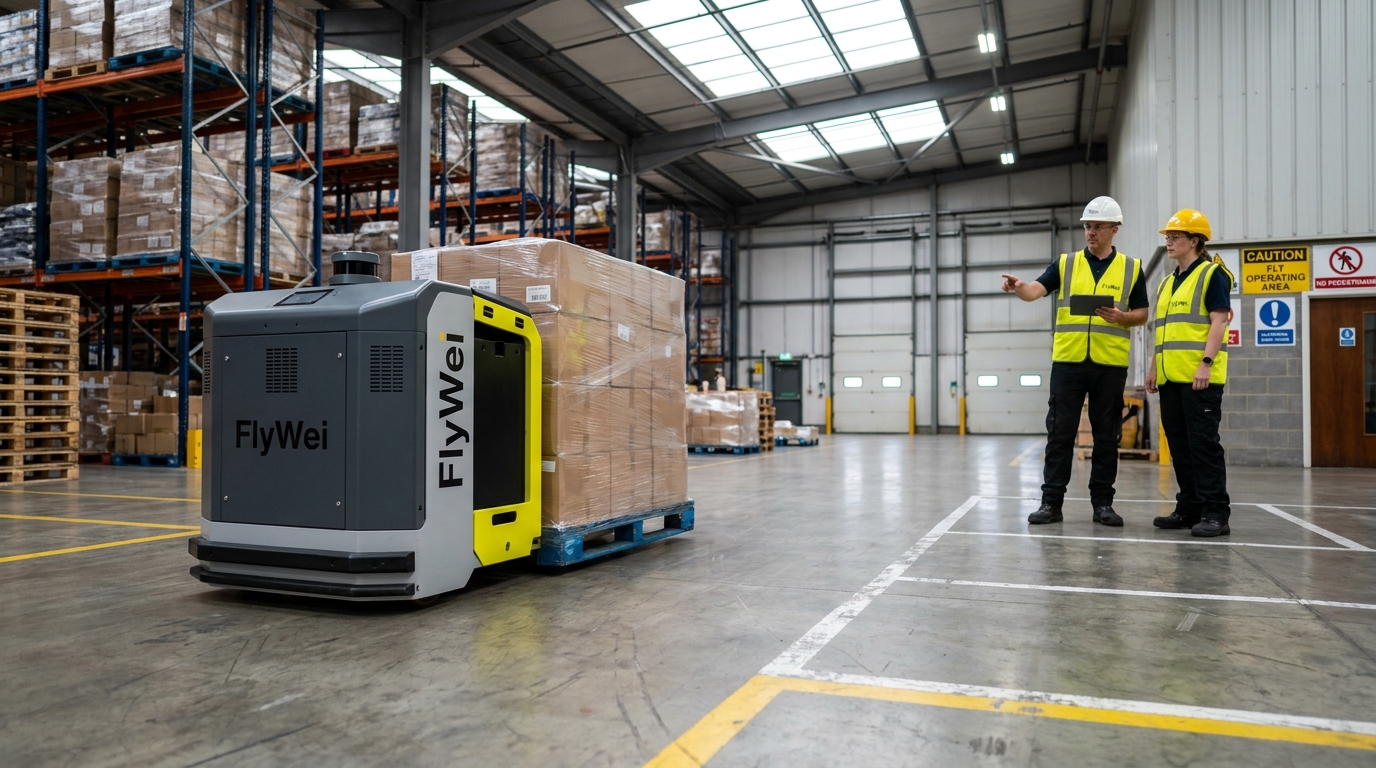
An automated pallet jack is a driverless, low-profile pallet truck that moves loaded and empty pallets between dock, staging and racking without an onboard operator. Workplace transport — overwhelmingly lift trucks — remains one of the largest single causes of worker fatalities in Great Britain, accounting for roughly a quarter of all workplace deaths each year according to the Health and Safety Executive. A single automated pallet jack operating under ISO 3691-4:2023 typically handles 800 to 1,200 pallets per shift and displaces 1.5 to 2 manual operators per machine on a continuous 24-hour roster, which is why UK 3PL procurement leaders are pulling this class of robot forward in their 2026 capex plans: tender margins are compressing, peak agency-operator churn sits well above sustainable levels, and capex committees want documented payback under five years before signing off another tranche of manual lift trucks.
Why UK 3PL procurement files keep landing on pallet flow first
Three UK-specific pressures have pushed pallet automation to the front of the contract logistics capex queue in 2026. First, the persistent shortage of pallet-truck operators inside the Midlands logistics golden triangle — Magna Park, DIRFT, SEGRO East Midlands Gateway, Daventry and Burton-on-Trent — where peak agency rates have risen sharply and six-month operator retention is at a multi-year low. Logistics UK has flagged workforce supply as the single largest operating cost risk for the segment.
Second, regulatory. The 2023 revision of ISO 3691-4 has rewritten what UK procurement can sign off as compliant, and any manual lift truck that hits an incident threshold now triggers an HSE-aligned remedial plan under workplace transport guidance.
Third, financial. Tender margins have compressed under multi-year fixed-price clauses signed before 2023''s wage inflation. Procurement leaders need to take a measurable slice out of dock-to-stock cost without adding capex to the balance sheet — which is why a lease line on a fleet of automated pallet jacks is now the equation boards will sign. PUWER 1998 supplies the compliance evidence base; the lease supplies the cash flow.
Lever 1 — Standardise on a single autonomous pallet-truck class, not a mixed pilot
The most common procurement mistake on a first automation contract is scoping a mixed-class pilot — one stacker, one tugger, one pallet truck — and being unable to scale any of them. The operational lever for a UK 3PL is the opposite: pick the single dock-to-stock pallet move that already absorbs 40 to 60 per cent of inbound and outbound hours, and standardise on the autonomous pallet-truck class that handles it end-to-end.
That class is a low-profile, driverless pallet truck — 1.5-tonne to 2-tonne payload, 1.6-metre forks, LiDAR-guided, no overhead-guard cab. One class covers receiving lane to bulk-store, bulk-store to pick-face replen, and finished goods to outbound dock. A fleet of four to six machines under one orchestration policy is fungible across shifts; the spares pool collapses to a single line. Procurement evidence collapses too: one PUWER risk assessment, one ISO 3691-4 conformity package, one training matrix, one set of autonomous pallet-truck spec sheets.
Lever 2 — Fund the fleet through a 3, 5 or 7-year full-service lease
Outright purchase is rarely the right answer for a UK 3PL procurement committee in 2026. A capex line of £180,000 to £260,000 per machine carries depreciation, obsolescence risk and a maintenance liability that competes with every other line in the budget. A full-service lease moves the fleet to operating expense, includes parts, scheduled service and software updates, and lets procurement match lease term to customer contract: a 3-year customer contract pairs with a 3-year lease; a multi-year framework anchor takes the 5 or 7-year term that prices materially lower per month.
Three knock-on advantages. Residual risk sits with the lessor, so the 2028 or 2030 ISO 3691-4 revision triggers a contractual refresh, not a stranded asset. Operating cost is forecastable at tender stage, which protects margin. Cash on hand stays available for the human-side investment — training, supervision, change management — that determines whether automation actually lands. FlyWei UK leasing terms (3, 5 and 7 years) are written against contract logistics tender cycles.
Lever 3 — Orchestrate the fleet with M4 and RDS over VDA 5050
A fleet of four to six automated pallet jacks is only as productive as the dispatch layer above it. The technical lever is to insist the fleet is orchestrated by a vendor-neutral fleet manager — in FlyWei''s case the M4 fleet manager — speaking VDA 5050 to every machine and exchanging dock-call and pallet-task messages with the operator''s warehouse management and execution systems through documented APIs.
VDA 5050 matters because it removes the silent vendor lock-in that procurement files miss: a VDA 5050-conformant fleet can be expanded mid-contract and the fleet manager continues to dispatch the new machines. The companion product, RDS, turns inbound dock arrivals, replen requests and outbound shipping waves into ordered task queues against the available robots. The procurement test is one line: does the proposal include M4 API documentation, a VDA 5050 conformity statement, and a written SLA on dispatch latency? If yes, the fleet scales; if no, every new machine becomes a fresh negotiation.
Lever 4 — Bring the compliance evidence to procurement on day one
UK procurement committees do not sign off automation contracts on price alone. Three regulatory anchors have to be visible in the appendix. First, PUWER 1998: an automated pallet jack is work equipment, and the duty-holder is the site operator. PUWER conformity is a structured risk assessment, not a tick-box — Approved Code of Practice L22 is the reference.
Second, LOLER 1998, which applies whenever the truck lifts a load — including ground-level pallet transfer in many HSE interpretations. A LOLER thorough examination schedule has to be in place on day one. Third, the ISO 3691-4:2023 conformity package for the truck itself: SIL 2 / PL d safety-rated stop, mandated load envelope, defined human-zone behaviour. A procurement file that arrives with all three pre-bound clears legal review in days, not weeks.
| Dimension | Outright purchase | 5-year full-service lease |
|---|---|---|
| Up-front capex | £720k – £1.04m | £0 |
| Monthly operating cost (4 machines) | Variable: service, parts, software updates | Fixed: £9,500 – £12,800 / month, all-in |
| Balance-sheet treatment | Capex asset plus depreciation schedule | Operating expense (IFRS 16 short-term where eligible) |
| 2028 / 2030 ISO 3691-4 refresh | 3PL absorbs cost | Lessor-contracted refresh |
| Indicative payback vs manual baseline | 52 – 66 months | 38 – 48 months |
| Aligns with customer tender cycle | No | Yes (term matches contract length) |
A single automated pallet jack operating under ISO 3691-4:2023 typically handles 800 to 1,200 pallets per shift and displaces 1.5 to 2 manual operators per machine on a continuous 24-hour roster.
What FlyWei brings to a UK 3PL procurement team
FlyWei designs, supplies, integrates and supports the autonomous pallet-truck fleet a UK 3PL procurement committee can actually sign off. The hardware is FlyWei''s low-profile autonomous pallet truck — 1.5-tonne to 2-tonne payload, top-mounted LiDAR, SIL 2 / PL d safety-rated stop, sealed electronics enclosure where a manual cab would be. No driver, no cab, no overhead guard.
The software is FlyWei''s own. The M4 fleet manager sits above every machine, exchanges VDA 5050 messages with the fleet, and exposes a documented REST and webhook surface for the operator''s warehouse management and execution systems. RDS turns dock arrivals, replen calls and outbound shipping waves into the task queue.
The commercial product is the UK lease — 3, 5 and 7-year full-service terms written against contract logistics tender cycles, including scheduled service, parts, telemetry and software updates. UK-based engineers respond inside the same business day. The procurement file that goes to the board carries PUWER, LOLER, ISO 3691-4 conformity and a written dispatch-latency SLA, bound together by FlyWei.
Frequently asked questions
What is an automated pallet jack?
An automated pallet jack is a driverless pallet truck that uses LiDAR and onboard safety-rated controllers to navigate, lift and place pallets without an onboard operator. One machine can work a continuous 24-hour roster, since there is no shift change.
Is an automated pallet jack the same as an autonomous pallet truck or pallet moving robot?
Yes — automated pallet jack, autonomous pallet truck, driverless pallet jack and pallet moving robot are interchangeable terms in UK procurement language. The variant matters more than the name: pick the low-profile pallet-truck class for ground-level dock-to-stock work.
What does an automated pallet jack cost to lease in the UK in 2026?
A 5-year full-service lease typically prices between £2,400 and £3,200 per machine per month, all-in. Outright purchase lands between £180,000 and £260,000 per machine depending on payload and safety package. FlyWei publishes 3, 5 and 7-year leasing terms on its leasing page.
Does an automated pallet jack need a LOLER thorough examination?
If the truck lifts a load — including ground-level pallet transfer in many HSE interpretations — LOLER applies, and a thorough examination schedule has to be in place on day one. The FlyWei lease contract includes the schedule as standard.
How does ISO 3691-4:2023 affect a UK 3PL placing automated pallet jacks on site?
ISO 3691-4:2023 is the international standard for driverless industrial trucks. A machine placed on a UK site after the 2023 revision must meet the revised safety envelope. The conformity package — SIL 2 / PL d safety-rated stop, defined load and human-zone behaviour — should be attached to the procurement file.
How many automated pallet jacks does a 1,000-pallet-per-shift dock typically need?
Four machines is the common starting fleet for a 24-hour dock running 800 to 1,200 pallets per shift — one machine on replen, three on dock-to-stock. The mix depends on aisle layout and dock-door schedule.
What is the realistic payback on a four-machine automated pallet-jack lease?
38 to 48 months on a 5-year lease at current UK agency pallet-truck rates. Outright purchase pushes payback to 52 to 66 months because depreciation and maintenance compete with the operating saving.
If pallet-truck operator churn and a 2026 capex sign-off are both on your Q3 risk register, the fastest path is a verified read on your highest-volume dock.
Request a fleet-sizing and ROI estimate for your DC — or browse the UK 3, 5 and 7-year full-service leasing terms.
UK-based engineers · no obligation · reply within one business day.