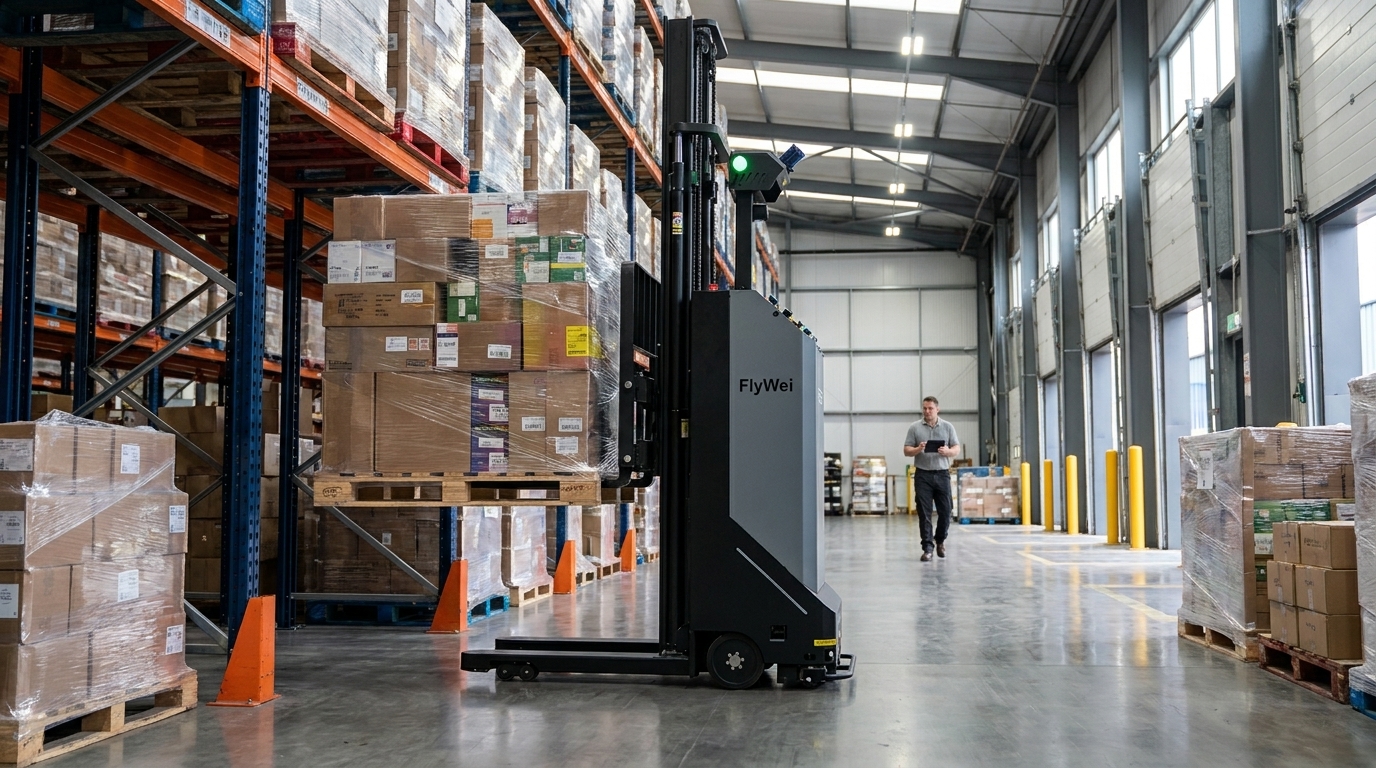
Autonomous forklifts in Eastern France are driverless industrial trucks — counterbalanced, reach and pallet variants — guided by SLAM and 2D safety LiDAR that handle pallet flows inside Tier-1 automotive plants from Mulhouse and Sochaux up through Sarreguemines, Hambach and the Strasbourg Rhine ports. Across the wider European market, autonomous mobile robots are projected to grow by double-digit CAGR through 2030 as Tier-1 suppliers respond to chronic forklift-driver shortages and just-in-sequence (JIS) penalty exposure, according to industry analysts cited in Logistics UK outlook commentary. For a Supply Chain Director running an Eastern France footprint, the pain is sharper than the headline: a missed JIS window at a Rhine corridor plant can cost €5,000 or more per hour, your local forklift-driver vacancy rate is running double the eurozone average, and CSRD reporting now wants Scope 1 and 2 emissions from your in-plant fleet — diesel counterbalance trucks no longer get a free pass.
A missed just-in-sequence delivery to a Rhine corridor automotive plant typically costs €5,000 or more per hour — a single shift of forklift-driver absenteeism can wipe out a year of Eastern France site margin.
Why Eastern France Tier-1 supply chains are hitting the wall in 2026
Three structural forces are converging on the Eastern France automotive belt. Each alone would justify automation; together they make manual pallet flow indefensible by 2027.
First, the labour market. Forklift driver vacancies across Alsace and Lorraine industrial parks have widened since the 2024 wage settlements at Mulhouse and Sandouville. The local CACES forklift-licence pipeline has not kept pace with retirements, and cross-border competition from Saarland and Baden-Württemberg sites has thinned the available pool. A site that used to fill a vacancy in two to three weeks now needs eight to twelve, and the agency rate has climbed past €38 per hour fully loaded.
Second, the just-in-sequence contracts. Eastern France Tier-1 suppliers feed Rhine corridor plants (Sindelfingen, Rastatt, Sochaux, Mulhouse) and increasingly East Germany. A JIS window is typically 90 to 120 minutes; missing it triggers liquidated damages above €5,000 per hour, and repeated breaches put OEM nomination at risk. Manual fleets — cycle-time variance ±20% across a shift change — are no longer compatible with that risk envelope.
Third, CSRD reporting. The EU Corporate Sustainability Reporting Directive requires Scope 1 and 2 disclosure on owned and leased operating equipment. Diesel and LPG counterbalance trucks running 18 hours a day produce a non-trivial Scope 1 footprint that the audit trail in 2026 will not tolerate. BSI guidance and ISO 3691-4 together provide the technical envelope; the procurement question is which fleet design satisfies both.
Lever 1: shift-coverage automation by lane, not by site
Most SC Directors treat automation as a site-wide capex decision. The faster wins come lane by lane — identify the three to five highest-volume, most-repeatable pallet flows and convert those first. In a typical Alsace Tier-1 plant the day-one ROI flow is the inbound goods-to-stock loop (dock to high-bay racking) on shift A, paired with the line-feed milk run on shift B. Manual drivers stay on the variable, non-repeatable work — supplier exceptions, cycle counts, rework. Cycle-time variance on the automated lane drops from ±20% to within ±3%, the threshold below which JIS commitments stop being a coin-flip. Audit the site safety incident log against HSE workplace transport equivalents and pedestrian-forklift near-misses concentrate on those same routine lanes — so the operational lever and the safety lever are one lever. FlyWei's lane-by-lane discovery method typically identifies the two highest-ROI lanes in a single shift of walk-the-floor work.
Lever 2: orchestrate a mixed fleet through M4 and VDA 5050, not vendor firmware
The technical trap is buying autonomous forklifts that only talk to their own dispatcher. A Tier-1 plant with three flows (dock, line-feed, returns) needs at least two robot variants — counterbalanced for dock and racking, pallet-truck for line-feed — and locking those to a single vendor's closed protocol means the day a third flow appears, the procurement process restarts. The published VDA 5050 standard solves it: any compliant truck speaks the same JSON-over-MQTT to any compliant fleet manager. FlyWei's M4 fleet manager runs the VDA 5050 master and RDS sits between M4 and the operator's existing ERP and WMS — no parallel software stack, no second integration debt for IT. The technical question to put to procurement is one line: "show me your VDA 5050 conformance certificate, and the last three sites you co-ran with another vendor's robots." Vendors who cannot answer it will eventually become the sole-source vendor of your factory floor.
Lever 3: build the compliance envelope before the auditor builds it for you
Eastern France sites that ship to UK customers, or are owned by UK groups, inherit UK PUWER 1998 obligations on top of the French Code du travail equivalents. Any lifting operation — a counterbalance forklift handling a 2-tonne pallet above 1.5 metres — also picks up LOLER 1998. The autonomous-truck-specific layer is ISO 3691-4, the international standard for driverless industrial trucks, which any serious vendor will hold a current conformance certificate against. CSRD then asks: what is the kWh and grams CO2e per pallet move? A correctly specified autonomous reach-truck on a 48V LiFePO4 pack with opportunity-charging draws roughly half the Scope 1 footprint of an LPG counterbalance on the same duty cycle, and the M4 telemetry feed produces the per-move energy data the CSRD assurance partner asks for. The single RFP sentence: "ISO 3691-4 conformance, BS EN 1525:1997 cross-reference, PUWER plus LOLER risk assessment templates, M4 CSRD energy export" — it eliminates roughly 70% of the vendor shortlist.
Lever 4: lease the fleet — don't buy it
The site P&L will resist an eight-figure capex line for autonomous trucks, and rightly so. FlyWei's 3, 5 and 7-year lease structure (live since June 2026) turns the same fleet into an opex line at roughly €1,800 to €3,200 per truck per month depending on variant and term, with on-site service, M4 software updates and battery refresh inside the headline rate. The procurement maths shifts from "can we justify €4–6m of capex this fiscal year?" to "can each automated lane carry a €25k–€40k annual lease?" — and on high-volume dock and line-feed lanes that crossover happens in months. For multi-site operators running both UK DCs at Magna Park or DIRFT and Eastern France plants in the Rhine corridor, the same envelope covers both balance sheets, simplifying the group-level CSRD asset register. The pragmatic SC Director move for the Q3 board: present a lane-level lease pilot, not a site-wide capex case.
Manual versus autonomous: the Eastern France Tier-1 comparison
| Metric | Manual diesel/LPG fleet | FlyWei autonomous fleet (M4-orchestrated) |
|---|---|---|
| Cycle-time variance on JIS lane | ±18–22% | ±2–3% |
| Forklift-driver vacancy exposure | 8–12 week fill time, €38/hr agency | None on automated lanes |
| Scope 1 emissions per pallet move | ~210 g CO2e | ~0 g CO2e (grid Scope 2 only) |
| Capex profile | €85k–€110k per truck, on balance sheet | €1,800–€3,200/month lease, opex line |
| ISO 3691-4 conformance | Not applicable (manual) | Certified per truck and per fleet |
| CSRD per-move energy data | Manual estimate, audit-light | M4 telemetry export, audit-ready |
| Pedestrian-incident exposure | Routine lanes carry highest risk | Safety LiDAR plus protected zones |
What FlyWei does on Eastern France sites
FlyWei designs and integrates an autonomous fleet that lands on the operator's existing rails — the WMS the plant already runs, the ERP the group already pays for, the SCADA layer the IT team already owns. The hardware portfolio for an Eastern France Tier-1 site usually mixes counterbalanced FlyWei autonomous forklifts (2-tonne CE-marked, dock to rack), reach-truck variants (1.4-tonne, narrow-aisle high-bay to 10 metres) and a pallet-truck class (1.5 to 3 tonne) on line-feed milk runs. The M4 fleet manager runs the VDA 5050 master against the ERP-issued sequence; RDS handles task dispatch, exception escalation and the operator handoff. Integration covers floor flatness survey to BS 8204 / TR34 equivalents, charger placement, safety-zone marking, operator training to ISO 3691-4 §5, and 24/7 remote monitoring from FlyWei's UK engineering desk that catches a stalled truck before the line-side trolley misses a JIS window. Day-90 of a typical deployment: one lane fully autonomous, manual fleet redeployed to exception work, M4 telemetry feeding the CSRD energy export, and documented HSE-style LOLER and PUWER schedules lodged with the site safety committee. FlyWei is UK-headquartered with European service coverage and a French-language interface via the French site; engineering, remote ops and customer success all run from UK time zones, which matters when the Eastern France plant calls at 23:00 with a third-shift fault.
Frequently asked questions
What is an autonomous forklift in the Eastern France context?
An autonomous forklift is a driverless industrial truck — counterbalanced, reach or pallet variant — that uses SLAM navigation and 2D safety LiDAR to move pallets without a CACES-licensed operator on board. For Eastern France Tier-1 sites it typically handles dock-to-rack, line-feed milk runs and finished-goods-to-dock flows on certified ISO 3691-4 conformance.
How long does an Alsace or Lorraine deployment take from contract to first autonomous lane?
A typical lane-by-lane deployment takes 10 to 14 weeks: 2 weeks for floor and route survey, 4 weeks for ERP and WMS integration through M4 and RDS, 4 weeks for on-site commissioning and operator training to ISO 3691-4 §5, and 2 to 4 weeks of supervised production-shadow before the lane is signed off as autonomous.
Do autonomous forklifts comply with ISO 3691-4 and the French Code du travail?
Yes. FlyWei autonomous forklifts are CE-marked under the Machinery Directive and certified to ISO 3691-4, the international safety standard for driverless industrial trucks. The Code du travail''s general workplace-equipment obligations (Article R.4321 et seq.) are satisfied by the same evidence pack used for PUWER assessments on the UK side of the operator''s footprint.
Can the fleet interface with our existing ERP and WMS?
Yes. M4 runs a VDA 5050 master and RDS exposes a standards-based interface to the operator''s existing enterprise WMS and ERP — no rip-and-replace and no parallel labour stack. Integration patterns are documented for the major enterprise systems used by Eastern France Tier-1 operators.
What is the typical CSRD reporting benefit?
A 48V LiFePO4 autonomous reach-truck on opportunity-charging typically halves Scope 1 emissions per pallet move versus an LPG counterbalance doing the same duty cycle, and the M4 telemetry feed exports per-move kWh and CO2e in the format CSRD assurance partners require. Logistics UK publishes benchmark guidance suppliers can cross-reference.
Why lease rather than buy?
The site P&L resists eight-figure capex; the leasing structure (3, 5 and 7-year terms, live since June 2026) converts the fleet into an opex line of roughly €1,800 to €3,200 per truck per month with service, software updates and battery refresh inside the headline rate. The procurement maths becomes lane-level rather than site-level, which is how most Eastern France sites get past the Q3 board.
Does the lease include UK engineering support out of hours?
Yes — 24/7 remote monitoring from FlyWei''s UK engineering desk plus on-site response within agreed SLA bands. The remote feed catches most stalls before they cascade into a JIS-window miss.
If a missed Rhine corridor JIS window is on your Q3 risk register, the cheapest first move is a lane-level read.
Get a 48-hour feasibility read on your highest-volume Eastern France flow, or see how FlyWei autonomous forklifts are specified for Tier-1 Rhine corridor operations.
UK-based engineers · no obligation · reply within one business day.